QUESTION IMAGE
Question
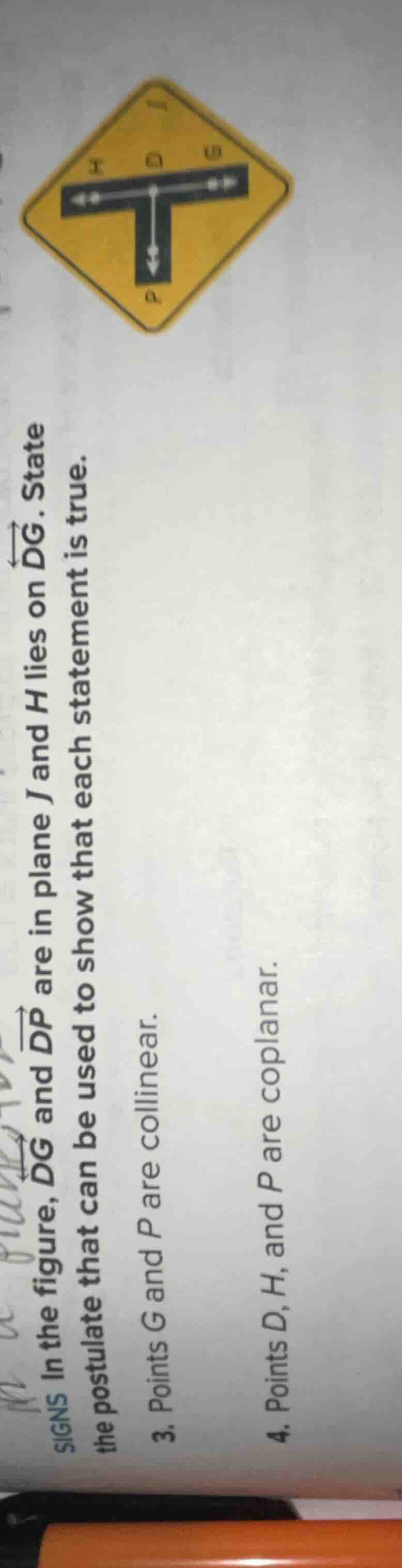
signs in the figure, $overleftrightarrow{dg}$ and $overleftrightarrow{dp}$ are in plane $j$ and $h$ lies on $overleftrightarrow{dg}$. state the postulate that can be used to show that each statement is true. 3. points $g$ and $p$ are collinear. 4. points $d$, $h$, and $p$ are coplanar.
Question 3: Points \( G \) and \( P \) are collinear.
Step 1: Recall the collinear postulate
The postulate for collinear points is: If two points lie on the same line, then they are collinear.
We know that \( \overrightarrow{DG} \) and \( \overrightarrow{DP} \) are given, and from the diagram (or context), points \( D \), \( G \), and \( P \) lie on the same line (since \( \overrightarrow{DG} \) and \( \overrightarrow{DP} \) share the line \( DG \) or \( DP \)). Specifically, \( G \) lies on \( \overrightarrow{DG} \) and \( P \) lies on \( \overrightarrow{DP} \), and these rays are part of the same line.
Step 2: Apply the postulate
Since points \( G \) and \( P \) lie on the same line (containing \( D \), \( G \), \( P \)), by the collinear postulate, they are collinear.
Question 4: Points \( D \), \( H \), and \( P \) are coplanar.
Step 1: Recall the coplanar postulate
The postulate for coplanar points is: If points lie in the same plane, then they are coplanar. Also, another relevant postulate: If two points lie in a plane, then the line containing them lies in the plane, and points on that line are also in the plane.
We know \( \overrightarrow{DG} \) and \( \overrightarrow{DP} \) are in plane \( J \), and \( H \) lies on \( \overrightarrow{DG} \). So, \( D \) and \( H \) are in plane \( J \), and \( D \) and \( P \) are in plane \( J \) (since \( \overrightarrow{DP} \) is in plane \( J \)).
Step 2: Apply the postulate
Since \( D \), \( H \), and \( P \) all lie in plane \( J \) ( \( D \) and \( H \) are in plane \( J \) via \( \overrightarrow{DG} \), \( D \) and \( P \) are in plane \( J \) via \( \overrightarrow{DP} \), and the line through \( D \), \( H \), \( P \) is contained in plane \( J \)), by the coplanar postulate, they are coplanar.

Snap & solve any problem in the app
Get step-by-step solutions on Sovi AI
Photo-based solutions with guided steps
Explore more problems and detailed explanations
s:
- The postulate "If two points lie on the same line, then they are collinear" shows \( G \) and \( P \) are collinear (since \( G \) and \( P \) lie on the same line \( DP \) or \( DG \)).
- The postulate "If points lie in the same plane, then they are coplanar" (or related plane - line postulates) shows \( D \), \( H \), \( P \) are coplanar (since \( D \), \( H \), \( P \) lie in plane \( J \)).
(For concise answers, you can state the postulate and conclusion directly:
- Postulate: Through any two points, there is exactly one line (or "If two points lie on a line, they are collinear"). Conclusion: \( G \) and \( P \) are collinear.
- Postulate: If two points lie in a plane, the line containing them lies in the plane (or "Points in the same plane are coplanar"). Conclusion: \( D \), \( H \), \( P \) are coplanar.)