QUESTION IMAGE
Question
- simplify the complex fraction.
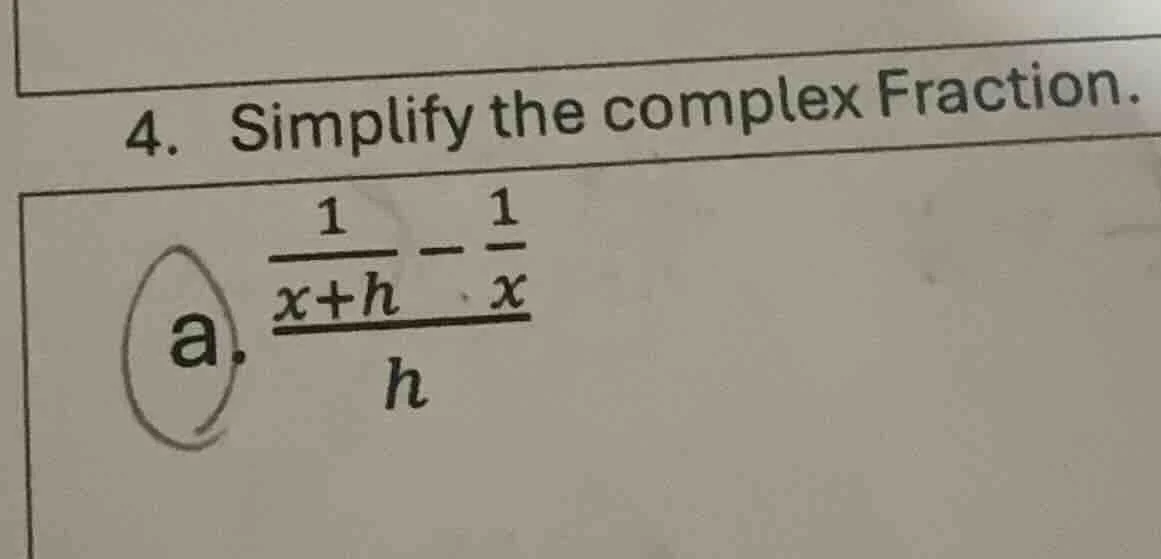
a. \\(\frac{\frac{1}{x+h} - \frac{1}{x}}{h}\\)
Step1: Simplify the numerator
First, we simplify the numerator \(\frac{1}{x + h}-\frac{1}{x}\). To subtract these two fractions, we find a common denominator, which is \(x(x + h)\). So we have:
\[
\frac{x}{x(x + h)}-\frac{x + h}{x(x + h)}=\frac{x-(x + h)}{x(x + h)}
\]
Simplifying the numerator of this new fraction: \(x-(x + h)=x - x - h=-h\). So the numerator becomes \(\frac{-h}{x(x + h)}\).
Step2: Divide by the denominator \(h\)
Now our complex fraction is \(\frac{\frac{-h}{x(x + h)}}{h}\). Dividing by a number is the same as multiplying by its reciprocal, so we can rewrite this as \(\frac{-h}{x(x + h)}\times\frac{1}{h}\).
Step3: Simplify the expression
The \(h\) in the numerator and the \(h\) in the denominator cancel out (assuming \(h
eq0\)), leaving us with \(\frac{-1}{x(x + h)}\).

Snap & solve any problem in the app
Get step-by-step solutions on Sovi AI
Photo-based solutions with guided steps
Explore more problems and detailed explanations
\(\boxed{-\dfrac{1}{x(x + h)}}\)