QUESTION IMAGE
Question
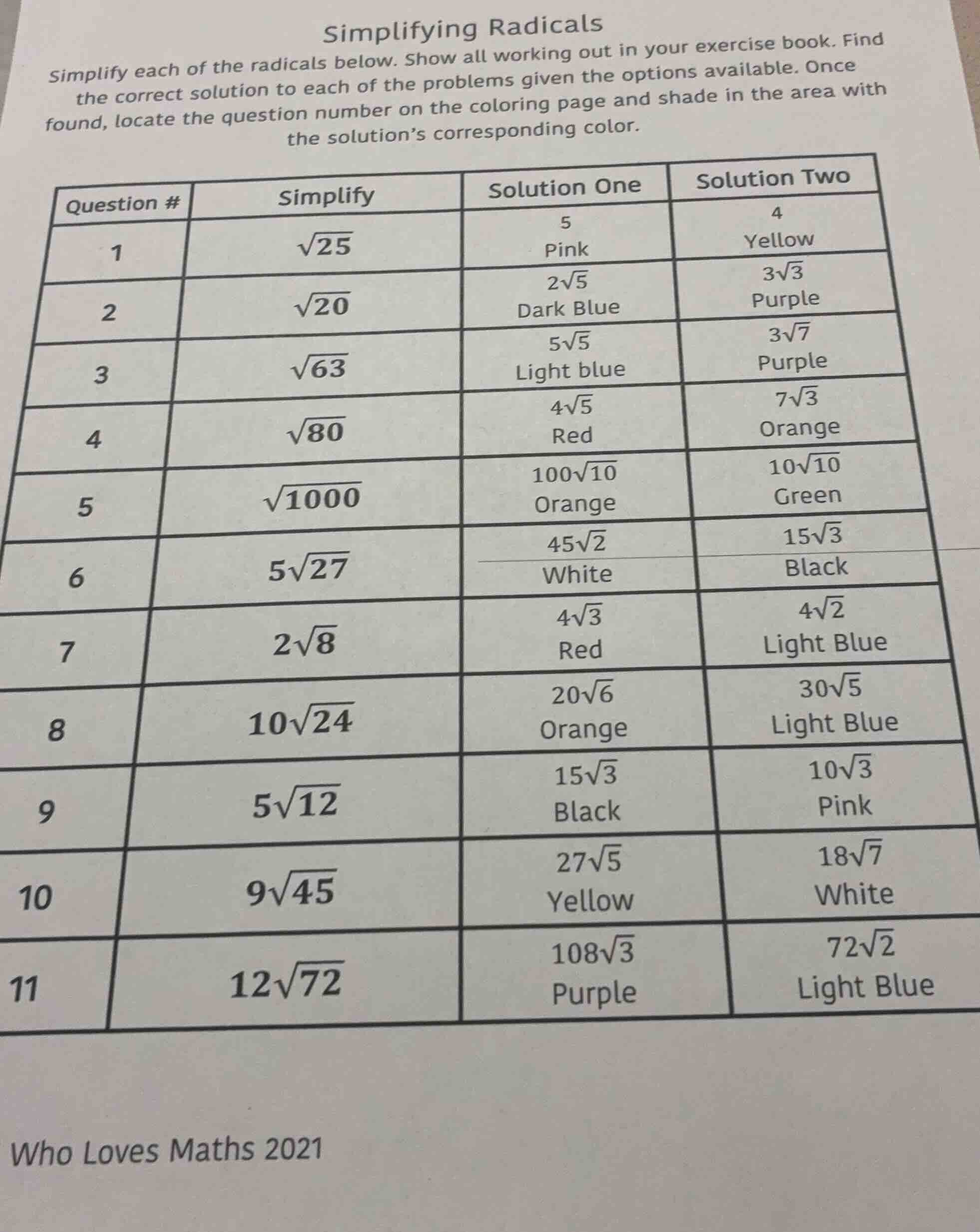
simplifying radicals
simplify each of the radicals below. show all working out in your exercise book. find
the correct solution to each of the problems given the options available. once
found, locate the question number on the coloring page and shade in the area with
the solution’s corresponding color.
| question # | simplify | solution one | solution two |
|---|
$ | $\
$ |
| 2 | $\sqrt{20}$ | $\ |
$ | $\
$ |
| 3 | $\sqrt{63}$ | $\ |
$ | $\
$ |
| 4 | $\sqrt{80}$ | $\ |
$ | $\
$ |
| 5 | $\sqrt{1000}$ | $\ |
$ | $\
$ |
| 6 | $5\sqrt{27}$ | $\ |
$ | $\
$ |
| 7 | $2\sqrt{8}$ | $\ |
$ | $\
$ |
| 8 | $10\sqrt{24}$ | $\ |
$ | $\
$ |
| 9 | $5\sqrt{12}$ | $\ |
$ | $\
$ |
| 10 | $9\sqrt{45}$ | $\ |
$ | $\
$ |
| 11 | $12\sqrt{72}$ | $\ |
$ | $\
$ |
who loves maths 2021
Let's solve each radical simplification problem step by step. We'll use the property of square roots: \(\sqrt{ab}=\sqrt{a}\cdot\sqrt{b}\) (where \(a\geq0\), \(b\geq0\)) and \(\sqrt{a^2}=a\) (where \(a\geq0\)).
Question 1: Simplify \(\boldsymbol{\sqrt{25}}\)
Step 1: Recall the square of 5
We know that \(5^2 = 25\). By the definition of square roots, \(\sqrt{25}=\sqrt{5^2}\).
Step 2: Apply the square root property
Using \(\sqrt{a^2}=a\) (for \(a\geq0\)), we get \(\sqrt{5^2}=5\).
So the correct solution is 5 (Pink).
Question 2: Simplify \(\boldsymbol{\sqrt{20}}\)
Step 1: Factor 20 into a perfect square and another number
We can write \(20 = 4\times5\), where 4 is a perfect square (\(2^2 = 4\)). So \(\sqrt{20}=\sqrt{4\times5}\).
Step 2: Apply the square root property \(\sqrt{ab}=\sqrt{a}\cdot\sqrt{b}\)
\(\sqrt{4\times5}=\sqrt{4}\cdot\sqrt{5}\). Since \(\sqrt{4}=2\), this simplifies to \(2\sqrt{5}\).
So the correct solution is \(2\sqrt{5}\) (Dark Blue).
Question 3: Simplify \(\boldsymbol{\sqrt{63}}\)
Step 1: Factor 63 into a perfect square and another number
We can write \(63 = 9\times7\), where 9 is a perfect square (\(3^2 = 9\)). So \(\sqrt{63}=\sqrt{9\times7}\).
Step 2: Apply the square root property \(\sqrt{ab}=\sqrt{a}\cdot\sqrt{b}\)
\(\sqrt{9\times7}=\sqrt{9}\cdot\sqrt{7}\). Since \(\sqrt{9}=3\), this simplifies to \(3\sqrt{7}\).
So the correct solution is \(3\sqrt{7}\) (Purple).
Question 4: Simplify \(\boldsymbol{\sqrt{80}}\)
Step 1: Factor 80 into a perfect square and another number
We can write \(80 = 16\times5\), where 16 is a perfect square (\(4^2 = 16\)). So \(\sqrt{80}=\sqrt{16\times5}\).
Step 2: Apply the square root property \(\sqrt{ab}=\sqrt{a}\cdot\sqrt{b}\)
\(\sqrt{16\times5}=\sqrt{16}\cdot\sqrt{5}\). Since \(\sqrt{16}=4\), this simplifies to \(4\sqrt{5}\).
So the correct solution is \(4\sqrt{5}\) (Red).
Question 5: Simplify \(\boldsymbol{\sqrt{1000}}\)
Step 1: Factor 1000 into a perfect square and another number
We can write \(1000 = 100\times10\), where 100 is a perfect square (\(10^2 = 100\)). So \(\sqrt{1000}=\sqrt{100\times10}\).
Step 2: Apply the square root property \(\sqrt{ab}=\sqrt{a}\cdot\sqrt{b}\)
\(\sqrt{100\times10}=\sqrt{100}\cdot\sqrt{10}\). Since \(\sqrt{100}=10\), this simplifies to \(10\sqrt{10}\).
So the correct solution is \(10\sqrt{10}\) (Green).
Question 6: Simplify \(\boldsymbol{5\sqrt{27}}\)
Step 1: Factor 27 into a perfect square and another number
We can write \(27 = 9\times3\), where 9 is a perfect square (\(3^2 = 9\)). So \(\sqrt{27}=\sqrt{9\times3}\).
Step 2: Apply the square root property \(\sqrt{ab}=\sqrt{a}\cdot\sqrt{b}\)
\(\sqrt{9\times3}=\sqrt{9}\cdot\sqrt{3}=3\sqrt{3}\).
Step 3: Multiply by the coefficient 5
Now we have \(5\times3\sqrt{3}=15\sqrt{3}\).
So the correct solution is \(15\sqrt{3}\) (Black).
Question 7: Simplify \(\boldsymbol{2\sqrt{8}}\)
Step 1: Factor 8 into a perfect square and another number
We can write \(8 = 4\times2\), where 4 is a perfect square (\(2^2 = 4\)). So \(\sqrt{8}=\sqrt{4\times2}\).
Step 2: Apply the square root property \(\sqrt{ab}=\sqrt{a}\cdot\sqrt{b}\)
\(\sqrt{4\times2}=\sqrt{4}\cdot\sqrt{2}=2\sqrt{2}\).
Step 3: Multiply by the coefficient 2
Now we have \(2\times2\sqrt{2}=4\sqrt{2}\).
So the correct solution is \(4\sqrt{2}\) (Light Blue).
Question 8: Simplify \(\boldsymbol{10\sqrt{24}}\)
Step 1: Factor 24 into a perfect square and another number
We can write \(24 = 4\times6\), where 4 is a perfect square (\(2^2 = 4\)). So \(\sqrt{24}=\sqrt{4\times6}\).
Step 2: A…

Snap & solve any problem in the app
Get step-by-step solutions on Sovi AI
Photo-based solutions with guided steps
Explore more problems and detailed explanations
Let's solve each radical simplification problem step by step. We'll use the property of square roots: \(\sqrt{ab}=\sqrt{a}\cdot\sqrt{b}\) (where \(a\geq0\), \(b\geq0\)) and \(\sqrt{a^2}=a\) (where \(a\geq0\)).
Question 1: Simplify \(\boldsymbol{\sqrt{25}}\)
Step 1: Recall the square of 5
We know that \(5^2 = 25\). By the definition of square roots, \(\sqrt{25}=\sqrt{5^2}\).
Step 2: Apply the square root property
Using \(\sqrt{a^2}=a\) (for \(a\geq0\)), we get \(\sqrt{5^2}=5\).
So the correct solution is 5 (Pink).
Question 2: Simplify \(\boldsymbol{\sqrt{20}}\)
Step 1: Factor 20 into a perfect square and another number
We can write \(20 = 4\times5\), where 4 is a perfect square (\(2^2 = 4\)). So \(\sqrt{20}=\sqrt{4\times5}\).
Step 2: Apply the square root property \(\sqrt{ab}=\sqrt{a}\cdot\sqrt{b}\)
\(\sqrt{4\times5}=\sqrt{4}\cdot\sqrt{5}\). Since \(\sqrt{4}=2\), this simplifies to \(2\sqrt{5}\).
So the correct solution is \(2\sqrt{5}\) (Dark Blue).
Question 3: Simplify \(\boldsymbol{\sqrt{63}}\)
Step 1: Factor 63 into a perfect square and another number
We can write \(63 = 9\times7\), where 9 is a perfect square (\(3^2 = 9\)). So \(\sqrt{63}=\sqrt{9\times7}\).
Step 2: Apply the square root property \(\sqrt{ab}=\sqrt{a}\cdot\sqrt{b}\)
\(\sqrt{9\times7}=\sqrt{9}\cdot\sqrt{7}\). Since \(\sqrt{9}=3\), this simplifies to \(3\sqrt{7}\).
So the correct solution is \(3\sqrt{7}\) (Purple).
Question 4: Simplify \(\boldsymbol{\sqrt{80}}\)
Step 1: Factor 80 into a perfect square and another number
We can write \(80 = 16\times5\), where 16 is a perfect square (\(4^2 = 16\)). So \(\sqrt{80}=\sqrt{16\times5}\).
Step 2: Apply the square root property \(\sqrt{ab}=\sqrt{a}\cdot\sqrt{b}\)
\(\sqrt{16\times5}=\sqrt{16}\cdot\sqrt{5}\). Since \(\sqrt{16}=4\), this simplifies to \(4\sqrt{5}\).
So the correct solution is \(4\sqrt{5}\) (Red).
Question 5: Simplify \(\boldsymbol{\sqrt{1000}}\)
Step 1: Factor 1000 into a perfect square and another number
We can write \(1000 = 100\times10\), where 100 is a perfect square (\(10^2 = 100\)). So \(\sqrt{1000}=\sqrt{100\times10}\).
Step 2: Apply the square root property \(\sqrt{ab}=\sqrt{a}\cdot\sqrt{b}\)
\(\sqrt{100\times10}=\sqrt{100}\cdot\sqrt{10}\). Since \(\sqrt{100}=10\), this simplifies to \(10\sqrt{10}\).
So the correct solution is \(10\sqrt{10}\) (Green).
Question 6: Simplify \(\boldsymbol{5\sqrt{27}}\)
Step 1: Factor 27 into a perfect square and another number
We can write \(27 = 9\times3\), where 9 is a perfect square (\(3^2 = 9\)). So \(\sqrt{27}=\sqrt{9\times3}\).
Step 2: Apply the square root property \(\sqrt{ab}=\sqrt{a}\cdot\sqrt{b}\)
\(\sqrt{9\times3}=\sqrt{9}\cdot\sqrt{3}=3\sqrt{3}\).
Step 3: Multiply by the coefficient 5
Now we have \(5\times3\sqrt{3}=15\sqrt{3}\).
So the correct solution is \(15\sqrt{3}\) (Black).
Question 7: Simplify \(\boldsymbol{2\sqrt{8}}\)
Step 1: Factor 8 into a perfect square and another number
We can write \(8 = 4\times2\), where 4 is a perfect square (\(2^2 = 4\)). So \(\sqrt{8}=\sqrt{4\times2}\).
Step 2: Apply the square root property \(\sqrt{ab}=\sqrt{a}\cdot\sqrt{b}\)
\(\sqrt{4\times2}=\sqrt{4}\cdot\sqrt{2}=2\sqrt{2}\).
Step 3: Multiply by the coefficient 2
Now we have \(2\times2\sqrt{2}=4\sqrt{2}\).
So the correct solution is \(4\sqrt{2}\) (Light Blue).
Question 8: Simplify \(\boldsymbol{10\sqrt{24}}\)
Step 1: Factor 24 into a perfect square and another number
We can write \(24 = 4\times6\), where 4 is a perfect square (\(2^2 = 4\)). So \(\sqrt{24}=\sqrt{4\times6}\).
Step 2: Apply the square root property \(\sqrt{ab}=\sqrt{a}\cdot\sqrt{b}\)
\(\sqrt{4\times6}=\sqrt{4}\cdot\sqrt{6}=2\sqrt{6}\).
Step 3: Multiply by the coefficient 10
Now we have \(10\times2\sqrt{6}=20\sqrt{6}\).
So the correct solution is \(20\sqrt{6}\) (Orange).
Question 9: Simplify \(\boldsymbol{5\sqrt{12}}\)
Step 1: Factor 12 into a perfect square and another number
We can write \(12 = 4\times3\), where 4 is a perfect square (\(2^2 = 4\)). So \(\sqrt{12}=\sqrt{4\times3}\).
Step 2: Apply the square root property \(\sqrt{ab}=\sqrt{a}\cdot\sqrt{b}\)
\(\sqrt{4\times3}=\sqrt{4}\cdot\sqrt{3}=2\sqrt{3}\).
Step 3: Multiply by the coefficient 5
Now we have \(5\times2\sqrt{3}=10\sqrt{3}\).
So the correct solution is \(10\sqrt{3}\) (Pink).
Question 10: Simplify \(\boldsymbol{9\sqrt{45}}\)
Step 1: Factor 45 into a perfect square and another number
We can write \(45 = 9\times5\), where 9 is a perfect square (\(3^2 = 9\)). So \(\sqrt{45}=\sqrt{9\times5}\).
Step 2: Apply the square root property \(\sqrt{ab}=\sqrt{a}\cdot\sqrt{b}\)
\(\sqrt{9\times5}=\sqrt{9}\cdot\sqrt{5}=3\sqrt{5}\).
Step 3: Multiply by the coefficient 9
Now we have \(9\times3\sqrt{5}=27\sqrt{5}\).
So the correct solution is \(27\sqrt{5}\) (Yellow).
Question 11: Simplify \(\boldsymbol{12\sqrt{72}}\)
Step 1: Factor 72 into a perfect square and another number
We can write \(72 = 36\times2\), where 36 is a perfect square (\(6^2 = 36\)). So \(\sqrt{72}=\sqrt{36\times2}\).
Step 2: Apply the square root property \(\sqrt{ab}=\sqrt{a}\cdot\sqrt{b}\)
\(\sqrt{36\times2}=\sqrt{36}\cdot\sqrt{2}=6\sqrt{2}\).
Step 3: Multiply by the coefficient 12
Now we have \(12\times6\sqrt{2}=72\sqrt{2}\).
So the correct solution is \(72\sqrt{2}\) (Light Blue).
Summary of Correct Solutions:
- \(\sqrt{25}\): 5 (Pink)
- \(\sqrt{20}\): \(2\sqrt{5}\) (Dark Blue)
- \(\sqrt{63}\): \(3\sqrt{7}\) (Purple)
- \(\sqrt{80}\): \(4\sqrt{5}\) (Red)
- \(\sqrt{1000}\): \(10\sqrt{10}\) (Green)
- \(5\sqrt{27}\): \(15\sqrt{3}\) (Black)
- \(2\sqrt{8}\): \(4\sqrt{2}\) (Light Blue)
- \(10\sqrt{24}\): \(20\sqrt{6}\) (Orange)
- \(5\sqrt{12}\): \(10\sqrt{3}\) (Pink)
- \(9\sqrt{45}\): \(27\sqrt{5}\) (Yellow)
- \(12\sqrt{72}\): \(72\sqrt{2}\) (Light Blue)