QUESTION IMAGE
Question
in a single organism, what do you notice about the relative proportions of dna bases?
□ a and t occur in similar proportions.
□ t and g occur in similar proportions.
□ a and c occur in similar proportions.
□ g and c occur in similar proportions.
done
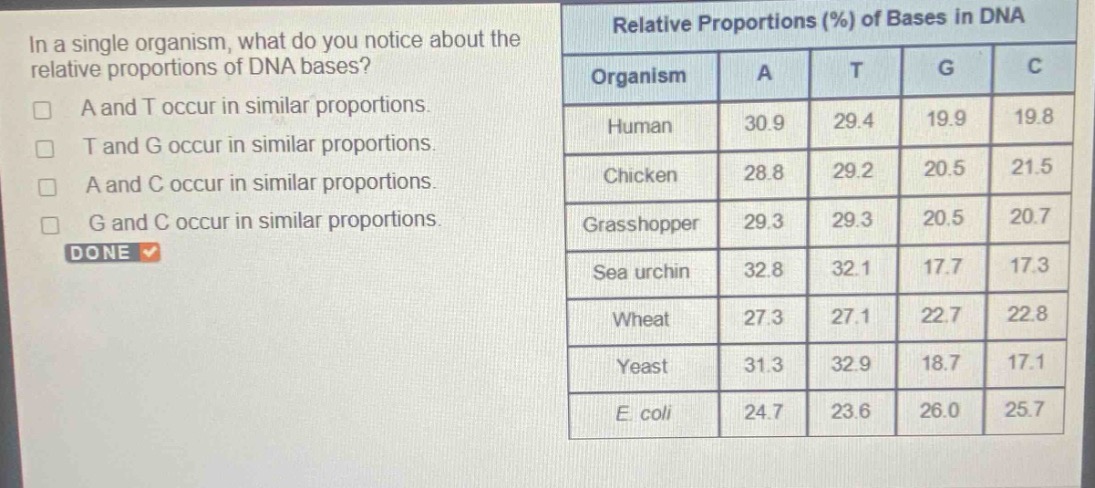
relative proportions (%) of bases in dna
organism | a | t | g | c
human | 30.9 | 29.4 | 19.9 | 19.8
chicken | 28.8 | 29.2 | 20.5 | 21.5
grasshopper | 29.3 | 29.3 | 20.5 | 20.7
sea urchin | 32.8 | 32.1 | 17.7 | 17.3
wheat | 27.3 | 27.1 | 22.7 | 22.8
yeast | 31.3 | 32.9 | 18.7 | 17.1
e. coli | 24.7 | 23.6 | 26.0 | 25.7
- For Human: A (30.9) and T (29.4) are close, G (19.9) and C (19.8) are close.
- For Chicken: A (28.8) and T (29.2) are close, G (20.5) and C (21.5) are close.
- For Grasshopper: A (29.3) and T (29.3) are equal, G (20.5) and C (20.7) are close.
- For Sea urchin: A (32.8) and T (32.1) are close, G (17.7) and C (17.3) are close.
- For Wheat: A (27.3) and T (27.1) are close, G (22.7) and C (22.8) are close.
- For Yeast: A (31.3) and T (32.9) are close, G (18.7) and C (17.1) are close.
- For E. coli: A (24.7) and T (23.6) are close, G (26.0) and C (25.7) are close.
From the data, in each organism, A and T have similar proportions, and G and C have similar proportions. So the correct options are the ones stating "A and T occur in similar proportions" and "G and C occur in similar proportions".

Snap & solve any problem in the app
Get step-by-step solutions on Sovi AI
Photo-based solutions with guided steps
Explore more problems and detailed explanations
A. A and T occur in similar proportions.
D. G and C occur in similar proportions.