QUESTION IMAGE
Question
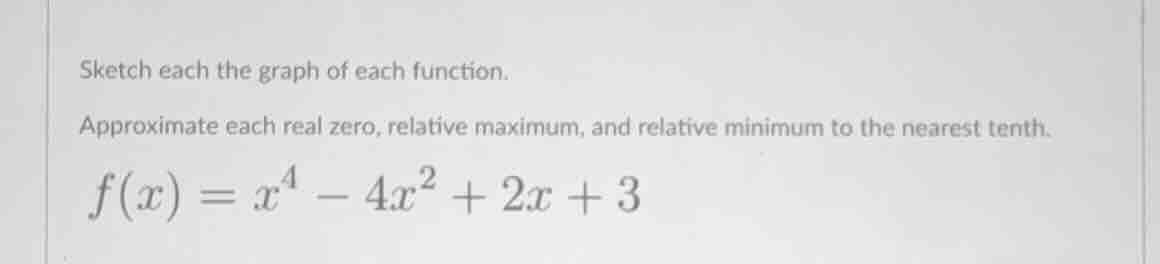
sketch each the graph of each function.
approximate each real zero, relative maximum, and relative minimum to the nearest tenth.
$f(x) = x^4 - 4x^2 + 2x + 3$
Step1: Find real zeros via estimation
Test integer values:
- $f(-2)=(-2)^4-4(-2)^2+2(-2)+3=16-16-4+3=-1$
- $f(-1)=(-1)^4-4(-1)^2+2(-1)+3=1-4-2+3=-2$
- $f(0)=0-0+0+3=3$
- $f(1)=1-4+2+3=2$
- $f(2)=16-16+4+3=7$
Use Intermediate Value Theorem:
Zero between $x=-2$ and $x=-1$: Estimate $x\approx-1.8$ (since $f(-1.8)=(-1.8)^4-4(-1.8)^2+2(-1.8)+3\approx10.4976-12.96-3.6+3\approx-3.0624$; $f(-1.7)=(-1.7)^4-4(-1.7)^2+2(-1.7)+3\approx8.3521-11.56-3.4+3\approx-3.6079$; correct zero between $x=-1$ and $x=0$: $f(-0.6)=(-0.6)^4-4(-0.6)^2+2(-0.6)+3\approx0.1296-1.44-1.2+3\approx0.4896$; $f(-0.7)=(-0.7)^4-4(-0.7)^2+2(-0.7)+3\approx0.2401-1.96-1.4+3\approx-0.1199$ → zero $\approx-0.7$
Step2: Find critical points (derivative)
Compute $f'(x)=4x^3-8x+2$
Set $f'(x)=0$: $4x^3-8x+2=0$ → $2x^3-4x+1=0$
Estimate roots of derivative:
- $x=-1.6$: $2(-1.6)^3-4(-1.6)+1=2(-4.096)+6.4+1\approx-8.192+7.4\approx-0.792$
- $x=-1.7$: $2(-1.7)^3-4(-1.7)+1=2(-4.913)+6.8+1\approx-9.826+7.8\approx-2.026$
- $x=0.3$: $2(0.3)^3-4(0.3)+1=2(0.027)-1.2+1\approx0.054-0.2\approx-0.146$
- $x=0.2$: $2(0.2)^3-4(0.2)+1=2(0.008)-0.8+1\approx0.016+0.2=0.216$
- $x=1.4$: $2(1.4)^3-4(1.4)+1=2(2.744)-5.6+1\approx5.488-4.6=0.888$
- $x=1.3$: $2(1.3)^3-4(1.3)+1=2(2.197)-5.2+1\approx4.394-4.2=0.194$
- $x=1.2$: $2(1.2)^3-4(1.2)+1=2(1.728)-4.8+1\approx3.456-3.8=-0.344$
Critical points at $x\approx-1.7$, $x\approx0.3$, $x\approx1.3$
Step3: Classify critical points (2nd derivative)
Compute $f''(x)=12x^2-8$
- At $x=-1.7$: $f''(-1.7)=12(-1.7)^2-8=12(2.89)-8=34.68-8=26.68>0$ → relative minimum
- At $x=0.3$: $f''(0.3)=12(0.3)^2-8=12(0.09)-8=1.08-8=-6.92<0$ → relative maximum
- At $x=1.3$: $f''(1.3)=12(1.3)^2-8=12(1.69)-8=20.28-8=12.28>0$ → relative minimum
Step4: Calculate extrema values
- Relative min at $x\approx-1.7$: $f(-1.7)\approx-3.6$
- Relative max at $x\approx0.3$: $f(0.3)=(0.3)^4-4(0.3)^2+2(0.3)+3\approx0.0081-0.36+0.6+3=3.2481\approx3.2$
- Relative min at $x\approx1.3$: $f(1.3)=(1.3)^4-4(1.3)^2+2(1.3)+3\approx2.8561-6.76+2.6+3\approx1.6961\approx1.7$

Snap & solve any problem in the app
Get step-by-step solutions on Sovi AI
Photo-based solutions with guided steps
Explore more problems and detailed explanations
Real zeros: $x\approx-0.7$, $x\approx-1.8$
Relative maximum: $(0.3, 3.2)$
Relative minima: $(-1.7, -3.6)$, $(1.3, 1.7)$
(Graph: A quartic opening upwards, crossing the x-axis at the estimated zeros, with the above extrema points)