QUESTION IMAGE
Question
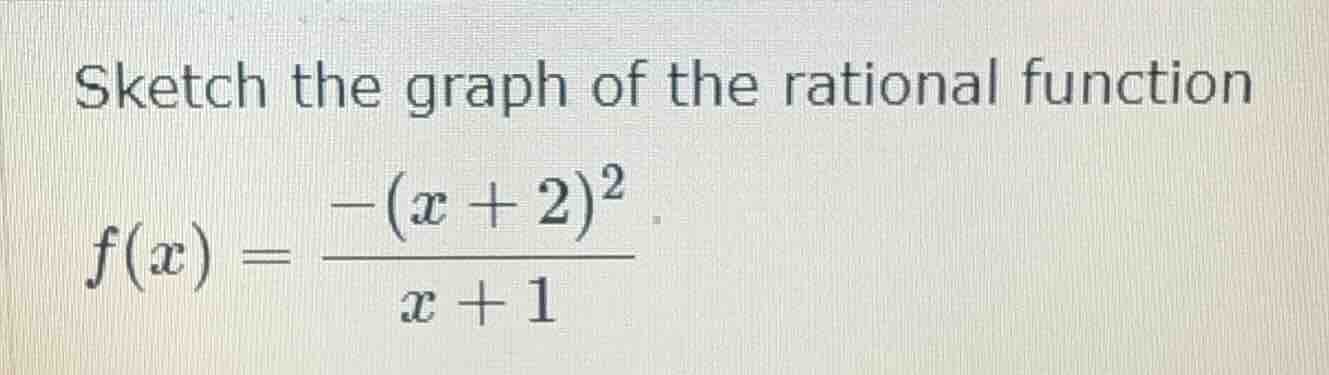
sketch the graph of the rational function $f(x) = \frac{-(x + 2)^2}{x + 1}$
Step1: Find domain & vertical asymptote
The denominator cannot be zero: $x+1
eq0 \implies x
eq-1$. Vertical asymptote: $x=-1$.
Step2: Simplify the function
Use polynomial division or expand numerator:
Step3: Find horizontal/slant asymptote
Since degree of numerator (2) is 1 more than denominator (1), there is a slant asymptote: $y=-x-3$.
Step4: Find x-intercepts
Set $f(x)=0$: $-(x+2)^2=0 \implies x=-2$. Intercept at $(-2,0)$.
Step5: Find y-intercept
Set $x=0$: $f(0)=\frac{-(0+2)^2}{0+1}=-4$. Intercept at $(0,-4)$.
Step6: Find holes
No common factors in numerator/denominator, so no holes.
Step7: Analyze sign & behavior
- For $x<-2$: $-(x+2)^2<0$, $x+1<0$, so $f(x)>0$
- For $-2
- For $x>-1$: $-(x+2)^2<0$, $x+1>0$, so $f(x)<0$
As $x\to-1^-$, $f(x)\to+\infty$; as $x\to-1^+$, $f(x)\to-\infty$.
As $x\to\pm\infty$, $f(x)\to -x-3$.
Step8: Find critical points (optional)
Take derivative:
Set $f'(x)=0$: $x=0$ or $x=-2$.
- Local max at $x=-2$ (point $(-2,0)$)
- Local min at $x=0$ (point $(0,-4)$)

Snap & solve any problem in the app
Get step-by-step solutions on Sovi AI
Photo-based solutions with guided steps
Explore more problems and detailed explanations
To sketch the graph:
- Draw vertical asymptote $x=-1$ (dashed line) and slant asymptote $y=-x-3$ (dashed line).
- Plot intercepts $(-2,0)$ and $(0,-4)$.
- For $x<-1$: The curve is positive, approaches $+\infty$ as $x\to-1^-$, approaches the slant asymptote as $x\to-\infty$, and touches the x-axis at $(-2,0)$.
- For $x>-1$: The curve is negative, approaches $-\infty$ as $x\to-1^+$, approaches the slant asymptote as $x\to+\infty$, and has a local minimum at $(0,-4)$.