QUESTION IMAGE
Question
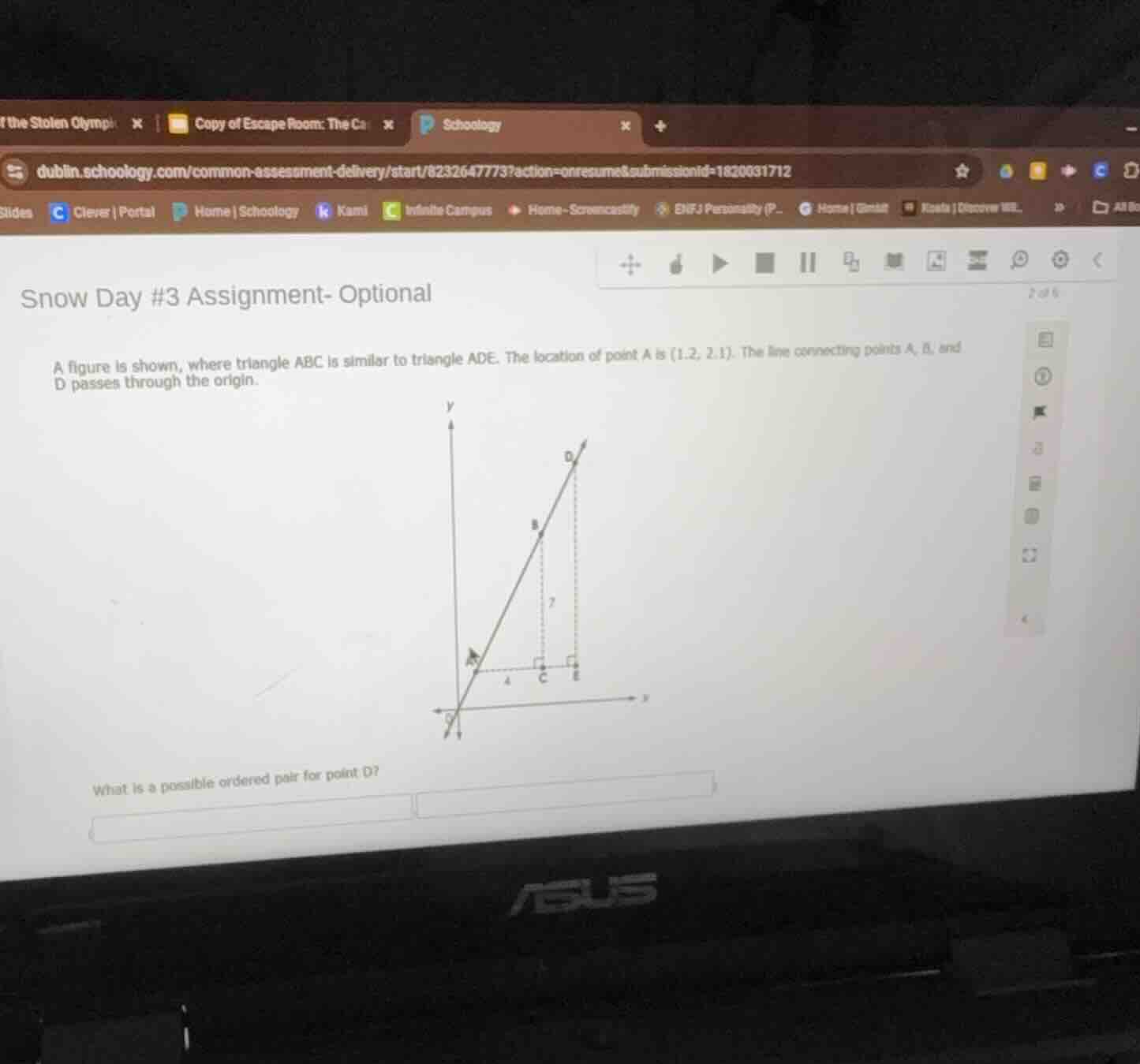
snow day #3 assignment- optional a figure is shown, where triangle abc is similar to triangle ade. the location of point a is (1.2, 2.1). the line connecting points a, b, and d passes through the origin. what is a possible ordered pair for point d?
Step1: Find scale factor of similarity
From triangle ABC, the horizontal leg is 4, vertical leg is 2. The ratio of vertical to horizontal for ABC is $\frac{2}{4} = \frac{1}{2}$, which matches the slope of line OA: $\frac{2.1}{1.2} = \frac{7}{4}$? No, wait: the line through O, A, B, D means all points are scalar multiples. First, find the scalar from A to B: For ABC, the coordinates of B are A + (4,2) = (1.2+4, 2.1+2) = (5.2, 4.1). Now find the scalar $k$ such that $B = kA$: $k = \frac{5.2}{1.2} = \frac{13}{3}$, or $\frac{4.1}{2.1} = \frac{41}{21}$? No, better: since triangles are similar, the ratio of similarity from ABC to ADE is the same as the scalar multiple of the line through origin. The slope of line OD is $\frac{2.1}{1.2} = \frac{7}{4}$, so all points on the line satisfy $y = \frac{7}{4}x$. Also, the ratio of ABC to ADE: let the scalar factor from A to D be $m$, so $D = m(1.2, 2.1)$. Also, since $\triangle ABC \sim \triangle ADE$, the ratio of sides is $\frac{DE}{BC} = \frac{AE}{AC}$. $AC=4$, $BC=2$, so $\frac{DE}{2} = \frac{AE}{4} \implies DE = \frac{1}{2}AE$, which matches the slope $\frac{7}{4}$? Wait, no: the line through O, A, B, D means that $\overrightarrow{OA}$, $\overrightarrow{OB}$, $\overrightarrow{OD}$ are colinear, so $\overrightarrow{OB} = t\overrightarrow{OA}$, $\overrightarrow{OD} = s\overrightarrow{OA}$. From the figure, $AC=4$, so the x-coordinate of B is $1.2 + 4 = 5.2$, so $t = \frac{5.2}{1.2} = \frac{13}{3}$. Then the ratio of similarity between $\triangle ADE$ and $\triangle ABC$ is the same as the ratio of $AD$ to $AB$. $AB$ length is $\sqrt{4^2 + 2^2} = \sqrt{20}$, $OA$ length is $\sqrt{1.2^2 + 2.1^2} = \sqrt{1.44 + 4.41} = \sqrt{5.85}$, $OB$ length is $\frac{13}{3}\sqrt{5.85}$, so $AB = OB - OA = (\frac{13}{3}-1)\sqrt{5.85} = \frac{10}{3}\sqrt{5.85}$. Let $AD = n \cdot AB$, so $OD = OA + AD = \sqrt{5.85} + n \cdot \frac{10}{3}\sqrt{5.85} = \sqrt{5.85}(1 + \frac{10n}{3})$. The coordinates of D are $(\frac{OD}{OA} \cdot 1.2, \frac{OD}{OA} \cdot 2.1) = (1.2(1 + \frac{10n}{3}), 2.1(1 + \frac{10n}{3}))$. A simple choice is $n=1$, so $OD = OA + 2AB = \sqrt{5.85} + 2 \cdot \frac{10}{3}\sqrt{5.85} = \frac{23}{3}\sqrt{5.85}$, but easier: since the line is $y = \frac{7}{4}x$, and $\triangle ABC$ has a horizontal run of 4, vertical rise of 2, so extending by the same amount from B: B is (5.2, 4.1), so adding (4,2) gives D = (5.2+4, 4.1+2) = (9.2, 6.1). Check if this is on the line: $\frac{6.1}{9.2} = \frac{61}{92} = \frac{7}{4}$? No, $\frac{7}{4}=1.75$, $\frac{61}{92}\approx0.663$. Wait, correct approach: since A, B, D are on line through origin, so $A = kO + A$, $B = mA$, $D = pA$. The vector $\overrightarrow{AC}=(4,0)$, $\overrightarrow{BC}=(0,2)$, so $\overrightarrow{AB}=(4,2)$. So $B = A + (4,2) = (1.2+4, 2.1+2)=(5.2,4.1)$. Then $m = \frac{5.2}{1.2} = \frac{13}{3}$, so $B = \frac{13}{3}A$. Then $\overrightarrow{AB} = B - A = \frac{10}{3}A$. To get D, we can take $D = B + \overrightarrow{AB} = \frac{13}{3}A + \frac{10}{3}A = \frac{23}{3}A = \frac{23}{3}(1.2, 2.1) = (23 \cdot 0.4, 23 \cdot 0.7) = (9.2, 16.1)$? Wait, $\frac{1.2}{3}=0.4$, $23*0.4=9.2$; $\frac{2.1}{3}=0.7$, $23*0.7=16.1$. Now check slope: $\frac{16.1}{9.2} = 1.75 = \frac{7}{4}$, which matches $\frac{2.1}{1.2}=1.75$. Also, $\triangle ADE$ is similar to $\triangle ABC$: $\overrightarrow{AE} = \overrightarrow{AC} + \overrightarrow{CE}$, $\overrightarrow{CE} = \overrightarrow{BD} = \overrightarrow{AB}=(4,2)$, so $\overrightarrow{AE}=(4+4,0)=(8,0)$, $\overrightarrow{DE}=(0,2+2)=(0,4)$, so $\triangle ADE$ has legs 8 and 4, which is 2 times $\triangl…

Snap & solve any problem in the app
Get step-by-step solutions on Sovi AI
Photo-based solutions with guided steps
Explore more problems and detailed explanations
$(9.2, 16.1)$
Note: Any scalar multiple of $(1.2,2.1)$ that extends the similarity will work; another valid answer is $(6, 10.5)$ (scalar factor 5, since $1.2*5=6$, $2.1*5=10.5$, which maintains the slope and similarity as the ratio of sides would be consistent).