QUESTION IMAGE
Question
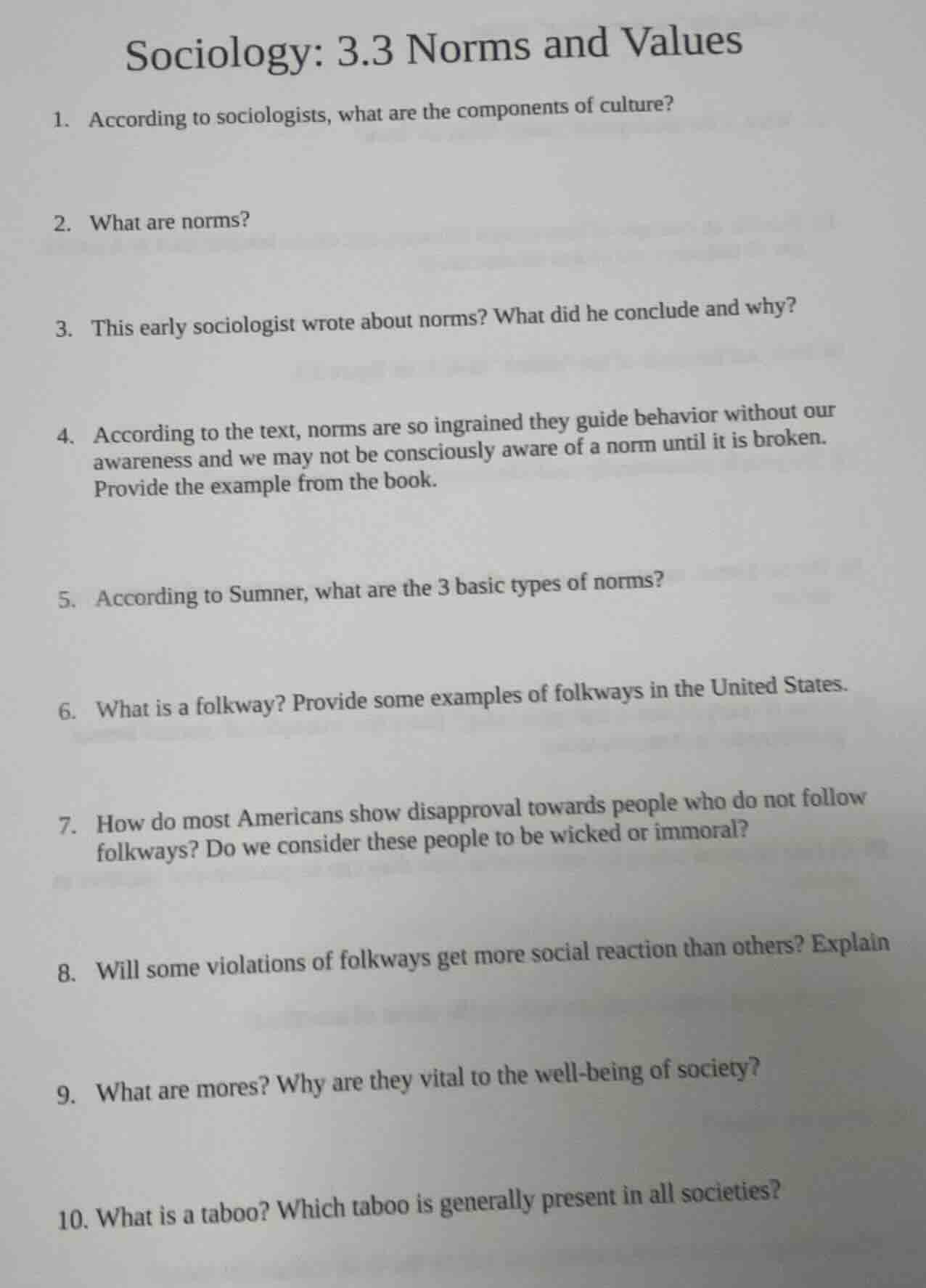
sociology: 3.3 norms and values
- according to sociologists, what are the components of culture?
- what are norms?
- this early sociologist wrote about norms? what did he conclude and why?
- according to the text, norms are so ingrained they guide behavior without our awareness and we may not be consciously aware of a norm until it is broken. provide the example from the book.
- according to sumner, what are the 3 basic types of norms?
- what is a folkway? provide some examples of folkways in the united states.
- how do most americans show disapproval towards people who do not follow folkways? do we consider these people to be wicked or immoral?
- will some violations of folkways get more social reaction than others? explain
- what are mores? why are they vital to the well-being of society?
- what is a taboo? which taboo is generally present in all societies?
Brief Explanations
- Identifies core culture elements per sociology.
- Defines norms as social behavioral guidelines.
- Focuses on Émile Durkheim's norm conclusions.
- Uses a common textbook example of broken norms.
- Lists Sumner's three norm categories.
- Defines folkways and gives U.S.-specific examples.
- Covers folkway disapproval and moral judgments.
- Explains variable social reaction to folkway violations.
- Defines mores and their societal function.
- Defines taboos and a universal taboo example.

Snap & solve any problem in the app
Get step-by-step solutions on Sovi AI
Photo-based solutions with guided steps
Explore more problems and detailed explanations
- The main components of culture (per sociologists) are norms, values, beliefs, language, symbols, and material culture.
- Norms are unwritten or written rules and expectations that guide acceptable social behavior within a group or society.
- The early sociologist is Émile Durkheim. He concluded that norms are essential for social order because they create shared expectations, which prevent anomie (normlessness) and maintain social cohesion.
- A common textbook example is standing too close to a stranger in an elevator: most people unconsciously follow the norm of maintaining personal space, and only notice the norm when someone violates it by standing too close, causing discomfort.
- According to William Graham Sumner, the three basic types of norms are folkways, mores, and taboos.
- Folkways are informal, everyday norms that guide routine social behavior without severe consequences for violation. Examples in the U.S. include saying "please" and "thank you," waiting in a line, and covering your mouth when coughing.
- Most Americans show disapproval of folkway violations through subtle cues like eye-rolling, staring, or quiet sighs. These people are not considered wicked or immoral—only rude or socially unaware.
- Yes, some violations of folkways get more social reaction than others. For example, wearing pajamas to a formal wedding (a violation of context-specific folkways) will draw stronger negative attention than forgetting to say "bless you" after someone sneezes, as the former violates a more contextually significant unwritten rule.
- Mores are strict, morally significant norms that govern behaviors essential to a society's core values. They are vital to societal well-being because they protect the group's safety, stability, and shared moral framework; violations (like theft or murder) result in harsh punishment and widespread social condemnation.
- A taboo is a norm so strongly ingrained that violating it triggers extreme disgust, condemnation, and often severe punishment. Incest is a taboo that is generally present in all societies, as it is widely seen as a threat to family and social structure.