QUESTION IMAGE
Question
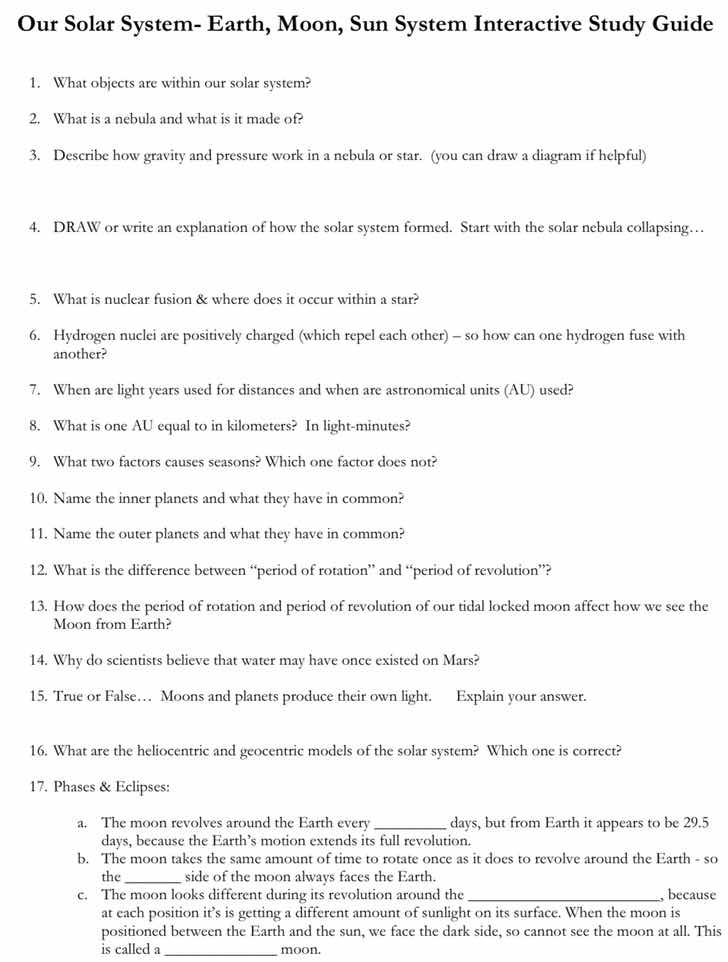
our solar system- earth, moon, sun system interactive study guide
- what objects are within our solar system?
- what is a nebula and what is it made of?
- describe how gravity and pressure work in a nebula or star. (you can draw a diagram if helpful)
- draw or write an explanation of how the solar system formed. start with the solar nebula collapsing…
- what is nuclear fusion & where does it occur within a star?
- hydrogen nuclei are positively charged (which repel each other) – so how can one hydrogen fuse with another?
- when are light years used for distances and when are astronomical units (au) used?
- what is one au equal to in kilometers? in light - minutes?
- what two factors causes seasons? which one factor does not?
- name the inner planets and what they have in common?
- name the outer planets and what they have in common?
- what is the difference between “period of rotation” and “period of revolution”?
- how does the period of rotation and period of revolution of our tidal locked moon affect how we see the moon from earth?
- why do scientists believe that water may have once existed on mars?
- true or false… moons and planets produce their own light. explain your answer.
- what are the heliocentric and geocentric models of the solar system? which one is correct?
- phases & eclipses:
a. the moon revolves around the earth every ______ days, but from earth it appears to be 29.5 days, because the earth’s motion extends its full revolution.
b. the moon takes the same amount of time to rotate once as it does to revolve around the earth - so the ______ side of the moon always faces the earth.
c. the moon looks different during its revolution around the ____, because at each position it’s is getting a different amount of sunlight on its surface. when the moon is positioned between the earth and the sun, we face the dark side, so cannot see the moon at all. this is called a ____ moon.
- Lists all major and minor objects in the solar system.
- Defines nebula and its composition.
- Explains the balance of gravity and pressure in stellar/nebular bodies.
- Outlines the solar nebula theory step-by-step.
- Defines nuclear fusion and its stellar location.
- Explains quantum tunneling as the mechanism for hydrogen fusion.
- Differentiates use cases for light-years and AU.
- Provides standard conversion values for 1 AU.
- Identifies factors that cause seasons and one that does not.
- Lists inner planets and their shared traits.
- Lists outer planets and their shared traits.
- Defines and distinguishes rotation vs revolution periods.
- Links tidal locking to lunar appearance from Earth.
- Summarizes scientific evidence for past Martian water.
- Addresses light production by moons/planets and explains the answer.
- Defines both solar system models and notes the correct one.
- Fills in key lunar cycle and eclipse/phase details.

Snap & solve any problem in the app
Get step-by-step solutions on Sovi AI
Photo-based solutions with guided steps
Explore more problems and detailed explanations
- The objects in our solar system include the Sun, the eight planets (Mercury, Venus, Earth, Mars, Jupiter, Saturn, Uranus, Neptune), their moons, dwarf planets (e.g., Pluto, Ceres), asteroids, comets, meteoroids, and interplanetary dust/gas.
- A nebula is a giant cloud of interstellar matter in space. It is made primarily of hydrogen and helium gas, along with small amounts of heavier elements and cosmic dust.
- In a nebula or star, gravity pulls matter inward, trying to collapse the object. Thermal pressure (from heat generated by particle motion) pushes outward, opposing gravity. In a stable star, these two forces are balanced, maintaining the star's size. In a collapsing nebula, gravity overwhelms initial pressure, causing the cloud to shrink and heat up.
- 1. A dense region in a giant molecular cloud collapses under its own gravity, forming a spinning solar nebula (a flattened, rotating disk of gas and dust).
- Most of the mass accumulates at the center, heating up to form a protostar.
- Dust particles in the disk collide and stick together, forming planetesimals, then protoplanets.
- The protostar's core temperature and pressure reach thresholds for nuclear fusion, igniting to become the Sun.
- Remaining gas and dust are cleared from the system, leaving the Sun and orbiting planets/moons/dwarf planets/asteroids.
- Nuclear fusion is a nuclear reaction where two or more light atomic nuclei combine to form a heavier nucleus, releasing a large amount of energy. It occurs in the core of a star, where temperature and pressure are high enough to force nuclei together.
- At the extreme temperatures and pressures in a star's core, hydrogen nuclei have enough kinetic energy to overcome electrostatic repulsion via a quantum mechanical effect called quantum tunneling, allowing them to get close enough for the strong nuclear force to bind them together.
- Light-years are used to measure very large distances, such as the distance between stars or galaxies. Astronomical units (AU) are used to measure shorter distances within our solar system, such as the distance between planets and the Sun.
- 1 AU is equal to approximately 149,597,870 kilometers. 1 AU is equal to approximately 8.317 light-minutes.
- The two factors that cause seasons are the tilt of Earth's axis (23.5 degrees relative to its orbital plane) and Earth's revolution around the Sun. The distance between Earth and the Sun does not cause seasons.
- The inner planets are Mercury, Venus, Earth, and Mars. They are all terrestrial (rocky) planets, relatively small, dense, and have few or no moons.
- The outer planets are Jupiter, Saturn, Uranus, and Neptune. They are all gas/ice giants, much larger and less dense than inner planets, have many moons, and have ring systems (though Uranus and Neptune's rings are faint).
- The period of rotation is the time it takes for a celestial body to spin once on its axis (e.g., Earth's rotation period is ~24 hours, one day). The period of revolution is the time it takes for a celestial body to orbit another body (e.g., Earth's revolution period is ~365 days, one year).
- The Moon is tidally locked to Earth, meaning its period of rotation equals its period of revolution (~27.3 days). This means the same side of the Moon always faces Earth, so we only see one hemisphere of the Moon from our planet.
- Scientists believe water may have once existed on Mars because:
- Orbital satellites and rovers have found features like ancient riverbeds, lake basins, and deltas that form only with flowing water.
- Mineral deposits (like clay minerals and sulfates) that form in the presence of water have been detected.
- Polar ice caps contain water ice, and subsurface water ice has been found in other regions.
- False. Moons and planets do not produce their own light. They only reflect light from the Sun (or in rare cases, other stars). We can see them because they bounce sunlight back to Earth.
- The geocentric model is an ancient model that places Earth at the center of the solar system, with all other celestial bodies orbiting it. The heliocentric model places the Sun at the center of the solar system, with Earth and other planets orbiting the Sun. The heliocentric model is correct.
- a. The moon revolves around the Earth every 27.3 days, but from Earth it appears to be 29.5 days, because the Earth's motion extends its full revolution.
b. The moon takes the same amount of time to rotate once as it does to revolve around the Earth - so the same side of the moon always faces the Earth.
c. The moon looks different during its revolution around the Earth, because at each position it's getting a different amount of sunlight on its surface. When the moon is positioned between the Earth and the sun, we face the dark side, so cannot see the moon at all. This is called a new moon.