QUESTION IMAGE
Question
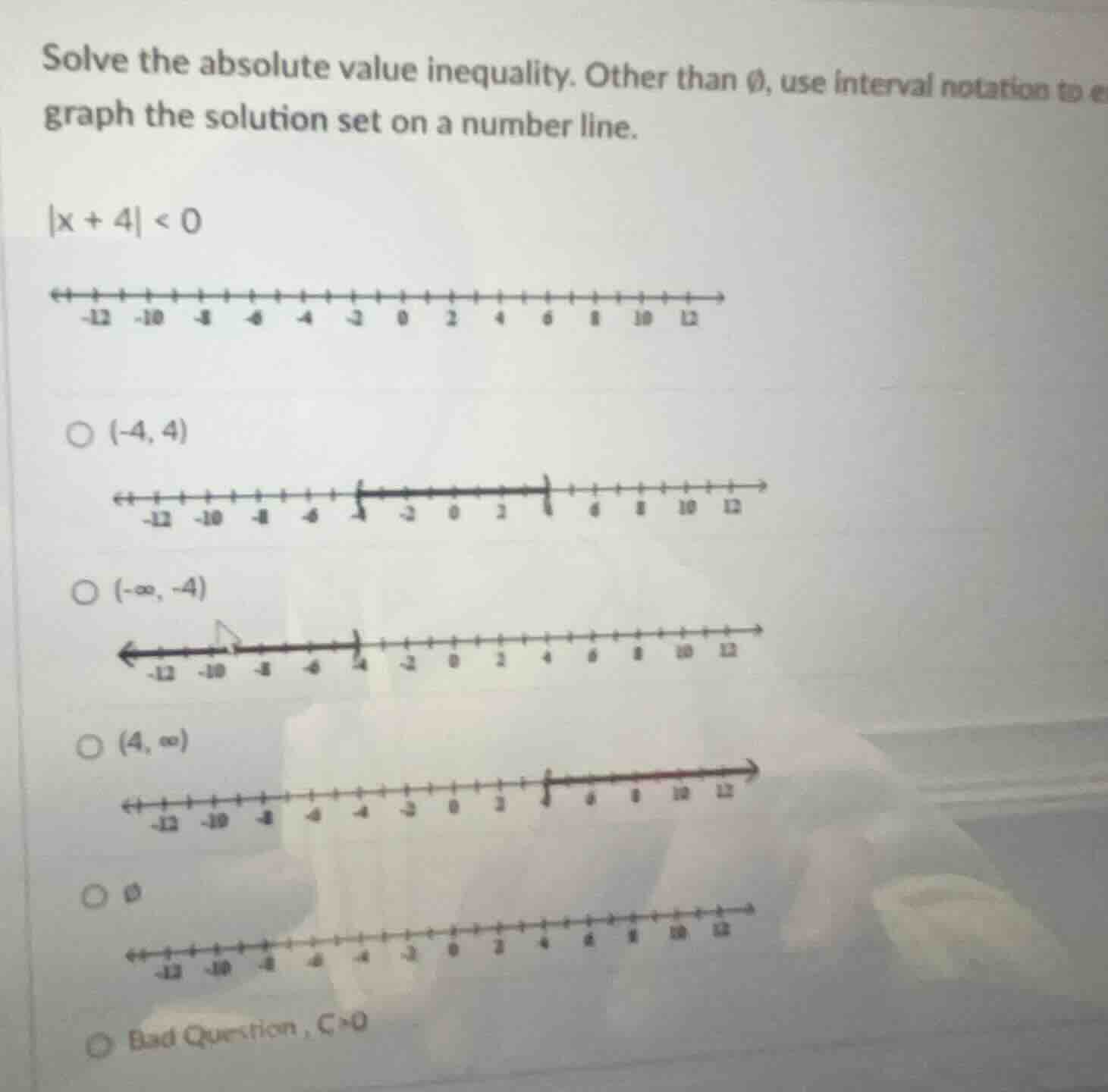
solve the absolute value inequality. other than ∅, use interval notation to e graph the solution set on a number line.\\(|x + 4| < 0\\)\\(\\ \\)\\(\circ (-4, 4)\\)\\(\circ (-infty, -4)\\)\\(\circ (4, infty)\\)\\(\circ \varnothing\\)\\(\circ \text{bad question}, c>0\\)
Step1: Recall the property of absolute value
The absolute value of a number, denoted as \(|a|\), is defined as the distance of \(a\) from \(0\) on the number line. By definition, the absolute value of any real number is always non - negative, that is \(|a|\geq0\) for all real numbers \(a\).
Step2: Analyze the inequality \(|x + 4|\lt0\)
Let \(a=x + 4\). From the property of absolute value, we know that \(|x + 4|\geq0\) for all real numbers \(x\). The inequality \(|x + 4|\lt0\) is asking for values of \(x\) such that the absolute value of \(x + 4\) is less than \(0\). But since the absolute value can never be negative (it is either positive or zero), there are no real numbers \(x\) that satisfy the inequality \(|x + 4|\lt0\). So the solution set is the empty set \(\varnothing\).

Snap & solve any problem in the app
Get step-by-step solutions on Sovi AI
Photo-based solutions with guided steps
Explore more problems and detailed explanations
\(\varnothing\) (the empty set)