QUESTION IMAGE
Question
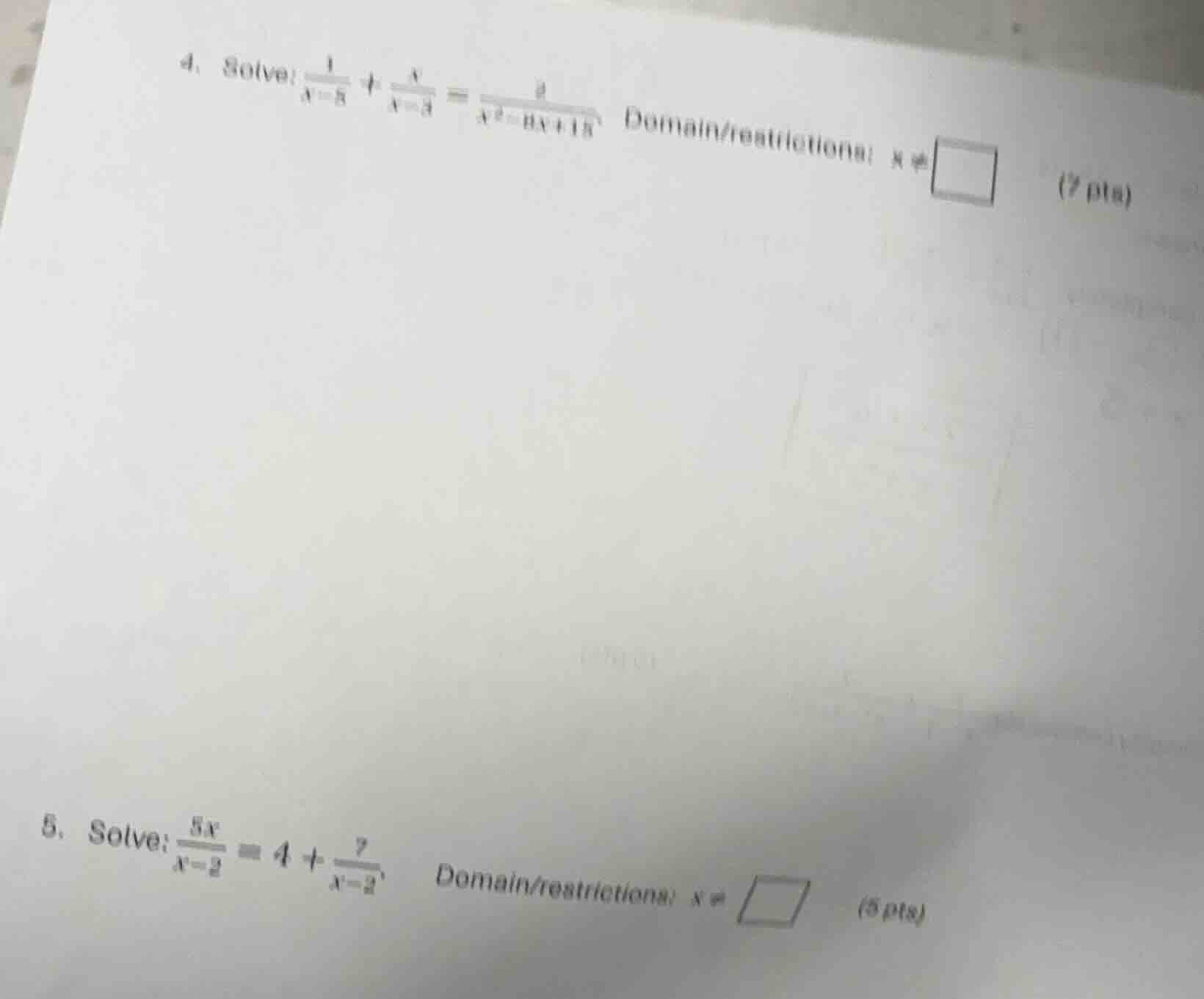
- solve: \\(\frac{1}{x - 5} + \frac{x}{x - 3} = \frac{4}{x^2 - 8x + 15}\\). domain/restrictions: \\(x \
eq \square\\) (7 pts)
- solve: \\(\frac{5x}{x - 2} = 4 + \frac{7}{x - 2}\\). domain/restrictions: \\(x \
eq \square\\) (5 pts)
Problem 4
Step1: Factor the denominator
The denominator \(x^2 - 8x + 15\) can be factored as \((x - 5)(x - 3)\) since \(5\times3 = 15\) and \(5 + 3 = 8\). So, \(x^2 - 8x + 15=(x - 5)(x - 3)\).
Step2: Find domain restrictions
For a rational function, the denominator cannot be zero. So we set each denominator equal to zero and solve for \(x\):
- For \(x - 5 = 0\), we get \(x = 5\).
- For \(x - 3 = 0\), we get \(x = 3\).
- For \((x - 5)(x - 3)=0\), the solutions are also \(x = 5\) and \(x = 3\) (since if either factor is zero, the product is zero).
So the domain restrictions are \(x
eq3\) and \(x
eq5\).
Now, let's solve the equation \(\frac{1}{x - 5}+\frac{x}{x - 3}=\frac{4}{x^2 - 8x + 15}\)
Step3: Multiply through by the LCD
The least common denominator (LCD) of the fractions is \((x - 5)(x - 3)\) (which is \(x^2 - 8x + 15\)). Multiply each term by the LCD to eliminate the fractions:
\[
\]
Step4: Simplify the left - hand side
Expand \(x(x - 5)\) to get \(x^2-5x\). Then the left - hand side becomes:
\(x - 3+x^2-5x=x^2-4x - 3\)
So our equation is \(x^2-4x - 3 = 4\)
Step5: Rearrange the equation to standard quadratic form
Subtract 4 from both sides:
\(x^2-4x-3 - 4=0\)
\(x^2-4x - 7 = 0\)
Step6: Use the quadratic formula
For a quadratic equation \(ax^2+bx + c = 0\) (\(a = 1\), \(b=-4\), \(c = - 7\)), the quadratic formula is \(x=\frac{-b\pm\sqrt{b^2 - 4ac}}{2a}\)
\[
\]
We need to check if these solutions are in the domain. Since \(2+\sqrt{11}\approx2 + 3.316=5.316
eq3,5\) and \(2-\sqrt{11}\approx2-3.316=-1.316
eq3,5\), both solutions are valid.
Problem 5
Step1: Find domain restrictions
For the equation \(\frac{5x}{x - 2}=4+\frac{7}{x - 2}\), the denominator is \(x - 2\). We set \(x - 2=0\), so \(x = 2\). Thus, the domain restriction is \(x
eq2\).
Step2: Multiply through by the LCD
The LCD of the fractions is \(x - 2\). Multiply each term by \(x - 2\) (note that \(x
eq2\)):
\[
\]
Step3: Simplify the right - hand side
Expand \(4(x - 2)\) to get \(4x-8\). Then the right - hand side is \(4x-8 + 7=4x-1\)
So our equation is \(5x=4x - 1\)
Step4: Solve for \(x\)
Subtract \(4x\) from both sides:
\(5x-4x=4x - 1-4x\)
\(x=-1\)
We check if \(x=-1\) is in the domain. Since \(-1
eq2\), it is a valid solution.

Snap & solve any problem in the app
Get step-by-step solutions on Sovi AI
Photo-based solutions with guided steps
Explore more problems and detailed explanations
s:
Problem 4
- Domain restrictions: \(x
eq3\), \(x
eq5\)
- Solution of the equation: \(x = 2+\sqrt{11}\) or \(x = 2-\sqrt{11}\)
Problem 5
- Domain restriction: \(x
eq2\)
- Solution of the equation: \(x=-1\)