QUESTION IMAGE
Question
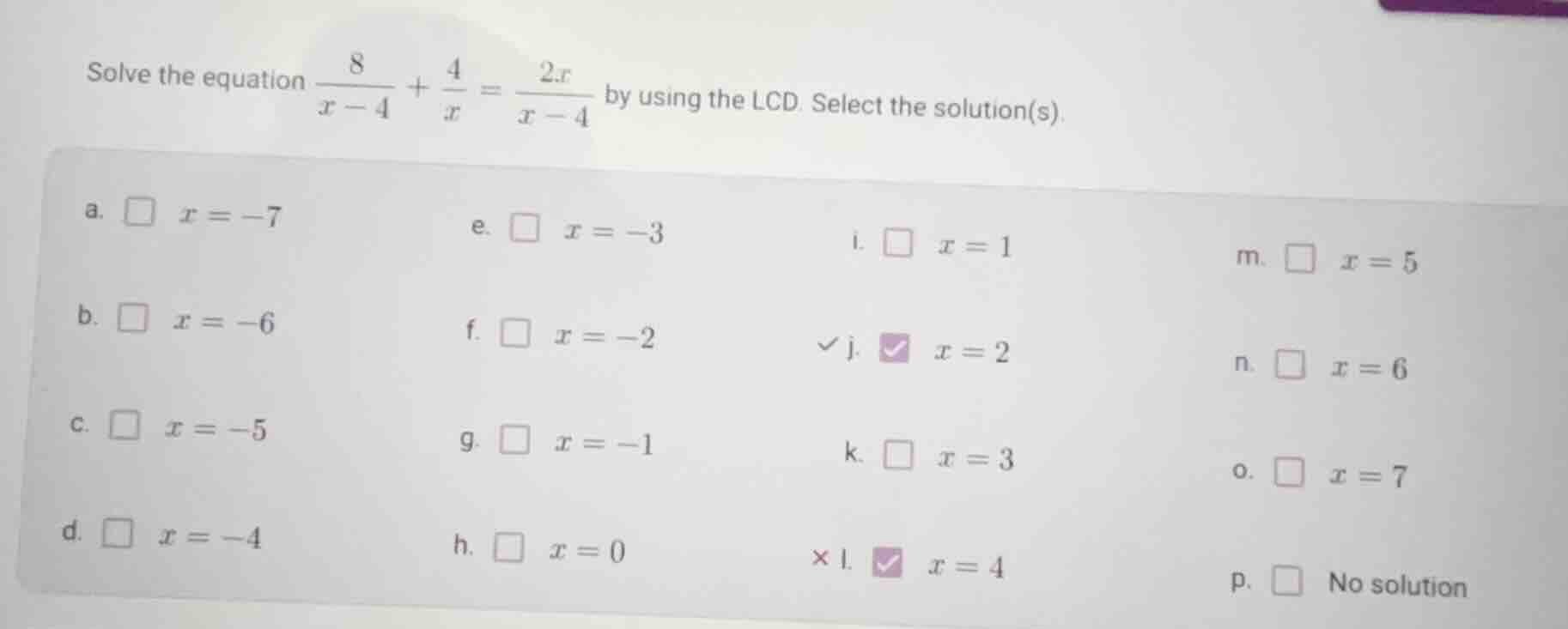
solve the equation \\(\frac{8}{x - 4} + \frac{4}{x} = \frac{2x}{x - 4}\\) by using the lcd. select the solution(s).
a. \\(\square\\) \\(x = -7\\) e. \\(\square\\) \\(x = -3\\) i. \\(\square\\) \\(x = 1\\) m. \\(\square\\) \\(x = 5\\)
b. \\(\square\\) \\(x = -6\\) f. \\(\square\\) \\(x = -2\\) \\(\checkmark\\)j. \\(\square\\) \\(x = 2\\) n. \\(\square\\) \\(x = 6\\)
c. \\(\square\\) \\(x = -5\\) g. \\(\square\\) \\(x = -1\\) k. \\(\square\\) \\(x = 3\\) o. \\(\square\\) \\(x = 7\\)
d. \\(\square\\) \\(x = -4\\) h. \\(\square\\) \\(x = 0\\) \\(\times\\) l. \\(\square\\) \\(x = 4\\) p. \\(\square\\) no solution
Step1: Identify the LCD
The denominators are \(x - 4\) and \(x\), so the LCD is \(x(x - 4)\). We note that \(x
eq0\) and \(x
eq4\) (since these would make the denominators zero).
Step2: Multiply each term by the LCD
Multiply each term in the equation \(\frac{8}{x - 4}+\frac{4}{x}=\frac{2x}{x - 4}\) by \(x(x - 4)\):
\[
\]
Step3: Simplify the equation
Expand and simplify the left - hand side:
\[
\]
Rearrange the equation to get a quadratic equation in standard form \(ax^{2}+bx + c = 0\):
\[
2x^{2}-12x + 16 = 0
\]
Divide the entire equation by 2:
\[
x^{2}-6x + 8=0
\]
Step4: Factor the quadratic equation
Factor \(x^{2}-6x + 8\):
We need two numbers that multiply to 8 and add up to - 6. The numbers are - 2 and - 4. So,
\[
(x - 2)(x - 4)=0
\]
Step5: Solve for x
Set each factor equal to zero:
\(x - 2=0\) gives \(x = 2\); \(x - 4=0\) gives \(x = 4\). But we know from the domain (since \(x
eq4\) as it makes the original denominator zero), we discard \(x = 4\). So the only valid solution is \(x = 2\). But we need to check the options. Wait, let's re - check our steps.
Wait, when we multiplied through by \(x(x - 4)\), let's re - do the multiplication:
Original equation: \(\frac{8}{x - 4}+\frac{4}{x}=\frac{2x}{x - 4}\)
Multiply each term by \(x(x - 4)\):
\(8\times x+4\times(x - 4)=2x\times x\)
\(8x + 4x-16 = 2x^{2}\)
\(12x-16=2x^{2}\)
\(2x^{2}-12x + 16 = 0\)
\(x^{2}-6x + 8 = 0\)
\((x - 2)(x - 4)=0\)
\(x = 2\) or \(x = 4\). But \(x = 4\) is not in the domain (because when \(x = 4\), the denominators \(x-4 = 0\) in the original equation). So the only solution is \(x = 2\). But let's check the options. However, if we made a mistake in the problem - solving process, let's substitute \(x = 2\) into the original equation:
Left - hand side: \(\frac{8}{2 - 4}+\frac{4}{2}=\frac{8}{-2}+2=-4 + 2=-2\)
Right - hand side: \(\frac{2\times2}{2 - 4}=\frac{4}{-2}=-2\). So \(x = 2\) is a valid solution.
Now, let's check the other options. If we consider the quadratic equation again, maybe we made a mistake in the sign when factoring? Wait, \(x^{2}-6x + 8=(x - 2)(x - 4)\) is correct.
But let's check the option \(x = 2\) is in the options (option j). And \(x = 4\) is not valid. So the correct solution is \(x = 2\) (option j) and we discard \(x = 4\) because it makes the denominator zero.

Snap & solve any problem in the app
Get step-by-step solutions on Sovi AI
Photo-based solutions with guided steps
Explore more problems and detailed explanations
j. \(x = 2\)