QUESTION IMAGE
Question
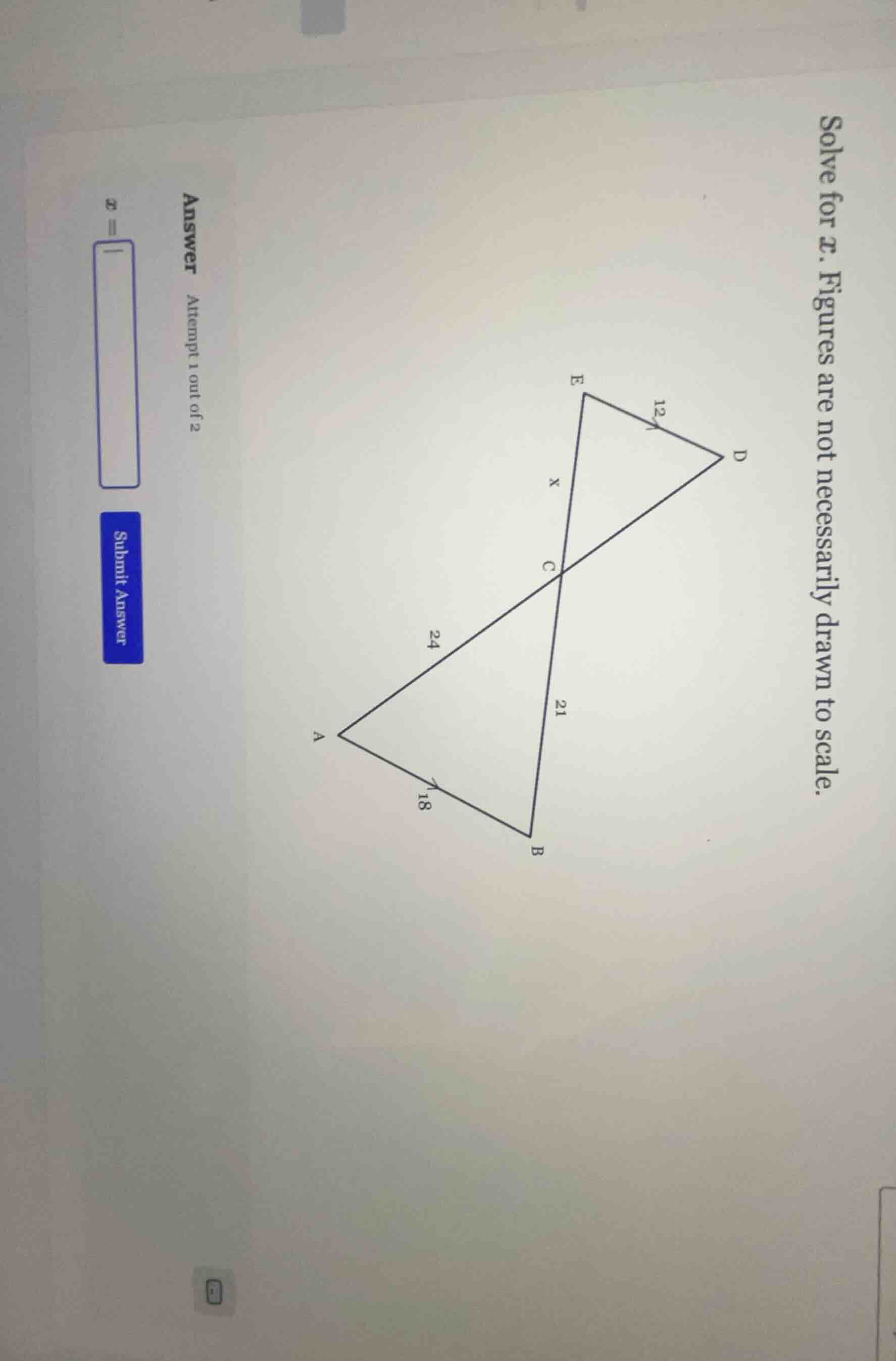
solve for x. figures are not necessarily drawn to scale. answer attempt 1 out of 2 x = submit answer
Step1: Identify Similar Triangles
Triangles \( \triangle ABC \) and \( \triangle DEC \) are similar (vertical angles and alternate interior angles imply AA similarity). So, the ratios of corresponding sides are equal.
Step2: Set Up Proportion
Corresponding sides: \( \frac{AB}{DE} = \frac{BC}{EC} = \frac{AC}{DC} \). Using \( \frac{AB}{DE} = \frac{BC}{EC} \), substitute \( AB = 18 \), \( DE = 12 \), \( BC = 21 \), \( EC = x \). Wait, no, correct correspondence: \( \frac{AC}{DC} = \frac{BC}{EC} = \frac{AB}{DE} \). \( AC = 24 \), \( DC =? \) Wait, no, let's re - check. Wait, \( AC = 24 \), \( BC = 21 \), \( AB = 18 \), \( DE = 12 \), \( EC = x \), \( DC \) is part of \( AC \)? No, actually, the sides: \( AC = 24 \), \( BC = 21 \), \( AB = 18 \); \( DC \) and \( EC = x \), \( DE = 12 \). So the correct proportion is \( \frac{AC}{DC}=\frac{BC}{EC}=\frac{AB}{DE} \). Wait, maybe \( \frac{AB}{DE}=\frac{BC}{EC} \). So \( \frac{18}{12}=\frac{21}{x} \)? No, that's wrong. Wait, maybe \( \frac{AB}{DE}=\frac{AC}{DC} \). Wait, \( AC = 24 \), \( DC \) is the segment from \( D \) to \( C \), and \( EC=x \), \( BC = 21 \). Wait, actually, the triangles are \( \triangle ABC \sim \triangle DEC \), so \( \frac{AB}{DE}=\frac{BC}{EC}=\frac{AC}{DC} \). So \( AB = 18 \), \( DE = 12 \), \( BC = 21 \), \( EC=x \), \( AC = 24 \), \( DC \) is the other segment. Wait, maybe the proportion is \( \frac{AB}{DE}=\frac{BC}{EC} \). Let's solve \( \frac{18}{12}=\frac{21}{x} \)? No, that gives \( 18x=12\times21 \), \( x = \frac{12\times21}{18}=\frac{252}{18} = 14 \). Wait, no, maybe I mixed up the sides. Wait, another way: \( \frac{DE}{AB}=\frac{EC}{BC}=\frac{DC}{AC} \). So \( \frac{12}{18}=\frac{x}{21} \). Then cross - multiply: \( 18x=12\times21 \), \( x=\frac{12\times21}{18}=\frac{252}{18}=14 \)? Wait, no, wait \( DE = 12 \), \( AB = 18 \), \( EC=x \), \( BC = 21 \). So \( \frac{DE}{AB}=\frac{EC}{BC} \), so \( \frac{12}{18}=\frac{x}{21} \), \( x=\frac{12\times21}{18}=\frac{252}{18} = 14 \). Wait, but let's check with \( \frac{AC}{DC}=\frac{AB}{DE} \). \( AC = 24 \), \( DC \) is the segment from \( D \) to \( C \), and if \( x = 14 \), then let's see \( \frac{24}{DC}=\frac{18}{12} \), \( \frac{18}{12}=\frac{3}{2} \), so \( DC=\frac{24\times2}{3}=16 \). Then check \( \frac{BC}{EC}=\frac{21}{14}=\frac{3}{2} \), which matches \( \frac{AB}{DE}=\frac{18}{12}=\frac{3}{2} \). So the proportion is correct.
So we set up the proportion \( \frac{AB}{DE}=\frac{BC}{EC} \), where \( AB = 18 \), \( DE = 12 \), \( BC = 21 \), \( EC=x \).
\[
\frac{18}{12}=\frac{21}{x}
\]
Cross - multiply: \( 18x=12\times21 \)
\[
18x = 252
\]
Divide both sides by 18:
\[
x=\frac{252}{18}=14
\]
Wait, no, wait I think I had the proportion reversed. Let's re - examine the triangles. If \( \triangle ABC \) and \( \triangle DEC \) are similar, then \( \angle ABC=\angle DEC \) and \( \angle BAC=\angle EDC \) (alternate interior angles). So the sides: \( AB \) corresponds to \( DE \), \( BC \) corresponds to \( EC \), \( AC \) corresponds to \( DC \). So \( \frac{AB}{DE}=\frac{BC}{EC}=\frac{AC}{DC} \). So \( AB = 18 \), \( DE = 12 \), \( BC = 21 \), \( EC=x \), \( AC = 24 \), \( DC \) is the length from \( D \) to \( C \). So \( \frac{18}{12}=\frac{21}{x} \) is wrong. Wait, \( AB = 18 \), \( DE = 12 \), \( BC = 21 \), \( EC=x \). So \( \frac{DE}{AB}=\frac{EC}{BC} \), which is \( \frac{12}{18}=\frac{x}{21} \). Then \( 18x = 12\times21 \), \( x=\frac{12\times21}{18}=\frac{252}{18}=14 \). Yes, that's correct. Because the ratio of similarity is \( \frac{DE}{AB}=\frac{12}{18}=\frac{2}{3} \), so \( EC=\fr…

Snap & solve any problem in the app
Get step-by-step solutions on Sovi AI
Photo-based solutions with guided steps
Explore more problems and detailed explanations
\( x = 14 \)