QUESTION IMAGE
Question
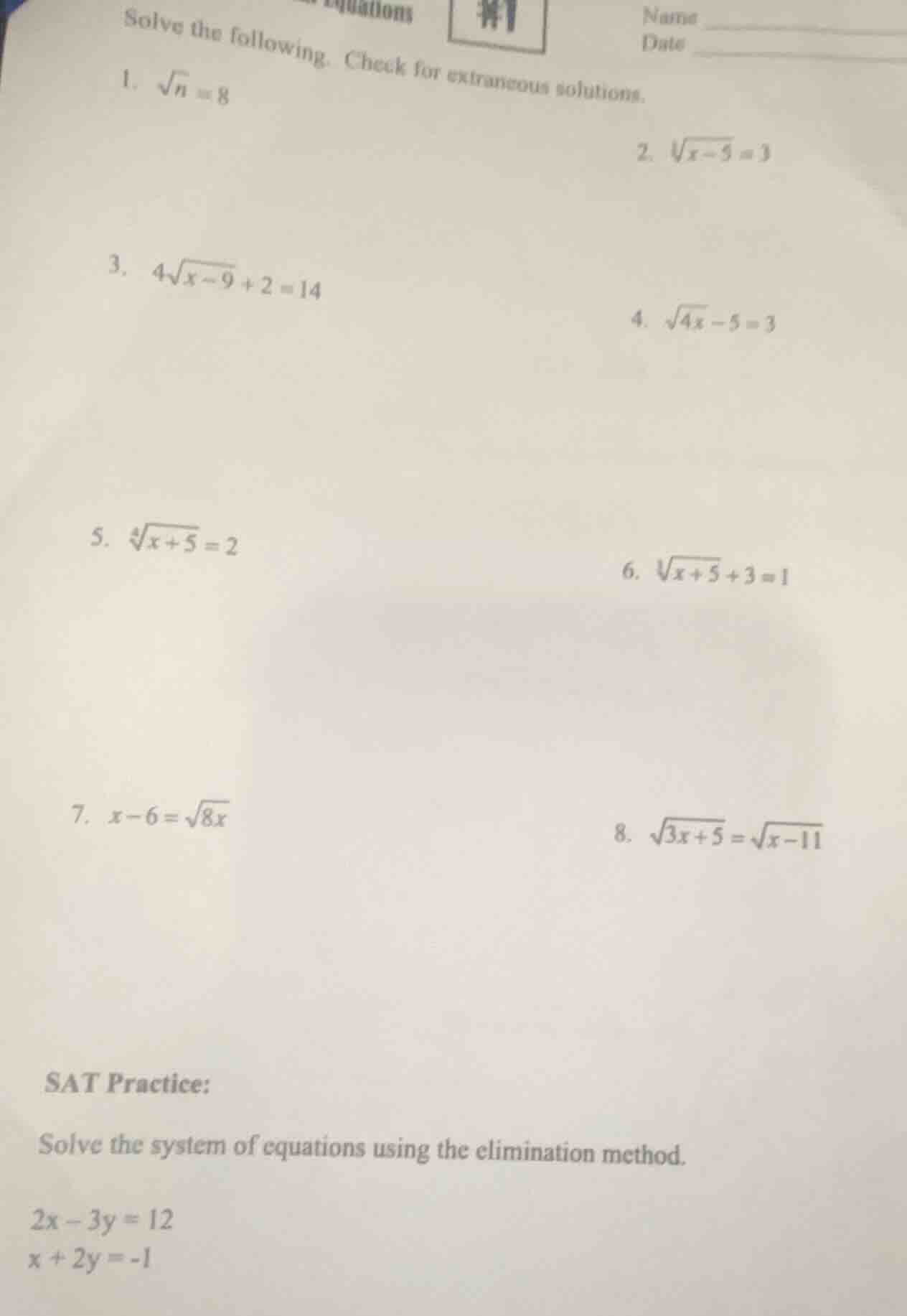
solve the following. check for extraneous solutions.
- $sqrt{n}=8$
- $sqrt3{x-5}=3$
- $4sqrt{x-9}+2=14$
- $sqrt{4x}-5=3$
- $sqrt4{x+5}=2$
- $sqrt{x+5}+3=1$
- $x-6=sqrt{8x}$
- $sqrt{3x+5}=sqrt{x-11}$
sat practice:
solve the system of equations using the elimination method.
$2x-3y=12$
$x+2y=-1$
---
Problem 1: $\sqrt{n}=8$
Step1: Square both sides
$(\sqrt{n})^2=8^2$
Step2: Simplify to solve for $n$
$n=64$
Step3: Check for extraneous solutions
$\sqrt{64}=8$, which matches the original equation.
---
Problem 2: $\sqrt{x-5}=3$
Step1: Square both sides
$(\sqrt{x-5})^2=3^2$
Step2: Simplify and solve for $x$
$x-5=9 \implies x=14$
Step3: Check for extraneous solutions
$\sqrt{14-5}=\sqrt{9}=3$, which matches the original equation.
---
Problem 3: $4\sqrt{x-9}+2=14$
Step1: Isolate the radical term
$4\sqrt{x-9}=14-2=12$
Step2: Divide both sides by 4
$\sqrt{x-9}=\frac{12}{4}=3$
Step3: Square both sides
$(\sqrt{x-9})^2=3^2$
Step4: Simplify and solve for $x$
$x-9=9 \implies x=18$
Step5: Check for extraneous solutions
$4\sqrt{18-9}+2=4*3+2=14$, which matches the original equation.
---
Problem 4: $\sqrt{4x}-5=3$
Step1: Isolate the radical term
$\sqrt{4x}=3+5=8$
Step2: Square both sides
$(\sqrt{4x})^2=8^2$
Step3: Simplify and solve for $x$
$4x=64 \implies x=\frac{64}{4}=16$
Step4: Check for extraneous solutions
$\sqrt{4*16}-5=\sqrt{64}-5=8-5=3$, which matches the original equation.
---
Problem 5: $\sqrt[4]{x+5}=2$
Step1: Raise both sides to 4th power
$(\sqrt[4]{x+5})^4=2^4$
Step2: Simplify and solve for $x$
$x+5=16 \implies x=11$
Step3: Check for extraneous solutions
$\sqrt[4]{11+5}=\sqrt[4]{16}=2$, which matches the original equation.
---
Problem 6: $\sqrt{x+5}+3=1$
Step1: Isolate the radical term
$\sqrt{x+5}=1-3=-2$
Step2: Analyze validity
A square root cannot equal a negative number, so there is no real solution.
---
Problem 7: $x-6=\sqrt{8x}$
Step1: Square both sides
$(x-6)^2=(\sqrt{8x})^2$
Step2: Expand and simplify
$x^2-12x+36=8x \implies x^2-20x+36=0$
Step3: Factor the quadratic
$(x-2)(x-18)=0$
Step4: Solve for $x$
$x=2$ or $x=18$
Step5: Check for extraneous solutions
- For $x=2$: $2-6=-4$, $\sqrt{8*2}=\sqrt{16}=4$. $-4
eq 4$, so $x=2$ is extraneous.
- For $x=18$: $18-6=12$, $\sqrt{8*18}=\sqrt{144}=12$, which matches the original equation.
---
Problem 8: $\sqrt{3x+5}=\sqrt{x-11}$
Step1: Square both sides
$3x+5=x-11$
Step2: Solve for $x$
$3x-x=-11-5 \implies 2x=-16 \implies x=-8$
Step3: Check for extraneous solutions
- $\sqrt{3*(-8)+5}=\sqrt{-19}$ (not a real number), $\sqrt{-8-11}=\sqrt{-19}$ (not a real number). Since square roots of negative numbers are not real, there is no real solution.
---
SAT Practice: System of Equations
Given:
$2x-3y=12$ --- (1)
$x+2y=-1$ --- (2)
Step1: Eliminate $x$: Multiply eq(2) by 2
$2x+4y=-2$ --- (3)
Step2: Subtract eq(1) from eq(3)
$(2x+4y)-(2x-3y)=-2-12$
Step3: Simplify to solve for $y$
$7y=-14 \implies y=-2$
Step4: Substitute $y=-2$ into eq(2)
$x+2*(-2)=-1$
Step5: Solve for $x$
$x-4=-1 \implies x=3$
Step6: Check solution
- Eq(1): $2*3-3*(-2)=6+6=12$, which matches.
- Eq(2): $3+2*(-2)=3-4=-1$, which matches.

Snap & solve any problem in the app
Get step-by-step solutions on Sovi AI
Photo-based solutions with guided steps
Explore more problems and detailed explanations
- $n=64$
- $x=14$
- $x=18$
- $x=16$
- $x=11$
- No real solution
- $x=18$
- No real solution
SAT Practice: $x=3$, $y=-2$