QUESTION IMAGE
Question
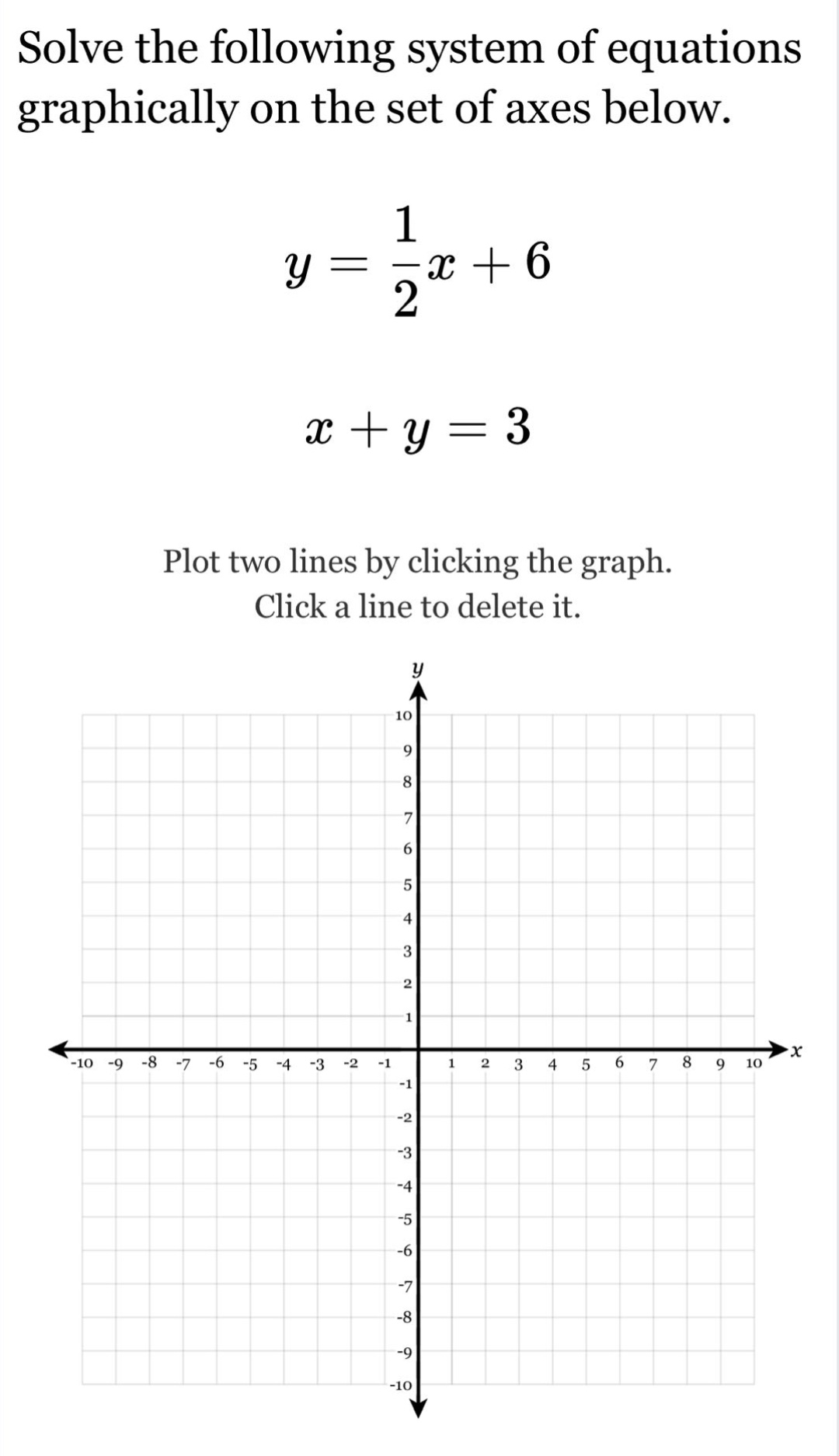
solve the following system of equations graphically on the set of axes below.
$y = \frac{1}{2}x + 6$
$x + y = 3$
plot two lines by clicking the graph.
click a line to delete it.
Step1: Analyze the first equation \( y = \frac{1}{2}x + 6 \)
This is in slope - intercept form \( y=mx + b \), where the slope \( m=\frac{1}{2} \) and the y - intercept \( b = 6 \). To graph this line, we start by plotting the y - intercept at the point \( (0,6) \). Then, using the slope (rise over run), from the point \( (0,6) \), we rise 1 unit and run 2 units to the right to get the next point \( (2,7) \), or we can go down 1 unit and run 2 units to the left to get \( (- 2,5) \).
Step2: Analyze the second equation \( x + y=3 \)
We can rewrite this equation in slope - intercept form (\( y=mx + b \)) by solving for \( y \). Subtract \( x \) from both sides: \( y=-x + 3 \). Here, the slope \( m=-1 \) and the y - intercept \( b = 3 \). We plot the y - intercept at \( (0,3) \). Then, using the slope (rise over run, since \( m=-1=\frac{- 1}{1} \)), from the point \( (0,3) \), we rise - 1 unit (or fall 1 unit) and run 1 unit to the right to get the point \( (1,2) \), or we can rise 1 unit and run 1 unit to the left to get \( (-1,4) \).
Step3: Find the intersection point
After plotting both lines, we look for the point where they intersect. To find the intersection algebraically (to confirm the graphical solution), we can set the two equations equal to each other:
\( \frac{1}{2}x+6=-x + 3 \)
Add \( x \) to both sides: \( \frac{1}{2}x+x+6=-x+x + 3 \)
\( \frac{3}{2}x+6 = 3 \)
Subtract 6 from both sides: \( \frac{3}{2}x+6 - 6=3 - 6 \)
\( \frac{3}{2}x=-3 \)
Multiply both sides by \( \frac{2}{3} \): \( x=-3\times\frac{2}{3}=-2 \)
Now substitute \( x = - 2 \) into one of the equations, say \( y=-x + 3 \). Then \( y=-(-2)+3=2 + 3=5 \)

Snap & solve any problem in the app
Get step-by-step solutions on Sovi AI
Photo-based solutions with guided steps
Explore more problems and detailed explanations
The solution to the system of equations is the point of intersection of the two lines, which is \( (-2,5) \)