QUESTION IMAGE
Question
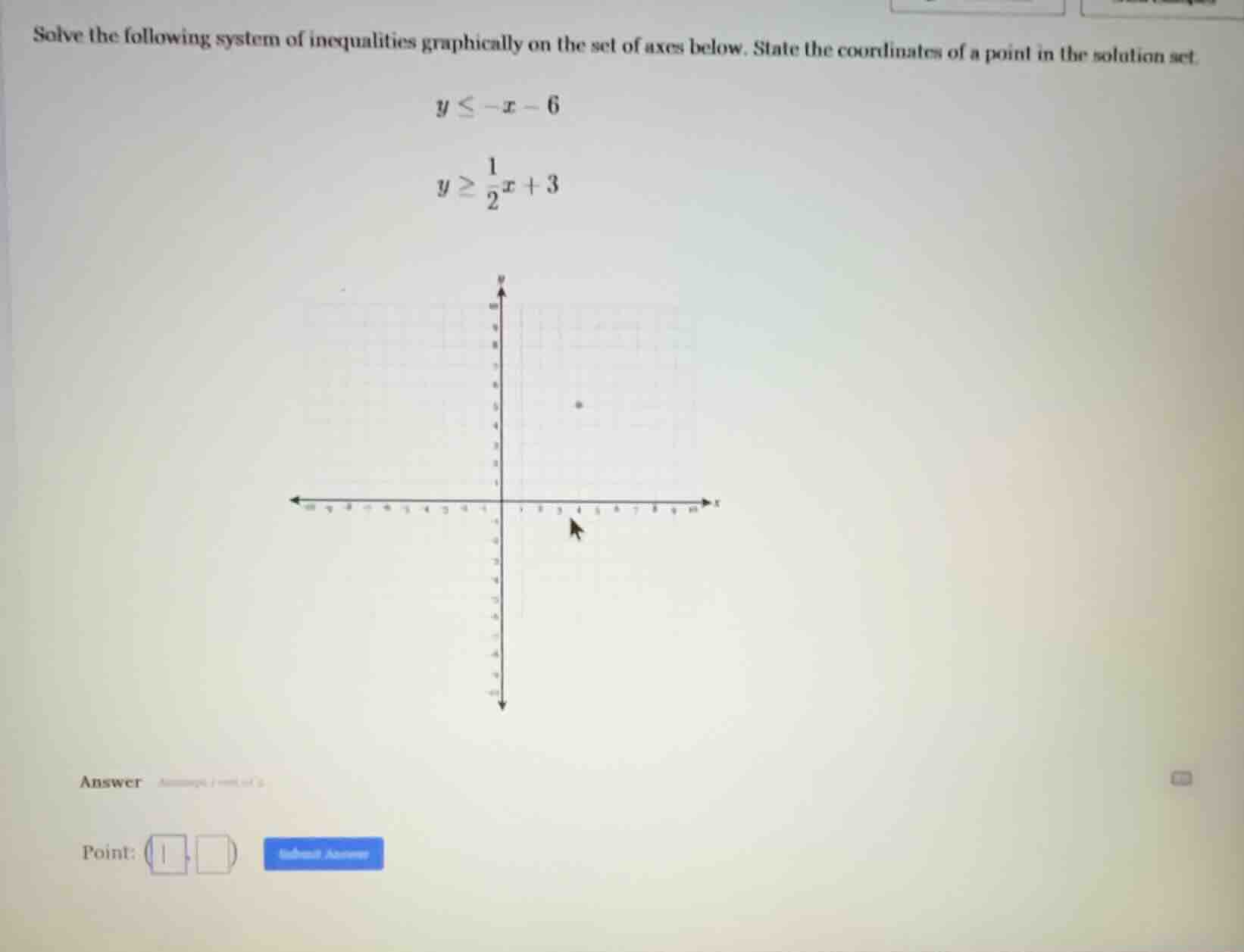
solve the following system of inequalities graphically on the set of axes below. state the coordinates of a point in the solution set.
$y \leq -x - 6$
$y \geq \frac{1}{2}x + 3$
answer
point: (\boxed{1}, \boxed{})
Step1: Find intersection of two lines
To find the solution set, first find the intersection of \( y = -x - 6 \) and \( y=\frac{1}{2}x + 3 \). Set them equal:
\[
-x - 6=\frac{1}{2}x + 3
\]
Multiply both sides by 2 to eliminate fraction:
\[
-2x - 12=x + 6
\]
Add \( 2x \) to both sides:
\[
-12 = 3x+6
\]
Subtract 6:
\[
-18 = 3x\implies x=-6
\]
Substitute \( x = -6 \) into \( y=-x - 6 \): \( y=-(-6)-6 = 0 \). So intersection is \( (-6,0) \).
Step2: Analyze inequalities
For \( y\leq -x - 6 \), the region is below the line (solid line, since \( \leq \)). For \( y\geq\frac{1}{2}x + 3 \), the region is above the line (solid line, since \( \geq \)). The solution set is the overlapping region.
Step3: Find a point in solution set
Let's test a point in the overlapping region. Let's take \( x=-6 \), \( y = 0 \) (the intersection point). Check both inequalities:
- For \( y\leq -x - 6 \): \( 0\leq -(-6)-6=0 \), true.
- For \( y\geq\frac{1}{2}x + 3 \): \( 0\geq\frac{1}{2}(-6)+3=-3 + 3=0 \), true.
Another point: Let's take \( x=-4 \). For \( y\leq -(-4)-6=-2 \), and \( y\geq\frac{1}{2}(-4)+3=-2 + 3 = 1 \). Wait, no, that's not overlapping. Wait, the overlapping region is where \( x\leq -6 \) (since the lines intersect at \( x=-6 \), and the slopes: first line has slope -1, second has \( 1/2 \), so the overlapping is to the left of \( x=-6 \)? Wait, no, wait when \( x < -6 \), let's take \( x=-8 \). For \( y\leq -(-8)-6 = 2 \), and \( y\geq\frac{1}{2}(-8)+3=-4 + 3=-1 \). So a point like \( (-8,0) \): check \( 0\leq -(-8)-6=2 \) (true), \( 0\geq\frac{1}{2}(-8)+3=-1 \) (true). Or the intersection point \( (-6,0) \) is in the solution set.

Snap & solve any problem in the app
Get step-by-step solutions on Sovi AI
Photo-based solutions with guided steps
Explore more problems and detailed explanations
Point: \((-6, 0)\) (Other valid points like \((-8, 0)\) also work, but \((-6,0)\) is the intersection and a clear solution.)