QUESTION IMAGE
Question
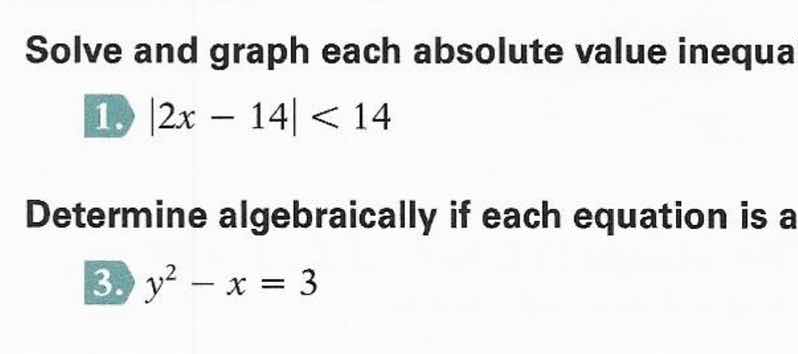
solve and graph each absolute value inequa
- (|2x - 14| < 14)
determine algebraically if each equation is a
- (y^2 - x = 3)
Problem 1: Solve \(|2x - 14| < 14\)
Step 1: Recall the absolute value inequality property
For \(|A| < B\) (where \(B>0\)), it is equivalent to \(-B < A < B\). So for \(|2x - 14| < 14\), we can write:
\(-14 < 2x - 14 < 14\)
Step 2: Add 14 to all parts of the inequality
Adding 14 to each part to isolate the term with \(x\):
\(-14 + 14 < 2x - 14 + 14 < 14 + 14\)
Simplifying each part:
\(0 < 2x < 28\)
Step 3: Divide all parts by 2
To solve for \(x\), divide each part of the inequality by 2:
\(\frac{0}{2} < \frac{2x}{2} < \frac{28}{2}\)
Simplifying gives:
\(0 < x < 14\)
Problem 3: Determine algebraically if \(y^2 - x = 3\) is a function (assuming the question is about whether it represents a function, typically we check the vertical line test or solve for \(y\) and see the number of outputs for an input)
Step 1: Solve the equation for \(y\)
Starting with \(y^2 - x = 3\), we can rearrange it to solve for \(y\):
\(y^2 = x + 3\)
Taking the square root of both sides, we get:
\(y=\pm\sqrt{x + 3}\)
Step 2: Analyze the number of outputs for a given input
For a relation to be a function, each input \(x\) (in the domain) must correspond to exactly one output \(y\). Let's take a value of \(x\) in the domain (e.g., \(x = 1\)). Then \(y^2=1 + 3=4\), so \(y = 2\) or \(y=- 2\). This means that for the input \(x = 1\), there are two different outputs (\(y = 2\) and \(y=-2\)). So the relation \(y^2 - x = 3\) does not represent a function.
Final Answers
- The solution to \(|2x - 14| < 14\) is \(0 < x < 14\) (in interval notation, \((0,14)\)).
- The equation \(y^2 - x = 3\) does not represent a function because a single input \(x\) (in the domain) can correspond to two different outputs \(y\) (e.g., for \(x = 1\), \(y = 2\) or \(y=-2\)).

Snap & solve any problem in the app
Get step-by-step solutions on Sovi AI
Photo-based solutions with guided steps
Explore more problems and detailed explanations
Problem 1: Solve \(|2x - 14| < 14\)
Step 1: Recall the absolute value inequality property
For \(|A| < B\) (where \(B>0\)), it is equivalent to \(-B < A < B\). So for \(|2x - 14| < 14\), we can write:
\(-14 < 2x - 14 < 14\)
Step 2: Add 14 to all parts of the inequality
Adding 14 to each part to isolate the term with \(x\):
\(-14 + 14 < 2x - 14 + 14 < 14 + 14\)
Simplifying each part:
\(0 < 2x < 28\)
Step 3: Divide all parts by 2
To solve for \(x\), divide each part of the inequality by 2:
\(\frac{0}{2} < \frac{2x}{2} < \frac{28}{2}\)
Simplifying gives:
\(0 < x < 14\)
Problem 3: Determine algebraically if \(y^2 - x = 3\) is a function (assuming the question is about whether it represents a function, typically we check the vertical line test or solve for \(y\) and see the number of outputs for an input)
Step 1: Solve the equation for \(y\)
Starting with \(y^2 - x = 3\), we can rearrange it to solve for \(y\):
\(y^2 = x + 3\)
Taking the square root of both sides, we get:
\(y=\pm\sqrt{x + 3}\)
Step 2: Analyze the number of outputs for a given input
For a relation to be a function, each input \(x\) (in the domain) must correspond to exactly one output \(y\). Let's take a value of \(x\) in the domain (e.g., \(x = 1\)). Then \(y^2=1 + 3=4\), so \(y = 2\) or \(y=- 2\). This means that for the input \(x = 1\), there are two different outputs (\(y = 2\) and \(y=-2\)). So the relation \(y^2 - x = 3\) does not represent a function.
Final Answers
- The solution to \(|2x - 14| < 14\) is \(0 < x < 14\) (in interval notation, \((0,14)\)).
- The equation \(y^2 - x = 3\) does not represent a function because a single input \(x\) (in the domain) can correspond to two different outputs \(y\) (e.g., for \(x = 1\), \(y = 2\) or \(y=-2\)).