QUESTION IMAGE
Question
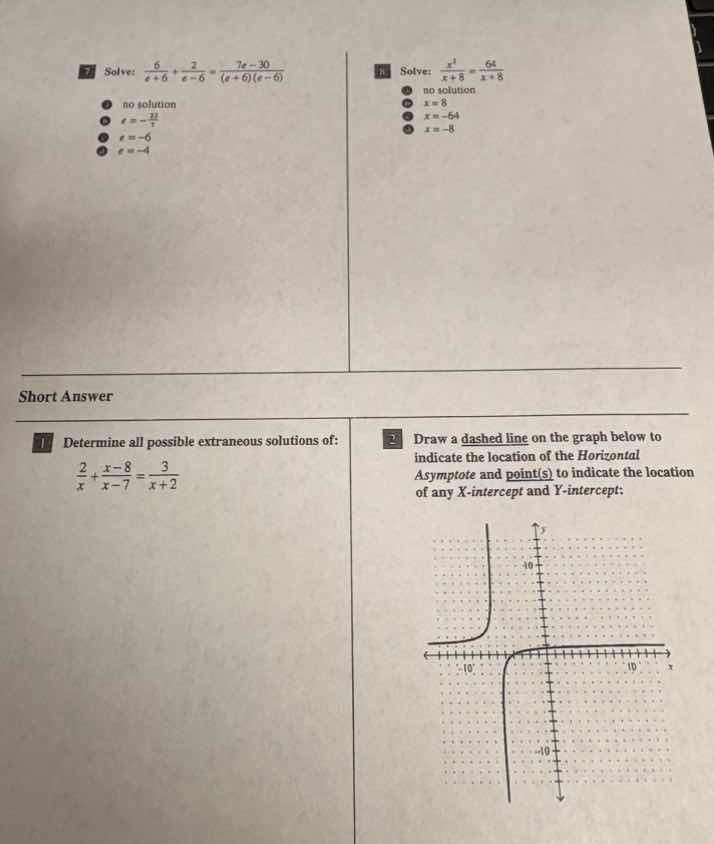
7 solve: $\frac{6}{e+6}+\frac{2}{e-6}=\frac{7e-30}{(e+6)(e-6)}$- no solution- $e = -\frac{21}{7}$- $e = -6$- $e = -4$8 solve: $\frac{x^2}{x+8}=\frac{64}{x+8}$- no solution- $x = 8$- $x = 64$- $x = -8$short answer1 determine all possible extraneous solutions of:$\frac{2}{x}+\frac{x-8}{x-7}=\frac{3}{x+2}$2 draw a dashed line on the graph below to indicate the location of the horizontal asymptote and point(s) to indicate the location of any x-intercept and y-intercept:
Problem 7
Step1: Find common denominator
The common denominator is $(e+6)(e-6)$. Multiply each term by it:
$$6(e-6) + 2(e+6) = 7e - 30$$
Step2: Expand and simplify left side
$$6e - 36 + 2e + 12 = 7e - 30$$
$$8e - 24 = 7e - 30$$
Step3: Isolate variable $e$
$$8e - 7e = -30 + 24$$
$$e = -6$$
Step4: Check for extraneous solutions
Substitute $e=-6$ into original equation: denominators $(e+6)=0$, which is undefined. So $e=-6$ is extraneous.
Step1: Multiply by common denominator
Common denominator is $x+8$. Multiply each term:
$$x^2 = 64$$
Step2: Solve quadratic equation
$$x^2 - 64 = 0$$
$$(x-8)(x+8)=0$$
$$x=8 \text{ or } x=-8$$
Step3: Check extraneous solutions
Substitute $x=-8$: denominator $x+8=0$, undefined. So $x=-8$ is extraneous.
Step1: Identify forbidden values
Extraneous solutions come from values that make original denominators zero. Set each denominator equal to 0:
$$x=0, \quad x-7=0, \quad x+2=0$$
Step2: Solve for $x$
$$x=0, x=7, x=-2$$

Snap & solve any problem in the app
Get step-by-step solutions on Sovi AI
Photo-based solutions with guided steps
Explore more problems and detailed explanations
no solution
---