QUESTION IMAGE
Question
solve polynomial equations
date hour
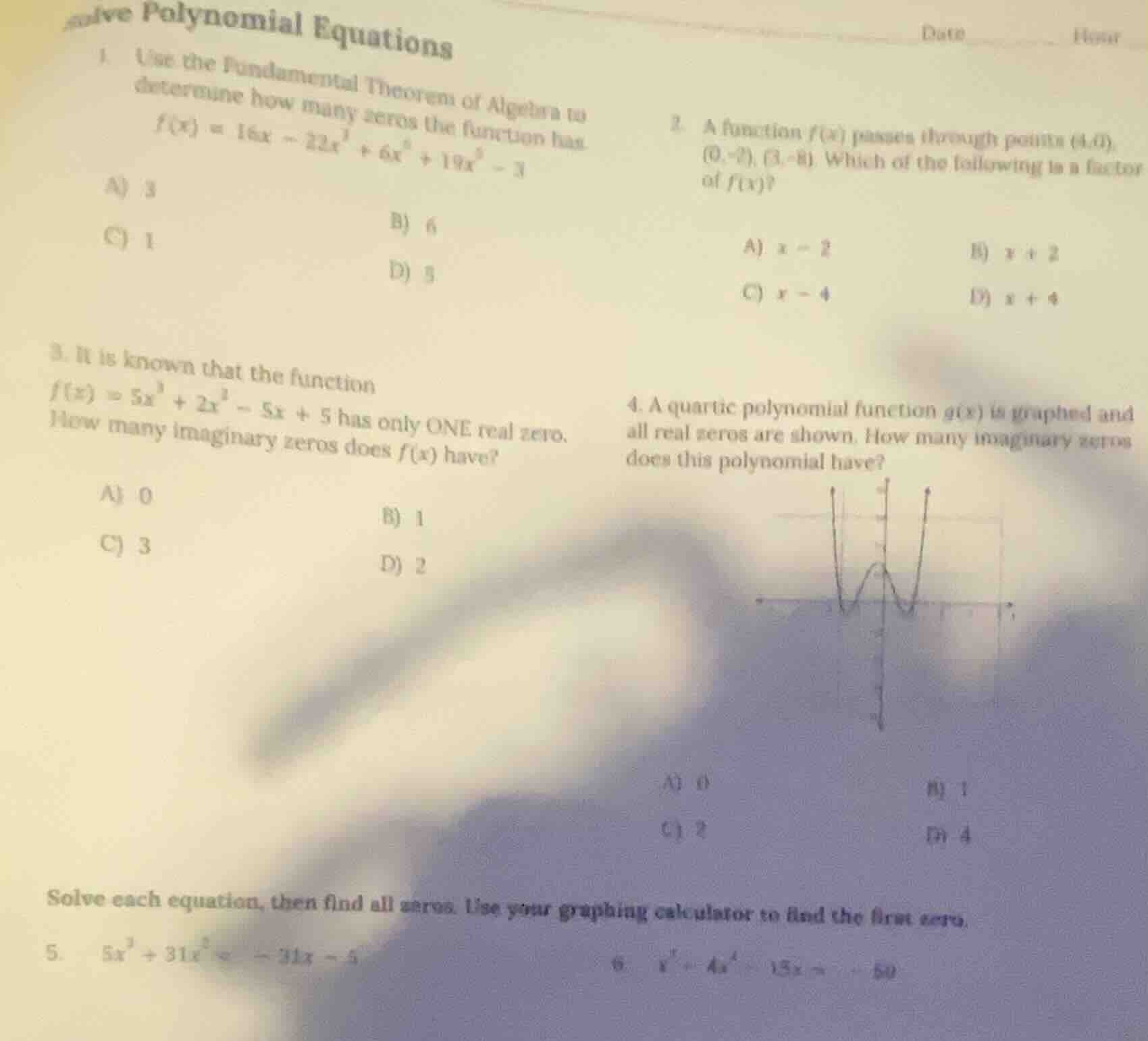
- use the fundamental theorem of algebra to determine how many zeros the function has.
$f(x) = 16x - 22x^3 + 6x^6 + 19x^5 - 3$
a) 3
b) 6
c) 1
d) 5
- a function $f(x)$ passes through points $(4,0)$, $(0,-2)$, $(3,-8)$. which of the following is a factor of $f(x)$?
a) $x - 2$
b) $x + 2$
c) $x - 4$
d) $x + 4$
- it is known that the function $f(x) = 5x^3 + 2x^2 - 5x + 5$ has only one real zero. how many imaginary zeros does $f(x)$ have?
a) 0
b) 1
c) 3
d) 2
- a quartic polynomial function $g(x)$ is graphed and all real zeros are shown. how many imaginary zeros does this polynomial have?
a) 0
b) 1
c) 2
d) 4
solve each equation, then find all zeros. use your graphing calculator to find the first zero.
- $5x^3 + 31x^2 = -31x - 5$
- $x^3 - 4x^2 - 15x = -50$
Step1: Identify polynomial degree
The function $f(x)=16x - 22x^3 + 6x^6 + 19x^5 - 3$ has a highest power of $x^6$, so degree $n=6$. By the Fundamental Theorem of Algebra, the number of zeros (counting multiplicities) equals the degree.
Step2: Apply Factor Theorem
For a point $(a,0)$ on $f(x)$, $x-a$ is a factor. The function passes through $(4,0)$, so $x-4$ is a factor.
Step3: Calculate imaginary zeros
The cubic function $f(x)=5x^3+2x^2-5x+5$ has degree 3, so total zeros = 3. With 1 real zero, imaginary zeros = $3-1=2$.
Step4: Find imaginary zeros of quartic
A quartic polynomial has degree 4, so total zeros = 4. The graph crosses/touches the x-axis 2 times, so 2 real zeros. Imaginary zeros = $4-2=2$.
Step5: Rearrange and factor cubic
Rearrange $5x^3 + 31x^2 + 31x + 5 = 0$. Use rational root theorem: $x=-1$ is a root. Factor out $(x+1)$:
$$(x+1)(5x^2+26x+5)=0$$
Factor quadratic: $5x^2+26x+5=(5x+1)(x+5)$
Solve for zeros: $x=-1, x=-\frac{1}{5}, x=-5$
Step6: Rearrange and factor quartic
Rearrange $x^3 - 4x^2 -15x + 50 = 0$. Use rational root theorem: $x=2$ is a root. Factor out $(x-2)$:
$$(x-2)(x^2-2x-25)=0$$
Solve quadratic with quadratic formula $x=\frac{-b\pm\sqrt{b^2-4ac}}{2a}$ where $a=1,b=-2,c=-25$:
$$x=\frac{2\pm\sqrt{4+100}}{2}=\frac{2\pm\sqrt{104}}{2}=1\pm\sqrt{26}$$
Zeros: $x=2, x=1+\sqrt{26}, x=1-\sqrt{26}$

Snap & solve any problem in the app
Get step-by-step solutions on Sovi AI
Photo-based solutions with guided steps
Explore more problems and detailed explanations
- B) 6
- C) $x - 4$
- D) 2
- C) 2
- $x=-5,\ x=-1,\ x=-\frac{1}{5}$
- $x=2,\ x=1+\sqrt{26},\ x=1-\sqrt{26}$