QUESTION IMAGE
Question
to solve real-life problems. (standards: g.co.2, g.co.4, g.co.5, g.co.6)
explain 1a performing translations
□ visit bim.easyaccessmaterials.com, read integrated mathematics 1 lesson 11.1, then read the section below.
teacher voice – having both magnitude (size) and direction, vectors are shown in the coordinate as arrows between two points.
vectors
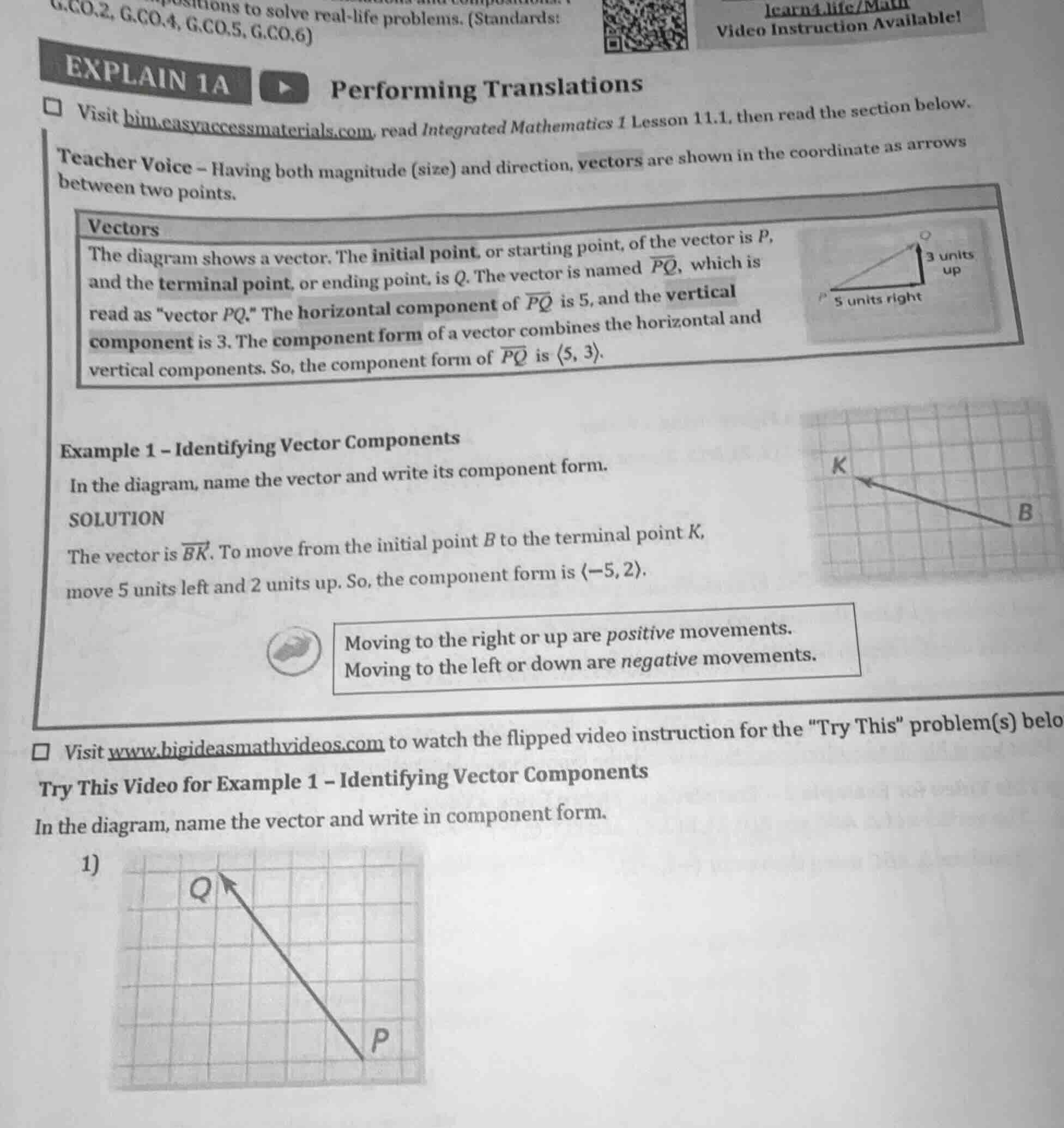
the diagram shows a vector. the initial point, or starting point, of the vector is p, and the terminal point, or ending point, is q. the vector is named \\(\overline{pq}\\), which is read as \vector pq.\ the horizontal component of \\(\overline{pq}\\) is 5, and the vertical component is 3. the component form of a vector combines the horizontal and vertical components. so, the component form of \\(\overline{pq}\\) is \\(\langle 5, 3 \
angle\\).
example 1 – identifying vector components
in the diagram, name the vector and write its component form.
solution
the vector is \\(\overline{bk}\\). to move from the initial point b to the terminal point k, move 5 units left and 2 units up. so, the component form is \\(\langle -5, 2 \
angle\\).
□ visit www.bigideasmathvideos.com to watch the flipped video instruction for the \try this\ problem(s) belo
try this video for example 1 – identifying vector components
in the diagram, name the vector and write in component form.
1)
Step1: Name the vector
The initial point is $P$, terminal point is $Q$, so the vector is $\overrightarrow{PQ}$.
Step2: Find horizontal component
From $P$ to $Q$, move 3 units left (negative direction): $-3$
Step3: Find vertical component
From $P$ to $Q$, move 4 units up (positive direction): $4$
Step4: Write component form
Combine horizontal and vertical components: $\langle -3, 4
angle$

Snap & solve any problem in the app
Get step-by-step solutions on Sovi AI
Photo-based solutions with guided steps
Explore more problems and detailed explanations
The vector is $\overrightarrow{PQ}$, and its component form is $\langle -3, 4
angle$