QUESTION IMAGE
Question
solve for x.
view solution history
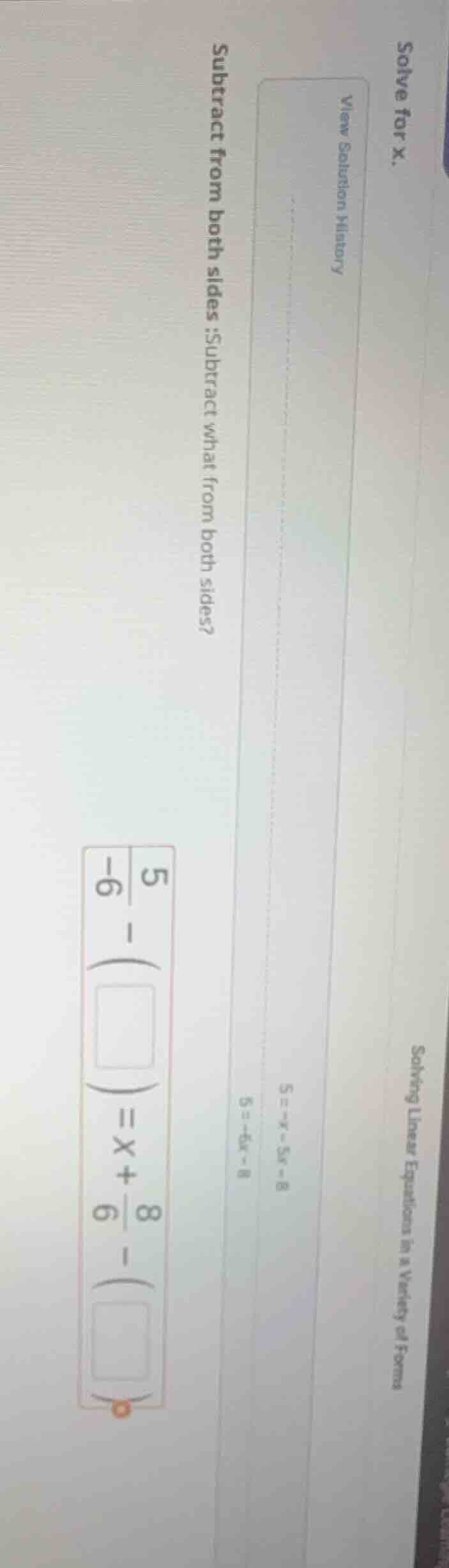
subtract from both sides: subtract what from both sides?
solving linear equations in a variety of forms
5 = -x + 5x + 8
5 = 4x + 8
(equation with blanks: \\(\frac{5}{-6} - (\square) = x + \frac{8}{6} - (\square)\\))
Step1: Identify target term to isolate x
We start with the simplified equation: $5 = -6x - 8$. To isolate the term with $x$, we first eliminate the constant $-8$ from the right side.
Step2: Add 8 to both sides (equivalent to subtracting -8)
To cancel $-8$ on the right, we add 8 to both sides, which is the same as subtracting $-8$ from both sides.
$\frac{5}{-6} - (-8) = x + \frac{8}{-6} - (-8)$
Step3: Confirm the missing values
The operation requires subtracting $-8$ (or adding 8) from both sides, so the empty boxes are filled with $-8$.

Snap & solve any problem in the app
Get step-by-step solutions on Sovi AI
Photo-based solutions with guided steps
Explore more problems and detailed explanations
The values to fill in the boxes (from left to right) are $\boldsymbol{-8}$ and $\boldsymbol{-8}$ (we subtract $-8$ from both sides, which is equivalent to adding 8 to both sides to solve for $x$).
For the full solution of $x$:
Step1: Start with simplified equation
$5 = -6x - 8$
Step2: Add 8 to both sides
$5 + 8 = -6x - 8 + 8$
$13 = -6x$
Step3: Solve for x
$x = \frac{13}{-6} = -\frac{13}{6}$
Final value of $x$: $-\frac{13}{6}$