QUESTION IMAGE
Question
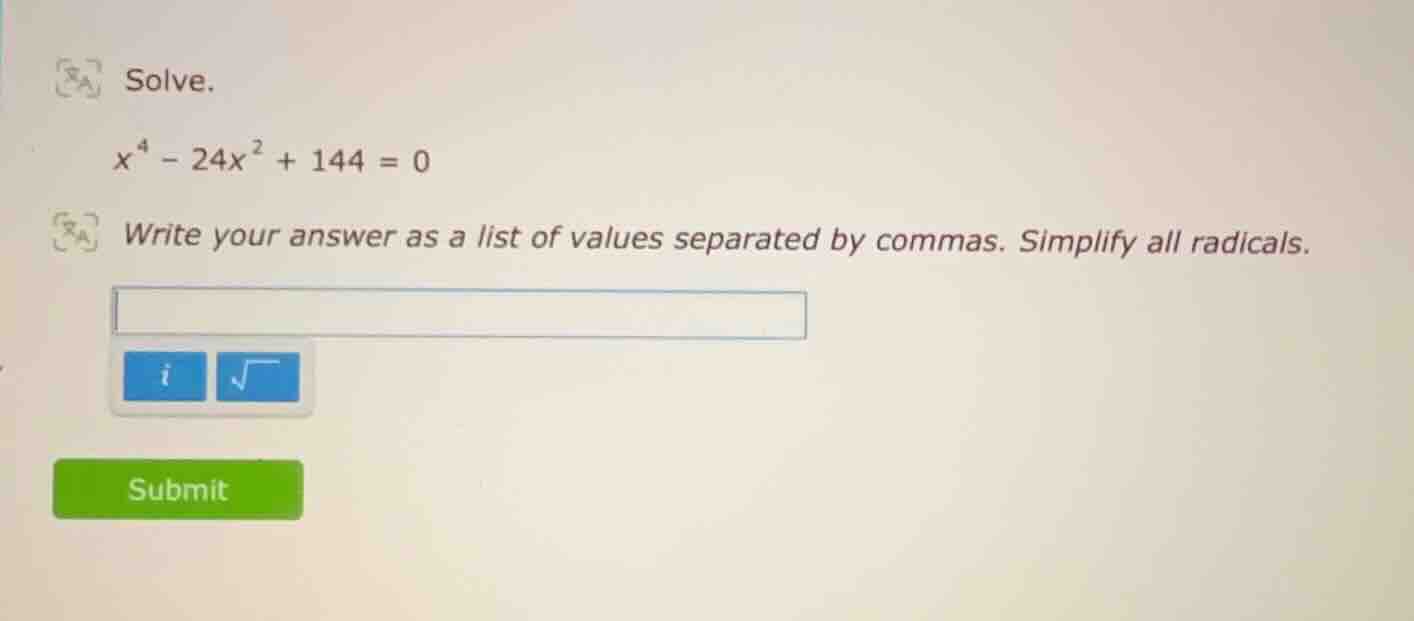
solve.
$x^{4}-24x^{2}+144 = 0$
write your answer as a list of values separated by commas. simplify all radicals.
Step1: Let \( y = x^2 \), rewrite the equation.
The equation \( x^4 - 24x^2 + 144 = 0 \) can be rewritten as \( y^2 - 24y + 144 = 0 \) by substituting \( y = x^2 \).
Step2: Solve the quadratic equation for \( y \).
We recognize that \( y^2 - 24y + 144 \) is a perfect square trinomial, since \( (-12)^2=144 \) and \( 2\times(-12)\times y=-24y \). So, \( y^2 - 24y + 144=(y - 12)^2 \).
Setting \( (y - 12)^2 = 0 \), we get \( y - 12 = 0 \), so \( y = 12 \).
Step3: Substitute back \( y = x^2 \) and solve for \( x \).
Since \( y = x^2 = 12 \), we solve for \( x \) by taking the square root of both sides. So, \( x=\pm\sqrt{12} \). Simplifying \( \sqrt{12} \), we know that \( 12 = 4\times3 \), so \( \sqrt{12}=\sqrt{4\times3}=2\sqrt{3} \). Thus, \( x = 2\sqrt{3}, - 2\sqrt{3} \). But we should also check if there are repeated roots. Since the original equation is a quartic (degree 4) and we had a repeated root for \( y \) (double root at \( y = 12 \)), when we solve \( x^2=12 \), each solution for \( x \) is also a double root? Wait, no. Wait, the quadratic in \( y \) was \( (y - 12)^2=0 \), so \( y = 12 \) is a double root. Then \( x^2=12 \) gives \( x=\pm\sqrt{12} \), and each of these is a root of multiplicity 2? Wait, let's check the original equation. Let's plug \( x = 2\sqrt{3} \) into \( x^4-24x^2 + 144 \). \( (2\sqrt{3})^4-24\times(2\sqrt{3})^2+144=(16\times9)-24\times(4\times3)+144 = 144-288 + 144=0 \). Similarly for \( x=-2\sqrt{3} \). But actually, since the equation in \( y \) had a double root, the original quartic equation has roots \( x = 2\sqrt{3},2\sqrt{3},-2\sqrt{3},-2\sqrt{3} \)? Wait, no, wait. Wait, the substitution \( y=x^2 \), so when we have \( (y - 12)^2=0 \), that means \( y = 12 \) is a root of multiplicity 2. Then \( x^2=12 \) is equivalent to \( x^2-12 = 0 \), which factors as \( (x - \sqrt{12})(x+\sqrt{12})=0 \), but since \( y - 12=(x^2 - 12)=(x - \sqrt{12})(x+\sqrt{12}) \), so \( (y - 12)^2=(x^2 - 12)^2=(x - \sqrt{12})^2(x+\sqrt{12})^2 \). So the roots of the original equation are \( x = \sqrt{12}, \sqrt{12}, -\sqrt{12}, -\sqrt{12} \), which simplifies to \( x = 2\sqrt{3},2\sqrt{3},-2\sqrt{3},-2\sqrt{3} \). But when we write the solution as a list of values (with duplicates or not? The problem says "write your answer as a list of values separated by commas". It doesn't specify to remove duplicates, but usually, for polynomial equations, we can list the roots with their multiplicities or just the distinct roots? Wait, let's check the problem statement: "Write your answer as a list of values separated by commas. Simplify all radicals." So probably, we can list the distinct roots, but actually, in the equation \( x^4-24x^2 + 144 = 0 \), the roots are \( 2\sqrt{3},2\sqrt{3},-2\sqrt{3},-2\sqrt{3} \), but when we solve \( x^2 = 12 \), we get \( x=\pm2\sqrt{3} \), and since the original equation is a perfect square of a quadratic, \( (x^2 - 12)^2=0 \), so the roots are \( x = 2\sqrt{3} \) (multiplicity 2) and \( x=-2\sqrt{3} \) (multiplicity 2). But the problem says "write your answer as a list of values separated by commas". So maybe we can write the distinct roots, but let's see: if we consider that when we solve \( x^2=12 \), we have two solutions, each with multiplicity 2, but the problem might just want the distinct solutions. Wait, let's re - examine the steps.
Wait, step 2: the quadratic in \( y \) is \( y^2-24y + 144=(y - 12)^2 \), so \( y = 12 \) (double root). Then \( x^2=12 \), so \( x=\pm\sqrt{12}=\pm2\sqrt{3} \). So the solutions for \( x \) are \( 2\sqrt{3}, - 2\sqrt{3} \), but each of these is…

Snap & solve any problem in the app
Get step-by-step solutions on Sovi AI
Photo-based solutions with guided steps
Explore more problems and detailed explanations
\( 2\sqrt{3}, - 2\sqrt{3} \)