QUESTION IMAGE
Question
solving equations containing two radicals
solving equations containing two radicals
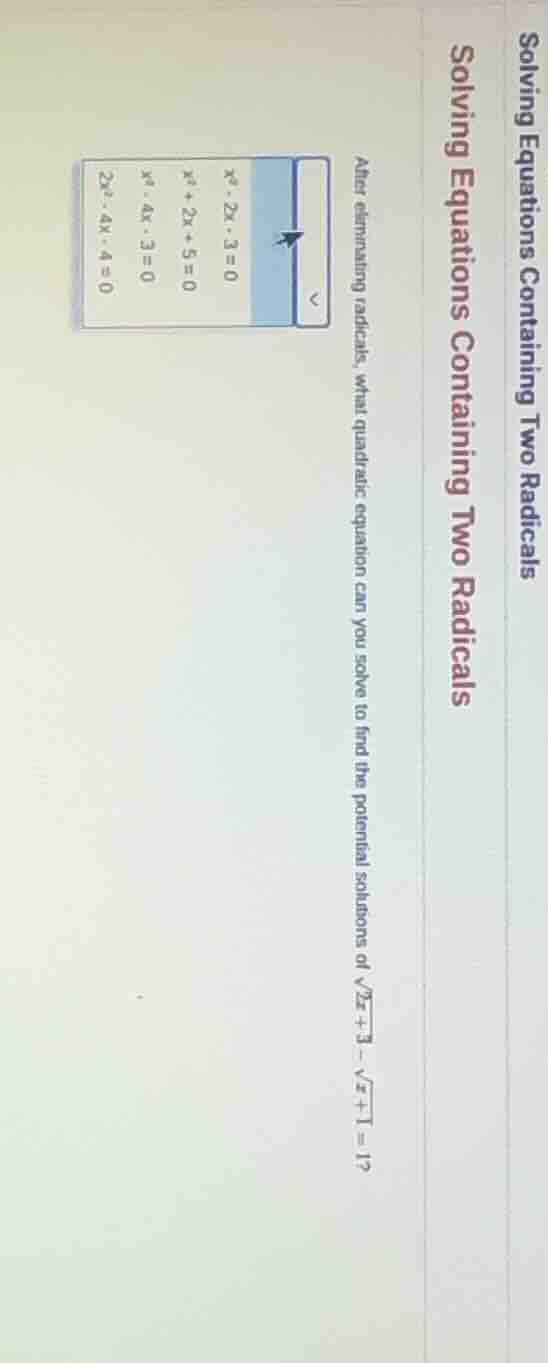
after eliminating radicals, what quadratic equation can you solve to find the potential solutions of $sqrt{2x+3}-sqrt{x+1}=1$
$x^2 - 2x - 3 = 0$
$x^2 + 2x + 5 = 0$
$x^2 - 4x - 3 = 0$
$2x^2 - 4x - 4 = 0$
Step1: Isolate one radical
$\sqrt{2x+3} = \sqrt{x+1} + 1$
Step2: Square both sides
$(\sqrt{2x+3})^2 = (\sqrt{x+1} + 1)^2$
$2x+3 = (x+1) + 2\sqrt{x+1} + 1$
Step3: Simplify and isolate remaining radical
$2x+3 = x+2 + 2\sqrt{x+1}$
$x+1 = 2\sqrt{x+1}$
Step4: Square both sides again
$(x+1)^2 = (2\sqrt{x+1})^2$
$x^2 + 2x + 1 = 4(x+1)$
Step5: Simplify to quadratic
$x^2 + 2x + 1 = 4x + 4$
$x^2 - 2x - 3 = 0$

Snap & solve any problem in the app
Get step-by-step solutions on Sovi AI
Photo-based solutions with guided steps
Explore more problems and detailed explanations
$x^2 - 2x - 3 = 0$