QUESTION IMAGE
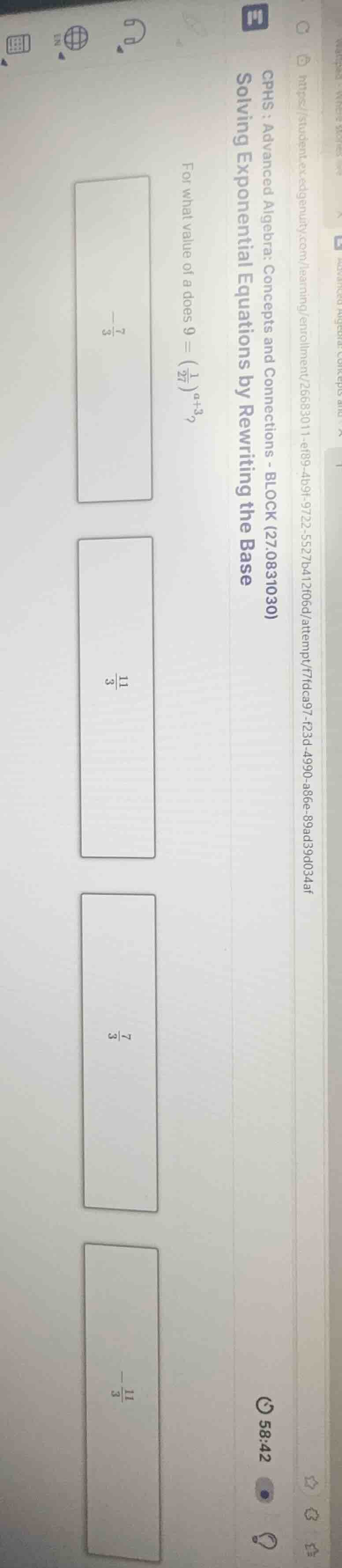
Question
solving exponential equations by rewriting the base cphs : advanced algebra: concepts and connections - block (27.0831030) for what value of a does 9 = \\((\frac{1}{27})^{a + 3}\\)? \\(-\frac{7}{3}\\) \\(\frac{11}{3}\\) \\(\frac{7}{3}\\) \\(-\frac{11}{3}\\)
Step1: Rewrite bases as powers of 3
We know that \(9 = 3^2\) and \(\frac{1}{27}=3^{-3}\) (since \(27 = 3^3\), so \(\frac{1}{27}=3^{-3}\)). Substitute these into the equation:
\(3^2=(3^{-3})^{a + 3}\)
Step2: Simplify the right - hand side
Using the power - of - a - power rule \((x^m)^n=x^{mn}\), we have \((3^{-3})^{a + 3}=3^{-3(a + 3)}\). So the equation becomes:
\(3^2 = 3^{-3(a + 3)}\)
Step3: Set the exponents equal
Since the bases are the same and the exponential function \(y = 3^x\) is one - to - one (if \(3^m=3^n\), then \(m = n\)), we can set the exponents equal to each other:
\(2=-3(a + 3)\)
Step4: Solve for \(a\)
First, divide both sides of the equation by \(-3\):
\(\frac{2}{-3}=a + 3\)
\(-\frac{2}{3}=a + 3\)
Then, subtract 3 from both sides. We can write 3 as \(\frac{9}{3}\), so:
\(a=-\frac{2}{3}-\frac{9}{3}\)
\(a =-\frac{11}{3}\)

Snap & solve any problem in the app
Get step-by-step solutions on Sovi AI
Photo-based solutions with guided steps
Explore more problems and detailed explanations
\(-\frac{11}{3}\)