QUESTION IMAGE
Question
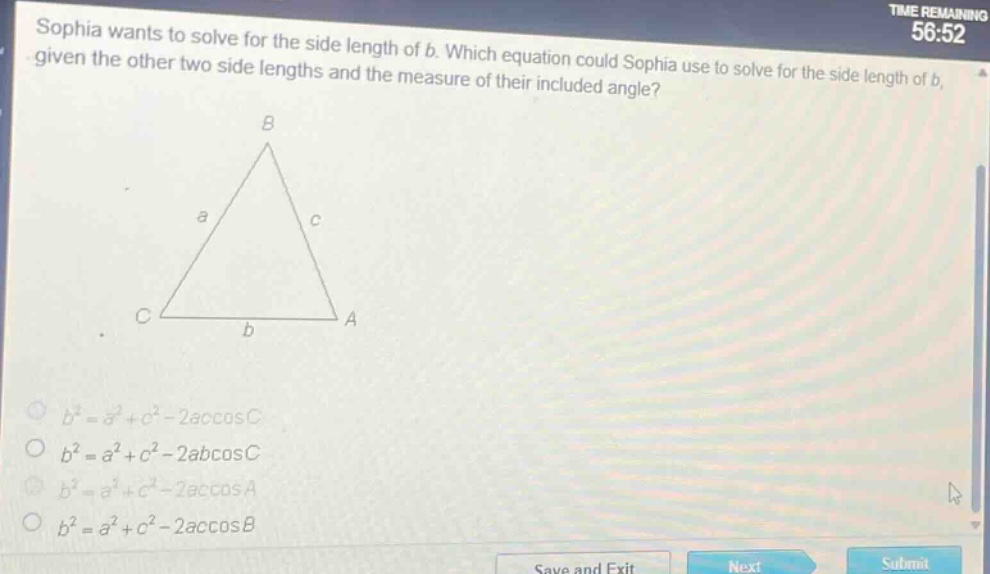
sophia wants to solve for the side length of ( b ). which equation could sophia use to solve for the side length of ( b ), given the other two side lengths and the measure of their included angle? ( b^2 = a^2 + c^2 - 2accos c ) ( b^2 = a^2 + c^2 - 2abcos c ) ( b^2 = a^2 + c^2 - 2accos a ) ( b^2 = a^2 + c^2 - 2accos b )
Step1: Recall the Law of Cosines
The Law of Cosines relates the lengths of the sides of a triangle to the cosine of one of its angles. The formula is \( b^2 = a^2 + c^2 - 2ac\cos B \) when we want to find side \( b \) and the included angle is \( B \) (between sides \( a \) and \( c \)). Wait, let's check the triangle labeling. In the triangle, side \( b \) is opposite angle \( B \)? Wait, no, the triangle has vertices \( A \), \( B \), \( C \), with side \( a \) opposite \( A \), side \( b \) opposite \( B \), side \( c \) opposite \( C \)? Wait, no, looking at the diagram: side \( b \) is between \( C \) and \( A \), so the angle included between sides \( a \) and \( c \) is angle \( B \)? Wait, no, let's re-examine. The sides: side \( a \) is from \( C \) to \( B \), side \( c \) is from \( A \) to \( B \), and side \( b \) is from \( C \) to \( A \). So the included angle between sides \( a \) and \( c \) is angle \( B \) (at vertex \( B \)). Wait, no, the included angle for sides \( a \) and \( c \) (which are adjacent to angle \( B \)) would be angle \( B \). But the Law of Cosines formula for side \( b \) (opposite angle \( B \)) is \( b^2 = a^2 + c^2 - 2ac\cos B \). Wait, but let's check the options. Wait, the first option: \( b^2 = a^2 + c^2 - 2ac\cos C \). Let's see: angle \( C \) is at vertex \( C \), between sides \( a \) (from \( C \) to \( B \)) and \( b \) (from \( C \) to \( A \)). Wait, no, maybe I mixed up. Wait, the Law of Cosines is: for any triangle with sides \( a \), \( b \), \( c \) opposite angles \( A \), \( B \), \( C \) respectively, \( c^2 = a^2 + b^2 - 2ab\cos C \), \( a^2 = b^2 + c^2 - 2bc\cos A \), \( b^2 = a^2 + c^2 - 2ac\cos B \). Wait, but in the problem, we need to find side \( b \), given the other two sides \( a \) and \( c \), and their included angle. The included angle between sides \( a \) and \( c \) is angle \( B \) (since \( a \) is \( CB \), \( c \) is \( AB \), so the angle between them is at \( B \)). So the formula should be \( b^2 = a^2 + c^2 - 2ac\cos B \), which is the last option? Wait, no, let's check the options again. Wait, the options are:
- \( b^2 = a^2 + c^2 - 2ac\cos C \)
- \( b^2 = a^2 + c^2 - 2ab\cos C \)
- \( b^2 = a^2 + c^2 - 2ac\cos A \)
- \( b^2 = a^2 + c^2 - 2ac\cos B \)
Wait, maybe I mislabeled the sides. Let's look at the diagram: side \( b \) is \( CA \), side \( a \) is \( CB \), side \( c \) is \( AB \). So angle at \( C \) is between sides \( a \) (CB) and \( b \) (CA). Angle at \( A \) is between sides \( c \) (AB) and \( b \) (CA). Angle at \( B \) is between sides \( a \) (CB) and \( c \) (AB). So to find side \( b \) (CA), the two sides adjacent to the included angle: the sides forming the included angle with \( b \) would be \( a \) (CB) and \( c \) (AB)? No, wait, side \( b \) is between \( C \) and \( A \), so the included angle for sides \( a \) (from \( C \) to \( B \)) and \( c \) (from \( A \) to \( B \)) is angle \( B \) (at \( B \)). So the included angle between \( a \) and \( c \) is angle \( B \), so the Law of Cosines for side \( b \) (opposite angle \( B \)) is \( b^2 = a^2 + c^2 - 2ac\cos B \), which is the fourth option. Wait, but let's check the options again. Wait, the fourth option is \( b^2 = a^2 + c^2 - 2ac\cos B \). So that's the correct formula. Wait, but let's verify with the Law of Cosines. The Law of Cosines states that for a triangle with sides \( a \), \( b \), \( c \) opposite angles \( A \), \( B \), \( C \) respectively, \( b^2 = a^2 + c^2 - 2ac\cos B \). So in this case, side \( b \) is opposite angle \( B \), and the…

Snap & solve any problem in the app
Get step-by-step solutions on Sovi AI
Photo-based solutions with guided steps
Explore more problems and detailed explanations
\( b^2 = a^2 + c^2 - 2ac\cos B \) (the fourth option: \( b^2 = a^2 + c^2 - 2ac\cos B \))