QUESTION IMAGE
Question
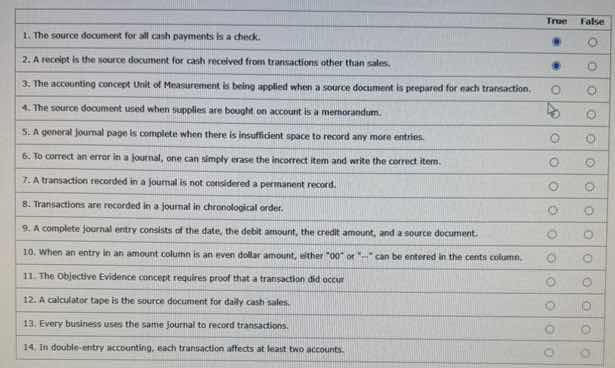
- the source document for all cash payments is a check. true false
- a receipt is the source document for cash received from transactions other than sales.
- the accounting concept unit of measurement is being applied when a source document is prepared for each transaction.
- the source document used when supplies are bought on account is a memorandum.
- a general journal page is complete when there is insufficient space to record any more entries.
- to correct an error in a journal, one can simply erase the incorrect item and write the correct item.
- a transaction recorded in a journal is not considered a permanent record.
- transactions are recorded in a journal in chronological order.
- a complete journal entry consists of the date, the debit amount, the credit amount, and a source document.
- when an entry in an account requires an even dollar amount, either \00\ or \ - \ can be entered in the cents column.
- the objective evidence concept is proof that a transaction did occur
- a calculator tape is the source document for daily cash sales.
- every business uses the same journal to record transactions.
- in double - entry accounting, each transaction affects at least two accounts.
Response
To solve these true - false accounting questions, we'll analyze each one based on accounting concepts and source documents:
Question 1
- Explanation: Checks are used for cash payments, but there are other forms of cash payments (like petty cash vouchers for small amounts). So the statement "The source document for all cash payments is a check" is false.
- Answer: False
Question 2
- Explanation: A receipt is the proper source document for cash received from non - sales transactions (e.g., receiving a refund or a loan). So this statement is true.
- Answer: True
Question 3
- Explanation: The "Unit of Measurement" concept is about using a monetary unit (like dollars) for recording. Preparing a source document for each transaction is related to the "Objective Evidence" or "Documentation" concept, not Unit of Measurement. So this statement is false.
- Answer: False
Question 4
- Explanation: When supplies are bought on account, an invoice (not a memorandum) is the source document. A memorandum is more for internal notes. So this statement is false.
- Answer: False
Question 5
- Explanation: A general journal page is complete when it's filled (based on the page's capacity for entries), not just when there's insufficient space for one more entry. So this statement is false.
- Answer: False
Question 6
- Explanation: In accounting, we don't erase journal entries (to maintain an audit trail). We use correcting entries. So this statement is false.
- Answer: False
Question 7
- Explanation: A journal is a permanent record of transactions. So the statement "A transaction recorded in a journal is not considered a permanent record" is false.
- Answer: False
Question 8
- Explanation: Journals record transactions in the order they occur (chronological order). So this statement is true.
- Answer: True
Question 9
- Explanation: A complete journal entry has the date, debit amount, credit amount, and a description (not necessarily the source document in the entry itself, though the source document is used to create the entry). So this statement is false.
- Answer: False
Question 10
- Explanation: In an evidence column, we put the source document reference (like a check number), not "00" or "-". So this statement is false.
- Answer: False
Question 11
- Explanation: The "Objective Evidence" concept means there must be proof (like a receipt, invoice) that a transaction occurred. So this statement is true.
- Answer: True
Question 12
- Explanation: A calculator tape from daily cash sales can serve as a source document (showing the total cash received). So this statement is true.
- Answer: True
Question 13
- Explanation: Different businesses may use different journals (e.g., special journals like sales journal, purchases journal, or just a general journal). So the statement "Every business uses the same journal to record transactions" is false.
- Answer: False
Question 14
- Explanation: In double - entry accounting, every transaction has at least one debit and one credit, so it affects at least two accounts. So this statement is true.
- Answer: True
Final Answers (in order of questions 1 - 14)
- False
- True
- False
- False
- False
- False
- False
- True
- False
- False
- True
- True
- False
- True

Snap & solve any problem in the app
Get step-by-step solutions on Sovi AI
Photo-based solutions with guided steps
Explore more problems and detailed explanations
To solve these true - false accounting questions, we'll analyze each one based on accounting concepts and source documents:
Question 1
- Explanation: Checks are used for cash payments, but there are other forms of cash payments (like petty cash vouchers for small amounts). So the statement "The source document for all cash payments is a check" is false.
- Answer: False
Question 2
- Explanation: A receipt is the proper source document for cash received from non - sales transactions (e.g., receiving a refund or a loan). So this statement is true.
- Answer: True
Question 3
- Explanation: The "Unit of Measurement" concept is about using a monetary unit (like dollars) for recording. Preparing a source document for each transaction is related to the "Objective Evidence" or "Documentation" concept, not Unit of Measurement. So this statement is false.
- Answer: False
Question 4
- Explanation: When supplies are bought on account, an invoice (not a memorandum) is the source document. A memorandum is more for internal notes. So this statement is false.
- Answer: False
Question 5
- Explanation: A general journal page is complete when it's filled (based on the page's capacity for entries), not just when there's insufficient space for one more entry. So this statement is false.
- Answer: False
Question 6
- Explanation: In accounting, we don't erase journal entries (to maintain an audit trail). We use correcting entries. So this statement is false.
- Answer: False
Question 7
- Explanation: A journal is a permanent record of transactions. So the statement "A transaction recorded in a journal is not considered a permanent record" is false.
- Answer: False
Question 8
- Explanation: Journals record transactions in the order they occur (chronological order). So this statement is true.
- Answer: True
Question 9
- Explanation: A complete journal entry has the date, debit amount, credit amount, and a description (not necessarily the source document in the entry itself, though the source document is used to create the entry). So this statement is false.
- Answer: False
Question 10
- Explanation: In an evidence column, we put the source document reference (like a check number), not "00" or "-". So this statement is false.
- Answer: False
Question 11
- Explanation: The "Objective Evidence" concept means there must be proof (like a receipt, invoice) that a transaction occurred. So this statement is true.
- Answer: True
Question 12
- Explanation: A calculator tape from daily cash sales can serve as a source document (showing the total cash received). So this statement is true.
- Answer: True
Question 13
- Explanation: Different businesses may use different journals (e.g., special journals like sales journal, purchases journal, or just a general journal). So the statement "Every business uses the same journal to record transactions" is false.
- Answer: False
Question 14
- Explanation: In double - entry accounting, every transaction has at least one debit and one credit, so it affects at least two accounts. So this statement is true.
- Answer: True
Final Answers (in order of questions 1 - 14)
- False
- True
- False
- False
- False
- False
- False
- True
- False
- False
- True
- True
- False
- True