QUESTION IMAGE
Question
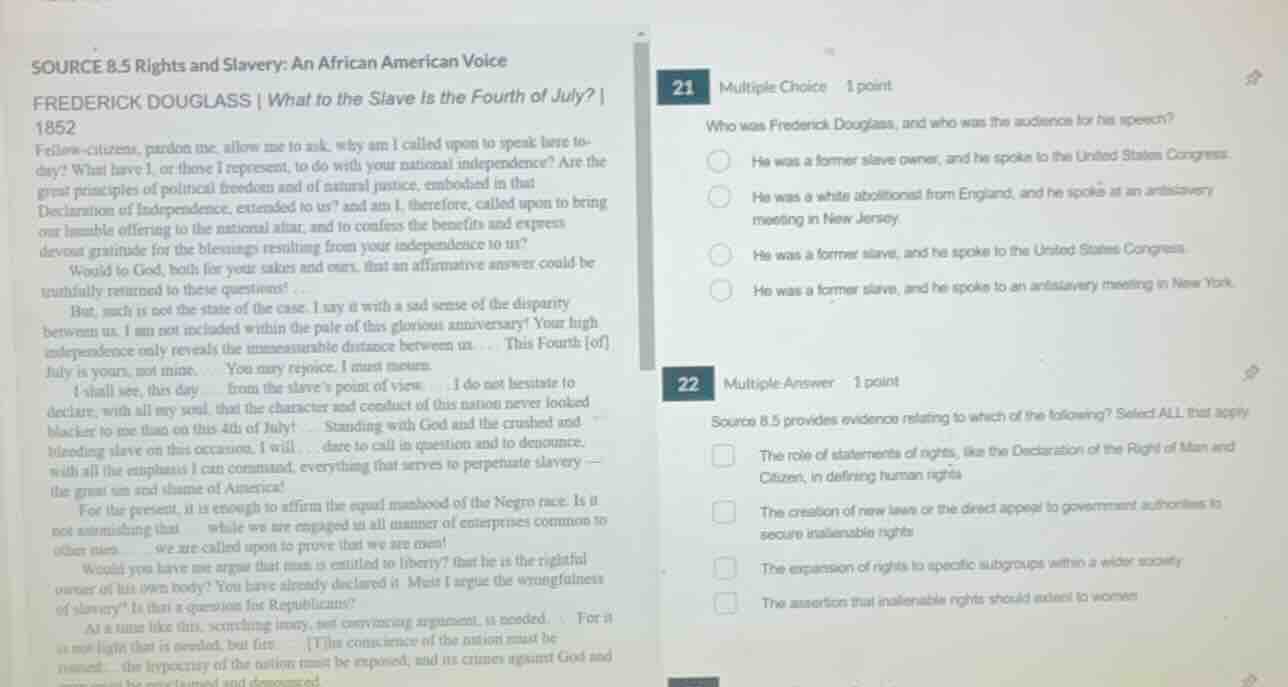
source 8.5 rights and slavery: an african american voice frederick douglass | what to the slave is the fourth of july? | 1852 fellow - citizens, pardon me, allow me to ask, why am i called upon to speak here to - day? what have i, or those i represent, to do with your national independence? are the great principles of political freedom and of natural justice, embodied in that declaration of independence, extended to us? and am i, therefore, called upon to bring our humble offering to the national altar, and to confess the benefits and express devout gratitude for the blessings resulting from your independence to us? would to god, both for your sakes and ours, that an affirmative answer could be truthfully returned to these questions! but, such is not the state of the case. i say it with a sad sense of the disparity between us. i am not included within the pale of this glorious anniversary! your high independence only reveals the immeasurable distance between us... this fourth of july is yours, not mine... you may rejoice, i must mourn. i shall see, this day, from the slaves point of view... i do not hesitate to declare, with all my soul, that the character and conduct of this nation never looked blacker to me than on this 4th of july! standing with god and the crushed and bleeding slave on this occasion, i will... dare to call in question and to denounce, with all the emphasis i can command, everything that serves to perpetuate slavery — the great sin and shame of america! for the present, it is enough to affirm the equal manhood of the negro race. is it not astonishing that while we are engaged in all manner of enterprises common to other men — we are called upon to prove that we are men! would you have me argue that man is entitled to liberty? that he is the rightful owner of his own body? you have already declared it. must i argue the wrongfulness of slavery? is that a question for republicans? at a time like this, scorching irony, not convincing argument, is needed... for it is not light that is needed, but fire... the conscience of the nation must be roused; the propriety of the nation must be startled; and its crimes against god and man must be proclaimed and denounced. 21 multiple choice 1 point who was frederick douglass, and who was the audience for his speech? ∘ he was a former slave owner, and he spoke to the united states congress. ∘ he was a white abolitionist from england, and he spoke at an antislavery meeting in new jersey. ∘ he was a former slave, and he spoke to the united states congress. ∘ he was a former slave, and he spoke to an antislavery meeting in new york. 22 multiple - answer 1 point source 8.5 provides evidence relating to which of the following? select all that apply. ☐ the role of statements of rights, like the declaration of the right of man and citizen, in defining human rights ☐ the creation of new laws or the direct appeal to government authorities to secure inalienable rights ☐ the expansion of rights to specific subgroups within a wider society ☐ the assertion that inalienable rights should extend to women
(Question 21, Step-by-Step):
Step1: Verify Douglass's identity
Frederick Douglass was an enslaved person who escaped slavery, eliminating options A (former slave owner) and B (white abolitionist from England).
Step2: Confirm speech audience
Douglass delivered What to the Slave is the Fourth of July? in 1852 at an antislavery meeting in Rochester, New York, not to Congress, eliminating option C.
(Question 22):
- Douglass references the Declaration of Independence (a foundational rights statement) to critique the gap between its ideals and the reality of slavery, so the first option applies.
- His speech centers on demanding that the inalienable rights promised in national founding documents be extended to enslaved African Americans, a specific subgroup excluded from full rights, so the third option applies.
- The text does not mention new laws, direct government appeals, or rights for women, so the second and fourth options are incorrect.

Snap & solve any problem in the app
Get step-by-step solutions on Sovi AI
Photo-based solutions with guided steps
Explore more problems and detailed explanations
Question 21:
D. He was a former slave, and he spoke to an antislavery meeting in New York.
Question 22:
- The role of statements of rights, like the Declaration of the Right of Man and Citizen, in defining human rights
- The expansion of rights to specific subgroups within a wider society