QUESTION IMAGE
Question
square root functions and equations
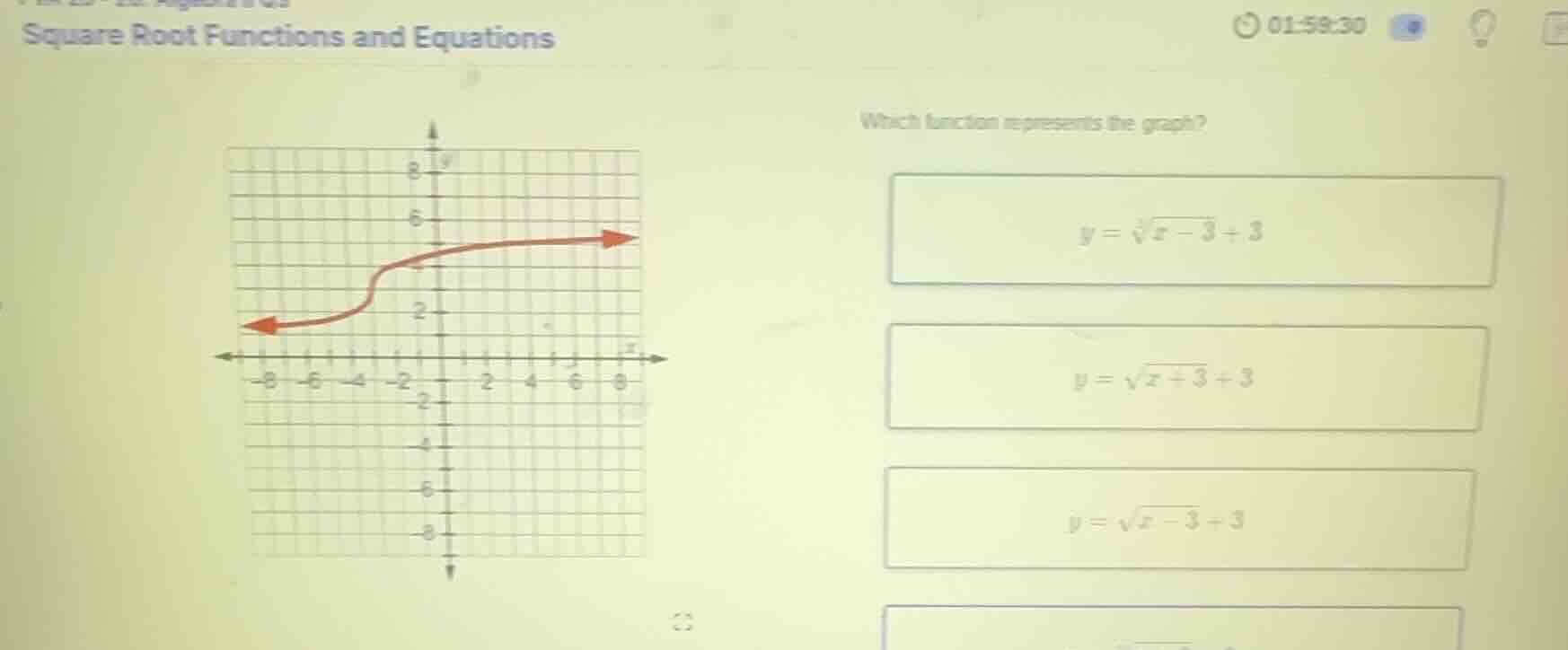
which function represents the graph?
$y = \sqrt3{x - 3} + 3$
$y = \sqrt{x + 3} + 3$
$y = \sqrt{x - 3} + 3$
Step1: Analyze the domain of square root function
The square root function \( y = \sqrt{x - h}+k \) has a domain of \( x\geq h \) (since the expression inside the square root must be non - negative). For a cube root function \( y=\sqrt[3]{x - h}+k \), the domain is all real numbers (\( x\in R \)) because we can take the cube root of any real number. Looking at the graph, it seems to be defined for all real numbers (the curve extends to the left of \( x=- 3\) etc.), so it is more likely a cube root function? Wait, no, wait. Wait, the first option is a cube root: \( y = \sqrt[3]{x - 3}+3 \), the second is square root \( y=\sqrt{x + 3}+3 \) (domain \( x\geq - 3\)), third is \( y=\sqrt{x - 3}+3 \) (domain \( x\geq3\)). Wait, maybe I misread the graph. Wait, let's check the starting point. Wait, the graph of a square root function \( y=\sqrt{x - h}+k \) starts at \( (h,k) \). For \( y=\sqrt{x + 3}+3 \), the starting point is \( (-3,3) \). Let's see the graph: when \( x=-3 \), what's \( y \)? If we plug \( x = - 3 \) into \( y=\sqrt{x + 3}+3 \), we get \( y=\sqrt{0}+3=3 \). Let's check the shape. The square root function has a curve that starts at the vertex and increases. But wait, the first option is a cube root. Wait, the graph in the picture: let's see the left - hand side. The cube root function is symmetric in a way and defined for all real numbers. But the second option: \( y=\sqrt{x + 3}+3 \), domain \( x\geq - 3 \). Wait, maybe the graph is of a square root function? Wait, no, the left - hand side of the graph (for \( x < - 3\)): if it's a square root function \( y=\sqrt{x + 3}+3 \), then for \( x < - 3\), \( x + 3<0 \), and the square root is not real. So that can't be. Wait, the first option is a cube root: \( y=\sqrt[3]{x - 3}+3 \). Let's check the vertex. The cube root function \( y=\sqrt[3]{x - h}+k \) has its "vertex" (the point where the curve changes its curvature) at \( (h,k)=(3,3) \)? Wait, no, maybe I made a mistake. Wait, let's re - examine. Wait, the second option: \( y=\sqrt{x + 3}+3 \). If we consider the graph, maybe the graph is actually a square root function, but the left - hand side is a mistake? No, that can't be. Wait, no, the first option is a cube root. Let's check the value at \( x = 3 \): for \( y=\sqrt[3]{x - 3}+3 \), when \( x = 3 \), \( y=\sqrt[3]{0}+3 = 3 \). For \( y=\sqrt{x + 3}+3 \), when \( x=-3 \), \( y = 3 \). Let's see the shape: the square root function \( y=\sqrt{x - h}+k \) has a curve that starts at \( (h,k) \) and increases. The cube root function has a more "S" - shaped curve? Wait, the graph in the picture: let's look at the y - intercept. When \( x = 0 \), for \( y=\sqrt{0 + 3}+3=\sqrt{3}+3\approx1.732 + 3=4.732 \). For \( y=\sqrt[3]{0 - 3}+3=\sqrt[3]{-3}+3\approx - 1.442+3 = 1.558 \). For \( y=\sqrt{0 - 3}+3 \), it's not real. Wait, maybe the correct answer is the first one? No, wait, maybe I misread the options. Wait, the user's options: first option \( y=\sqrt[3]{x - 3}+3 \), second \( y=\sqrt{x + 3}+3 \), third \( y=\sqrt{x - 3}+3 \). Wait, maybe the graph is of a cube root function? But let's think again. Wait, the key is the domain. If the graph is defined for all real numbers (including \( x < - 3\) and \( x < 3\)), then it must be a cube root function (since square root functions have restricted domains). So the first option \( y=\sqrt[3]{x - 3}+3 \) has domain all real numbers, while the square root options have restricted domains. So the function that represents the graph is \( y=\sqrt[3]{x - 3}+3 \). Wait, but maybe I made a mistake. Wait, let's check the vertex. The cube…

Snap & solve any problem in the app
Get step-by-step solutions on Sovi AI
Photo-based solutions with guided steps
Explore more problems and detailed explanations
\( y=\sqrt[3]{x - 3}+3 \) (the first option)