QUESTION IMAGE
Question
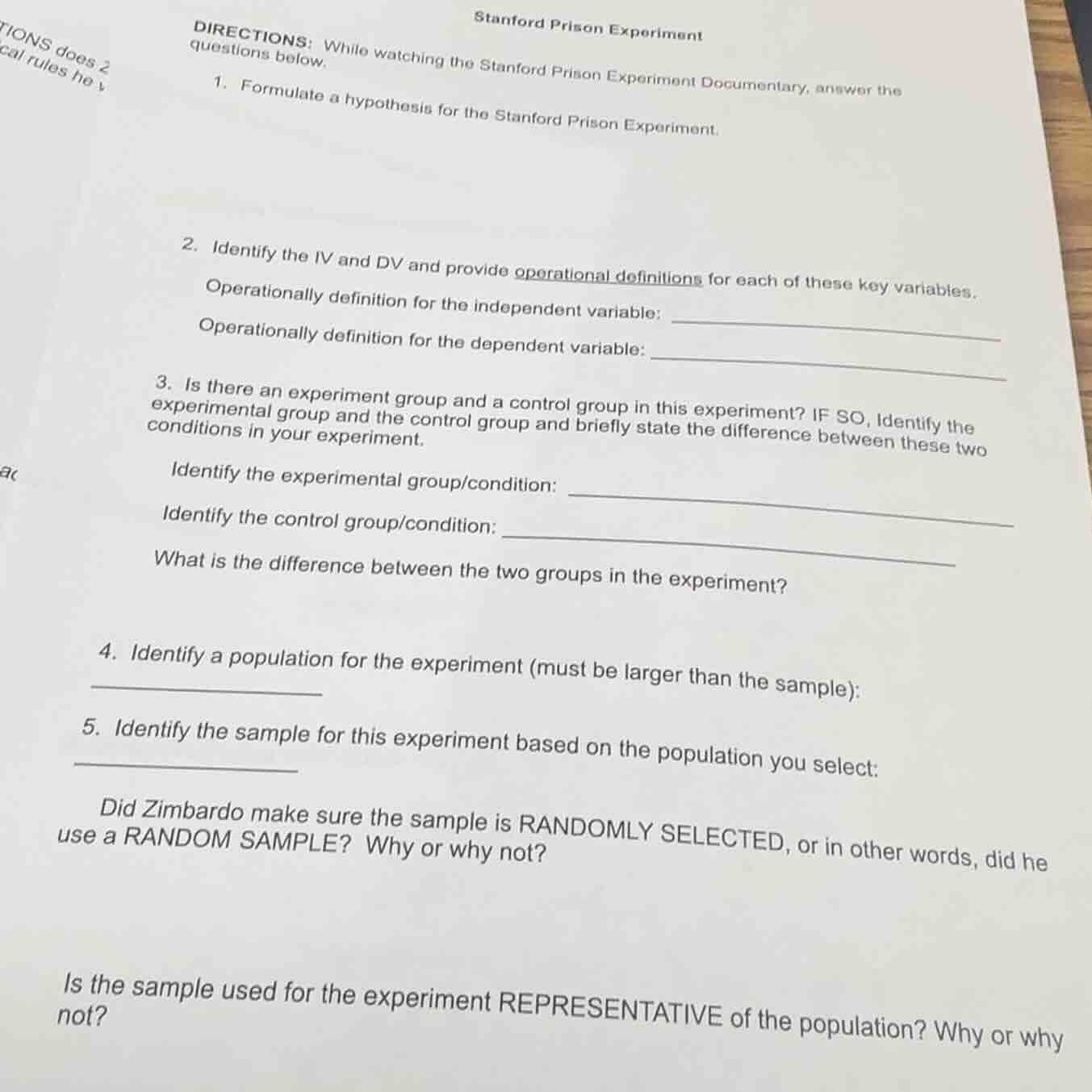
stanford prison experiment
directions: while watching the stanford prison experiment documentary, answer the questions below.
- formulate a hypothesis for the stanford prison experiment.
- identify the iv and dv and provide operational definitions for each of these key variables.
operationally definition for the independent variable:
operationally definition for the dependent variable:
- is there an experiment group and a control group in this experiment? if so, identify the experimental group and the control group and briefly state the difference between these two conditions in your experiment.
identify the experimental group/condition:
identify the control group/condition:
what is the difference between the two groups in the experiment?
- identify a population for the experiment (must be larger than the sample):
- identify the sample for this experiment based on the population you select:
did zimbardo make sure the sample is randomly selected, or in other words, did he use a random sample? why or why not?
is the sample used for the experiment representative of the population? why or why not?
- Hypothesis: Based on the experiment's focus on role impact, this hypothesis predicts the causal relationship between assigned prison roles and aggressive/submissive behavior.
- IV/DV Definitions: The independent variable is the assigned social role, defined by the specific rules and authority given to participants. The dependent variable is behavioral change, measured by observable actions and interactions recorded during the experiment.
- Groups: The experiment uses two groups defined by their assigned roles; the difference is the level of authority and constraints each group faces.
- Population: The population is the broad group from which the sample was recruited, encompassing young, mentally healthy adult men in the US.
- Sample: The sample is the specific group that participated in the experiment. Random selection was not used because recruitment relied on voluntary responses to an advertisement, not random sampling from the population. The sample is not representative because it only included self-selected, young, white, middle-class men, excluding women, people of color, and other demographics.

Snap & solve any problem in the app
Get step-by-step solutions on Sovi AI
Photo-based solutions with guided steps
Explore more problems and detailed explanations
- If assigned to a prison guard role, participants will exhibit aggressive, authoritarian behavior; if assigned to a prisoner role, participants will exhibit passive, submissive behavior.
- Operationally definition for the independent variable: Assigned social role (guard or prisoner, defined by the specific rules, authority, and constraints given to each role)
Operationally definition for the dependent variable: Observable behavioral changes (measured by frequency of authoritarian acts, compliance, or displays of stress recorded during the experiment)
- Identify the experimental group/condition: Both guards and prisoners are experimental groups, as both are assigned a manipulated role.
Identify the control group/condition: There is no formal control group in the original Stanford Prison Experiment.
What is the difference between the two groups in the experiment? The guard group was given authority to enforce rules, while the prisoner group was subjected to loss of autonomy and forced compliance with guard instructions.
- Young, mentally healthy adult men in the United States
- Identify the sample for this experiment based on the population you select: 24 male college students recruited via a newspaper advertisement.
Did Zimbardo make sure the sample is RANDOMLY SELECTED, or in other words, did he use a RANDOM SAMPLE? Why or why not? No, he did not use a random sample. Participants volunteered in response to an advertisement, so the sample was self-selected, not randomly chosen from the broader population.
Is the sample used for the experiment REPRESENTATIVE of the population? Why or why not? No, the sample is not representative. It only included self-selected, young, white, middle-class men, so it does not reflect the diversity of the broader population of young adult men (e.g., excluding men of color, lower-income men, non-college men).