QUESTION IMAGE
Question
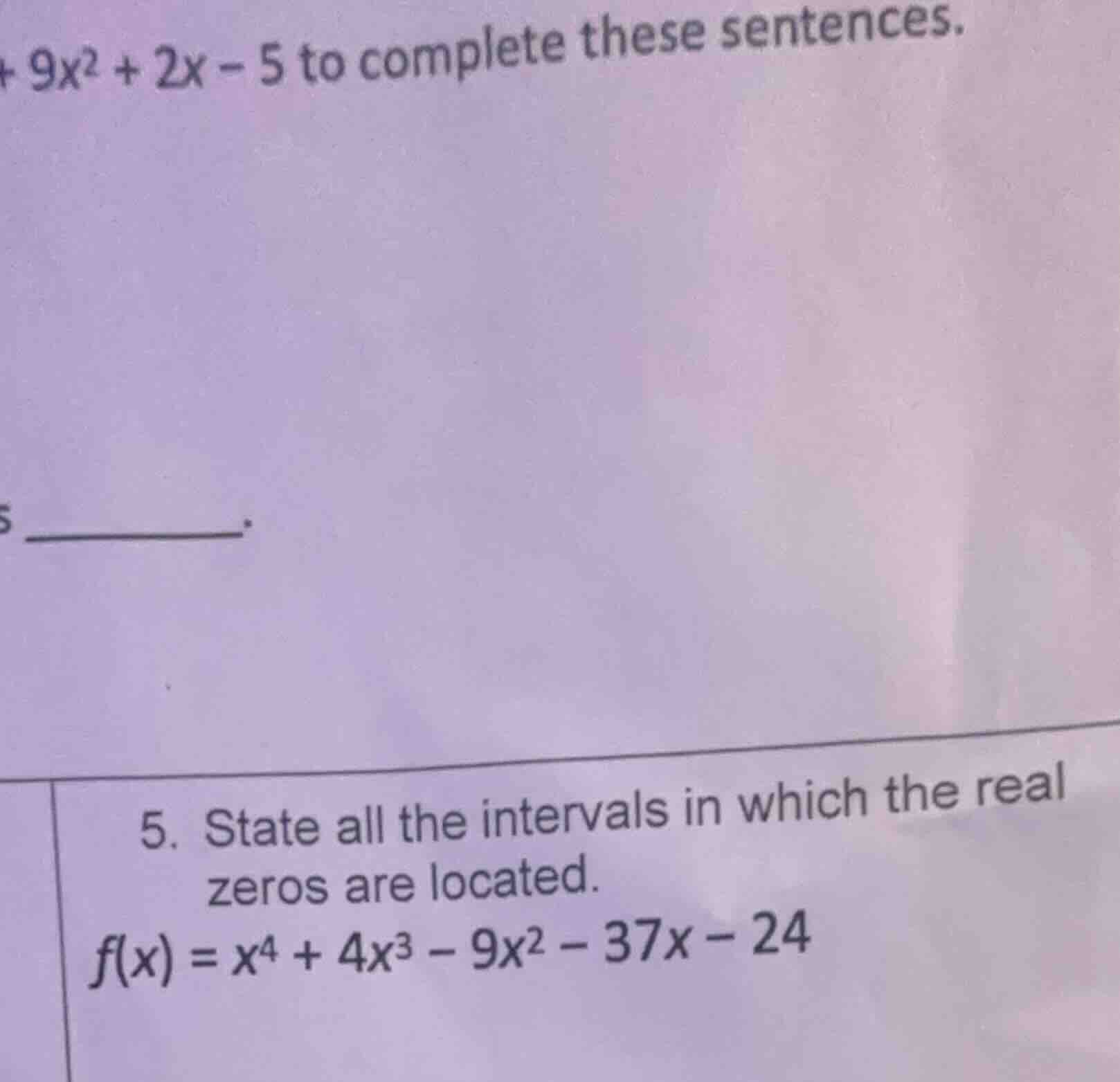
- state all the intervals in which the real zeros are located.\\(f(x) = x^4 + 4x^3 - 9x^2 - 37x - 24\\)
Step1: Use Rational Root Theorem
The Rational Root Theorem states that possible rational roots are factors of the constant term over factors of the leading coefficient. For \(f(x)=x^{4}+4x^{3}-9x^{2}-37x - 24\), leading coefficient is \(1\), constant term is \(-24\). Possible roots: \(\pm1,\pm2,\pm3,\pm4,\pm6,\pm8,\pm12,\pm24\).
Step2: Test possible roots
- \(f(1)=1 + 4-9 - 37-24=-65
eq0\)
- \(f(-1)=1-4 - 9 + 37-24=1
eq0\)
- \(f(2)=16 + 32-36 - 74-24=-86
eq0\)
- \(f(-2)=16-32 - 36 + 74-24= -2
eq0\)
- \(f(3)=81 + 108-81 - 111-24=-27
eq0\)
- \(f(-3)=81-108 - 81 + 111-24=-1
eq0\)
- \(f(4)=256 + 256-144 - 148-24=196
eq0\)
- \(f(-4)=256-256 - 144 + 152-24=-16
eq0\)
- \(f(8)=4096 + 2048-576 - 296-24=5248
eq0\)
- \(f(-8)=4096-2048 - 576 + 296-24=1744
eq0\)
- \(f(12)=20736 + 6912-1296 - 444-24=25884
eq0\)
- \(f(-12)=20736-6912 - 1296 + 444-24=12948
eq0\)
- \(f(24)=24^4+4\times24^3 - 9\times24^2-37\times24 - 24\) is large, not zero.
- \(f(-24)\) is large, not zero. Wait, maybe I made a mistake. Wait, let's try factoring. Let's try to factor by grouping or use synthetic division. Wait, maybe I miscalculated \(f(-3)\): \(f(-3)=(-3)^4+4\times(-3)^3-9\times(-3)^2-37\times(-3)-24=81-108 - 81 + 111-24=(81+111)-(108 + 81+24)=192 - 213=-21
eq0\). Wait, \(f(-1)=1 - 4-9 + 37-24=1\), \(f(0)=-24\), \(f(1)=-65\), \(f(2)=-86\), \(f(3)=-27\), \(f(4)=196\). So between \(3\) and \(4\), \(f(3)<0\), \(f(4)>0\), so root in \((3,4)\).
Now negative side: \(f(-4)=(-4)^4+4\times(-4)^3-9\times(-4)^2-37\times(-4)-24=256-256 - 144 + 152-24=-16\), \(f(-5)=625-500 - 225 + 185-24=61\). So \(f(-5)=61\), \(f(-4)=-16\), so root in \((-5,-4)\).
\(f(-1)=1\), \(f(-2)=-2\), so root in \((-2,-1)\).
Wait, let's check \(f(-3)=81-108 - 81 + 111-24=-21\), \(f(-4)=-16\), \(f(-5)=61\). Wait, \(f(-5)=61\), \(f(-4)=-16\), so sign change from \(-5\) to \(-4\): root in \((-5,-4)\).
\(f(-4)=-16\), \(f(-3)=-21\) (same sign), \(f(-2)=-2\), \(f(-1)=1\): sign change from \(-2\) to \(-1\): root in \((-2,-1)\).
\(f(0)=-24\), \(f(1)=-65\), \(f(2)=-86\), \(f(3)=-27\), \(f(4)=196\): sign change from \(3\) to \(4\): root in \((3,4)\).
Wait, but maybe there are two real roots? Wait, no, quartic can have up to 4 real roots. Wait, maybe I missed a root. Let's try \(f( - 1)=1\), \(f(0)=-24\): sign change from \(-1\) to \(0\)? Wait, \(f(-1)=1\), \(f(0)=-24\), so root in \((-1,0)\). Oh! I missed that. \(f(-1)=1\), \(f(0)=-24\), so sign change: root in \((-1,0)\).
So let's re - check:
- For \(x=-5\): \(f(-5)=(-5)^4 + 4\times(-5)^3-9\times(-5)^2-37\times(-5)-24=625-500 - 225 + 185-24=61\) (positive)
- \(x=-4\): \(f(-4)=256-256 - 144 + 152-24=-16\) (negative) → root in \((-5,-4)\)
- \(x=-2\): \(f(-2)=16-32 - 36 + 74-24=-2\) (negative)
- \(x=-1\): \(f(-1)=1-4 - 9 + 37-24=1\) (positive) → root in \((-2,-1)\)
- \(x=-1\): \(1\) (positive)
- \(x = 0\): \(-24\) (negative) → root in \((-1,0)\)
- \(x = 3\): \(81 + 108-81 - 111-24=-27\) (negative)
- \(x = 4\): \(256 + 256-144 - 148-24=196\) (positive) → root in \((3,4)\)

Snap & solve any problem in the app
Get step-by-step solutions on Sovi AI
Photo-based solutions with guided steps
Explore more problems and detailed explanations
The intervals containing the real zeros of \(f(x)=x^{4}+4x^{3}-9x^{2}-37x - 24\) are \((-5,-4)\), \((-2,-1)\), \((-1,0)\), and \((3,4)\)