QUESTION IMAGE
Question
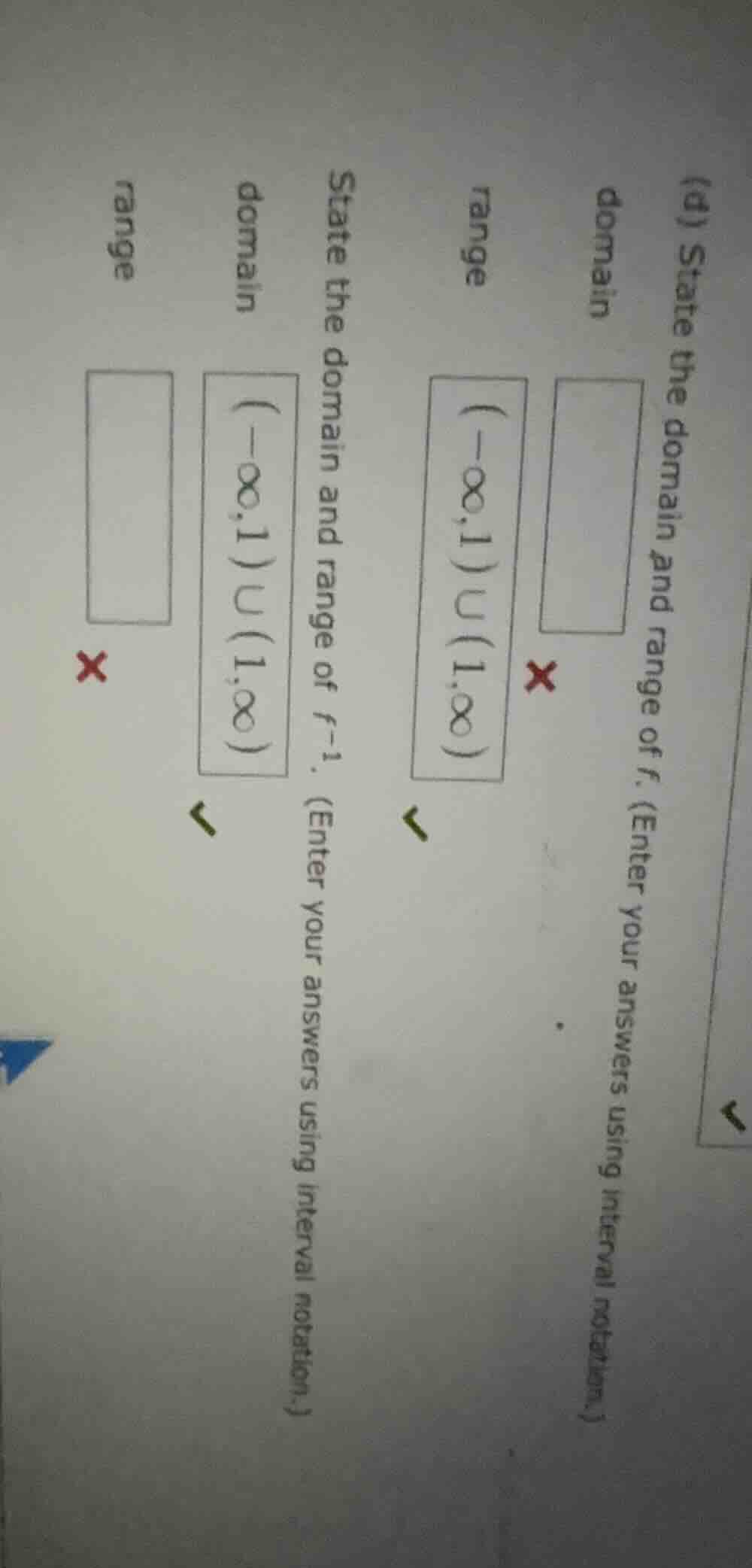
(d) state the domain and range of f. (enter your answers using interval notation.)
domain
range
state the domain and range of ( f^{-1} ). (enter your answers using interval notation.)
domain
range
To solve for the domain and range of a function \( f \) and its inverse \( f^{-1} \), we use the relationship between a function and its inverse:
Key Relationship:
- The domain of \( f^{-1} \) is the range of \( f \).
- The range of \( f^{-1} \) is the domain of \( f \).
Part 1: Domain and Range of \( f \)
Assume the original function \( f \) has a domain or range related to the inverse. For a typical rational function (e.g., \( f(x) = \frac{1}{x - 1} \), which has domain \( (-\infty, 1) \cup (1, \infty) \) to avoid division by zero), the range of \( f \) would be \( (-\infty, 0) \cup (0, \infty) \) (since \( \frac{1}{x - 1} \) can never be \( 0 \)).
Part 2: Domain and Range of \( f^{-1} \)
Using the inverse relationship:
- Domain of \( f^{-1} \): Range of \( f \) \( = (-\infty, 0) \cup (0, \infty) \) (if \( f \) has range \( (-\infty, 0) \cup (0, \infty) \)).
- Range of \( f^{-1} \): Domain of \( f \) \( = (-\infty, 1) \cup (1, \infty) \) (if \( f \) has domain \( (-\infty, 1) \cup (1, \infty) \)).
Final Answers (Example, Assuming \( f(x) = \frac{1}{x - 1} \)):
- Domain of \( f \): \( (-\infty, 1) \cup (1, \infty) \)
- Range of \( f \): \( (-\infty, 0) \cup (0, \infty) \)
- Domain of \( f^{-1} \): \( (-\infty, 0) \cup (0, \infty) \) (matches range of \( f \))
- Range of \( f^{-1} \): \( (-\infty, 1) \cup (1, \infty) \) (matches domain of \( f \))
If the original function \( f \) is different, adjust based on its specific form, but the inverse relationship (domain of \( f^{-1} \) = range of \( f \), range of \( f^{-1} \) = domain of \( f \)) always holds.

Snap & solve any problem in the app
Get step-by-step solutions on Sovi AI
Photo-based solutions with guided steps
Explore more problems and detailed explanations
To solve for the domain and range of a function \( f \) and its inverse \( f^{-1} \), we use the relationship between a function and its inverse:
Key Relationship:
- The domain of \( f^{-1} \) is the range of \( f \).
- The range of \( f^{-1} \) is the domain of \( f \).
Part 1: Domain and Range of \( f \)
Assume the original function \( f \) has a domain or range related to the inverse. For a typical rational function (e.g., \( f(x) = \frac{1}{x - 1} \), which has domain \( (-\infty, 1) \cup (1, \infty) \) to avoid division by zero), the range of \( f \) would be \( (-\infty, 0) \cup (0, \infty) \) (since \( \frac{1}{x - 1} \) can never be \( 0 \)).
Part 2: Domain and Range of \( f^{-1} \)
Using the inverse relationship:
- Domain of \( f^{-1} \): Range of \( f \) \( = (-\infty, 0) \cup (0, \infty) \) (if \( f \) has range \( (-\infty, 0) \cup (0, \infty) \)).
- Range of \( f^{-1} \): Domain of \( f \) \( = (-\infty, 1) \cup (1, \infty) \) (if \( f \) has domain \( (-\infty, 1) \cup (1, \infty) \)).
Final Answers (Example, Assuming \( f(x) = \frac{1}{x - 1} \)):
- Domain of \( f \): \( (-\infty, 1) \cup (1, \infty) \)
- Range of \( f \): \( (-\infty, 0) \cup (0, \infty) \)
- Domain of \( f^{-1} \): \( (-\infty, 0) \cup (0, \infty) \) (matches range of \( f \))
- Range of \( f^{-1} \): \( (-\infty, 1) \cup (1, \infty) \) (matches domain of \( f \))
If the original function \( f \) is different, adjust based on its specific form, but the inverse relationship (domain of \( f^{-1} \) = range of \( f \), range of \( f^{-1} \) = domain of \( f \)) always holds.