QUESTION IMAGE
Question
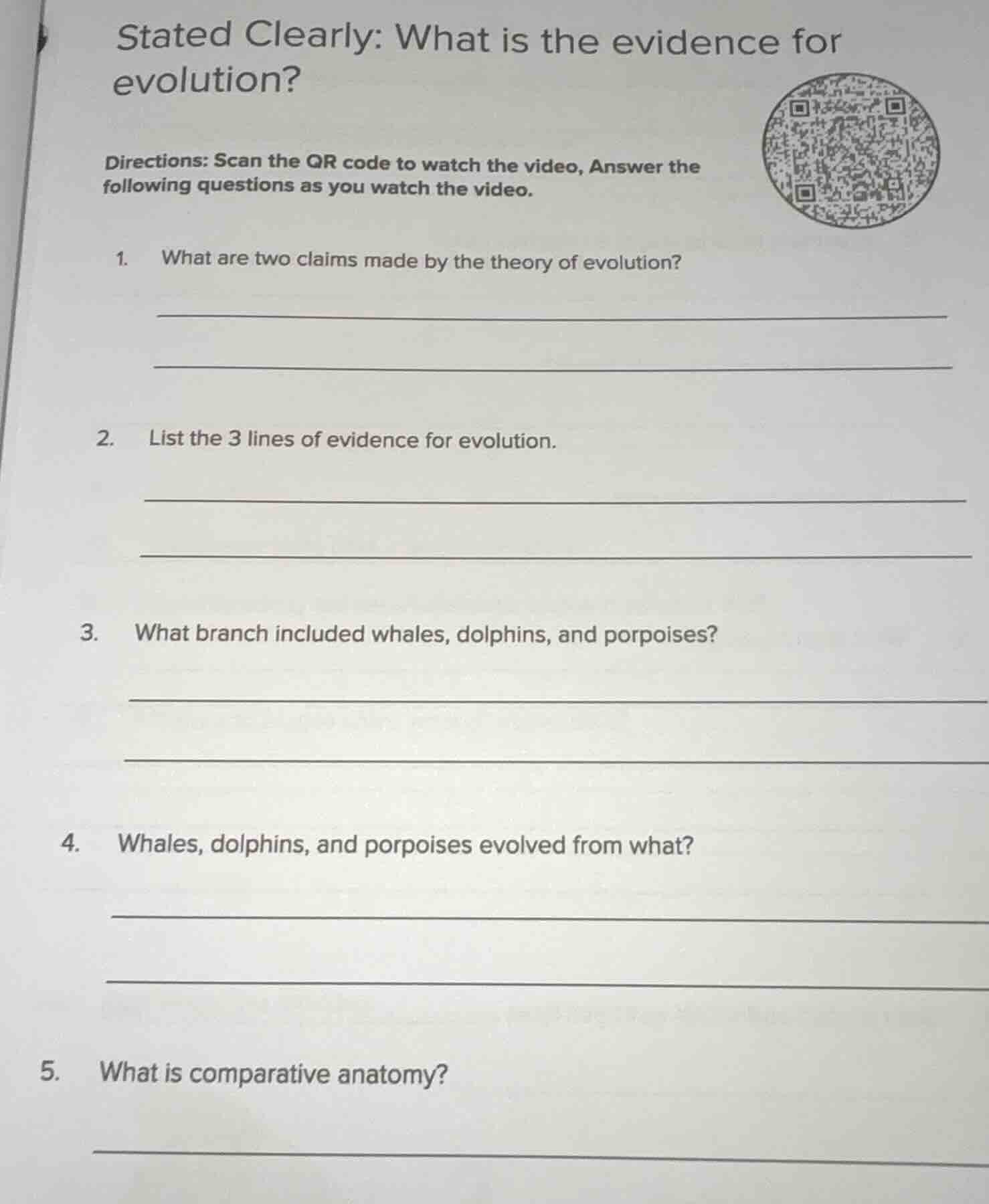
stated clearly: what is the evidence for evolution? directions: scan the qr code to watch the video, answer the following questions as you watch the video. 1. what are two claims made by the theory of evolution? 2. list the 3 lines of evidence for evolution. 3. what branch included whales, dolphins, and porpoises? 4. whales, dolphins, and porpoises evolved from what? 5. what is comparative anatomy?
To answer these questions, we refer to the video "Stated Clearly: What is the evidence for evolution?" and general knowledge about evolutionary theory:
Question 1: What are two claims made by the theory of evolution?
The theory of evolution claims:
- All life on Earth shares a common ancestor (common descent).
- Populations of organisms change over time (descent with modification) through mechanisms like natural selection.
Question 2: List the 3 lines of evidence for evolution.
Three key lines of evidence for evolution are:
- Fossil Record: Shows gradual changes in species over time (e.g., whale evolution from land - dwelling ancestors).
- Comparative Anatomy: Studies similarities/differences in body structures (e.g., homologous structures like vertebrate forelimbs).
- Molecular Biology: Compares DNA/protein sequences (closely related species have more similar genetic code).
Question 3: What branch included whales, dolphins, and porpoises?
Whales, dolphins, and porpoises belong to the branch Cetacea (within the class Mammalia).
Question 4: Whales, dolphins, and porpoises evolved from what?
Whales, dolphins, and porpoises evolved from land - dwelling, four - legged mammals (likely ancient artiodactyls, a group of hoofed mammals).
Question 5: What is comparative anatomy?
Comparative anatomy is the study of similarities and differences in the anatomical structures of different species. It helps identify evolutionary relationships (e.g., homologous structures suggest common ancestry, while analogous structures show convergent evolution).

Snap & solve any problem in the app
Get step-by-step solutions on Sovi AI
Photo-based solutions with guided steps
Explore more problems and detailed explanations
s:
- (1) All life shares a common ancestor. (2) Populations change over time (descent with modification).
- Fossil Record, Comparative Anatomy, Molecular Biology.
- Cetacea.
- Land - dwelling, four - legged mammals (ancient artiodactyls).
- The study of anatomical similarities/differences across species to infer evolution.