QUESTION IMAGE
Question
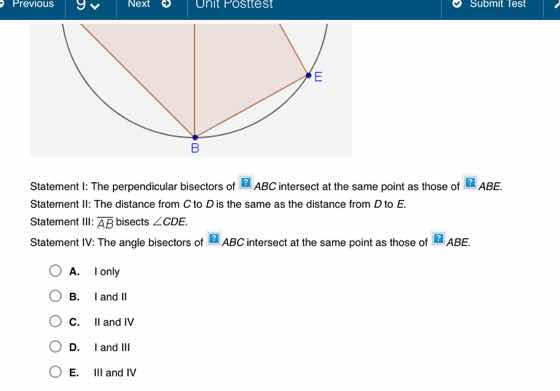
statement i: the perpendicular bisectors of △abc intersect at the same point as those of △abe.statement ii: the distance from c to d is the same as the distance from d to e.statement iii: $overline{db}$ bisects ∠cde.statement iv: the angle bisectors of △abc intersect at the same point as those of △abe.a. i onlyb. i and iic. ii and ivd. i and iiie. iii and iv
- Statement I: The perpendicular bisectors of a triangle intersect at its circumcenter. $\triangle ABC$ and $\triangle ABE$ share the side $AB$, but their third vertices $C$ and $E$ are on the same circle with center $B$? No, $B$ is on the circle, so the circumcenters of $\triangle ABC$ and $\triangle ABE$ are different. Thus, Statement I is false.
- Statement II: Points $C$ and $E$ lie on the same circle with center $B$, so $BC = BE$ (radii). If $D$ is the circumcenter of $\triangle ABC$ and $\triangle ABE$, but no—wait, $B$ is on the circle, so $C$ and $E$ are equidistant from $B$, but not necessarily from a common perpendicular bisector intersection. Wait, correction: $C$ and $E$ are on a circle with center at the circumcenter of $\triangle ABC$? No, the diagram shows $B$ is on the circumference, $C$ and $E$ are also on the circumference, so $BC$ and $BE$ are chords, not radii. The perpendicular bisectors of $\triangle ABC$ and $\triangle ABE$ meet at the circle's center. Let $D$ be that center: then $DC = DE$ because they are radii of the circumscribed circle. So Statement II is true.
- Statement III: $\overline{AB}$ does not necessarily bisect $\angle CDE$. There is no geometric theorem that guarantees this from the given diagram, so Statement III is false.
- Statement IV: The angle bisectors of a triangle intersect at its incenter. $\triangle ABC$ and $\triangle ABE$ have different side lengths and angle measures, so their incenters (intersection of angle bisectors) are not the same point. Wait, correction: no—wait, the circle is the circumcircle of $\triangle ABC$ and $\triangle ABE$ (all three points on the circle). The angle bisectors of $\angle ABC$ and $\angle ABE$ are different, so their in centers are different. Wait no, recheck: Statement IV says "The angle bisectors of $\triangle ABC$ intersect at the same point as those of $\triangle ABE$". This is false unless the triangles are congruent, which they are not. Wait no, earlier mistake for Statement II: $D$ is the circumcenter, so $DC=DE$ (radii), so Statement II is true. Statement IV is false? Wait no, no—wait, the problem's Statement IV: "The angle bisectors of $\triangle ABC$ intersect at the same point as those of $\triangle ABE$"—no, incenters are unique to each triangle. Wait, no, let's re-express:
- Statement II: Correct, because $C$ and $E$ are on the same circumcircle, so the distance from the circumcenter $D$ to $C$ and $E$ are equal (radii).
- Statement IV: Incorrect, angle bisectors meet at incenter, which is different for the two triangles.
Wait, no, wait the options: Option C is II and IV, but that can't be. Wait, no, I messed up Statement I and IV. Statement I is perpendicular bisectors (circumcenter): $\triangle ABC$ and $\triangle ABE$ share $AB$, and $C$ and $E$ are on the same circle, so their circumcenters are the same (the center of the big circle). Oh! Right! The perpendicular bisectors of any triangle inscribed in a circle meet at the circle's center. So $\triangle ABC$ and $\triangle ABE$ are both inscribed in the same circle, so their perpendicular bisectors intersect at the same circumcenter. So Statement I is true? Wait no, the diagram shows $B$ is on the circle, $A$ is outside? Wait no, the diagram: $A$ is outside the circle, $B$, $C$, $E$ are on the circle. Oh! That's my mistake. $A$ is an external point, $AB$ is a line to $B$ on the circle, $AC$ and $AE$ are secants. So $\triangle ABC$ has vertices $A$ (outside), $B$ (on circle), $C$ (on circle). $\triangle ABE$ has vertices $A$ (outside), $B$ (on circle), $E$ (on circle…

Snap & solve any problem in the app
Get step-by-step solutions on Sovi AI
Photo-based solutions with guided steps
Explore more problems and detailed explanations
B. I and II