QUESTION IMAGE
Question
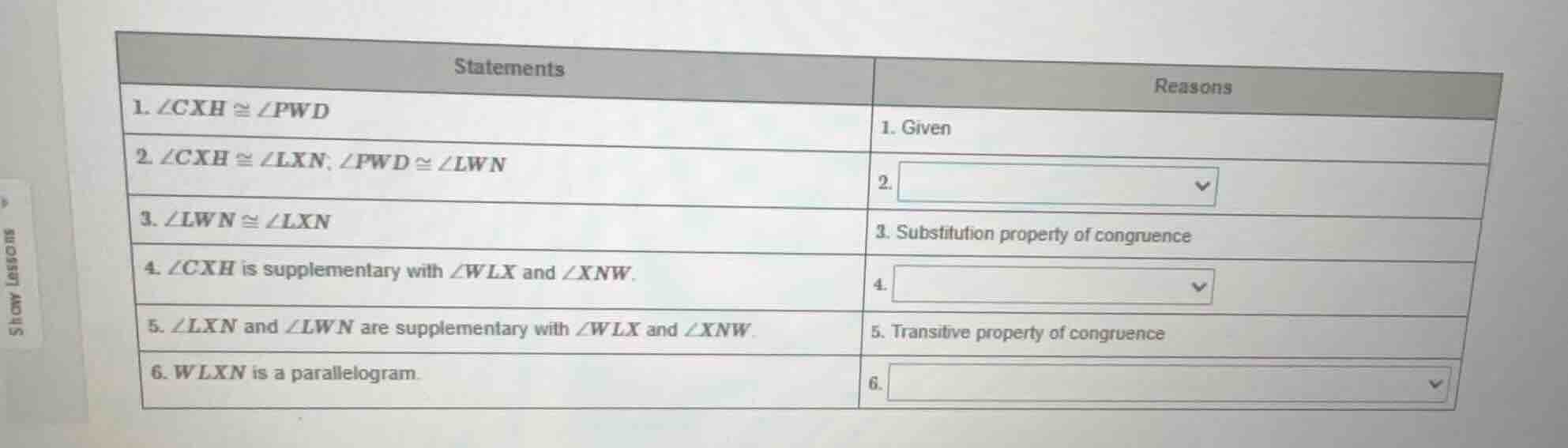
statements reasons 1. $\angle cxh \cong \angle pwd$ 1. given 2. $\angle cxh \cong \angle lxn$, $\angle pwd \cong \angle lwn$ 2. $\boldsymbol{\downarrow}$ 3. $\angle lwn \cong \angle lxn$ 3. substitution property of congruence 4. $\angle cxh$ is supplementary with $\angle wlx$ and $\angle xnw$. 4. $\boldsymbol{\downarrow}$ 5. $\angle lxn$ and $\angle lwn$ are supplementary with $\angle wlx$ and $\angle xnw$. 5. transitive property of congruence 6. $wlxn$ is a parallelogram. 6. $\boldsymbol{\downarrow}$
Brief Explanations
- For step 2: The statement states pairs of angles are congruent, which matches the definition of vertical angles (vertical angles are always congruent).
- For step 4: The explanation refers to the definition of supplementary angles formed by a transversal cutting parallel lines, or more directly, if two angles form a linear pair with the same angles, they are supplementary to those angles; this aligns with the definition of supplementary angles (angles that add to 180°) from the given angle relationships.
- For step 6: If two pairs of opposite angles are congruent (∠LWN ≅ ∠LXN, and the supplementary angle pair implies the other opposite angles are congruent), this satisfies the theorem that if both pairs of opposite angles of a quadrilateral are congruent, the quadrilateral is a parallelogram.

Snap & solve any problem in the app
Get step-by-step solutions on Sovi AI
Photo-based solutions with guided steps
Explore more problems and detailed explanations
- Vertical Angles Congruence Theorem
- Definition of supplementary angles
- If both pairs of opposite angles of a quadrilateral are congruent, then the quadrilateral is a parallelogram