QUESTION IMAGE
Question
student name:
class period:
date:
activity overview:
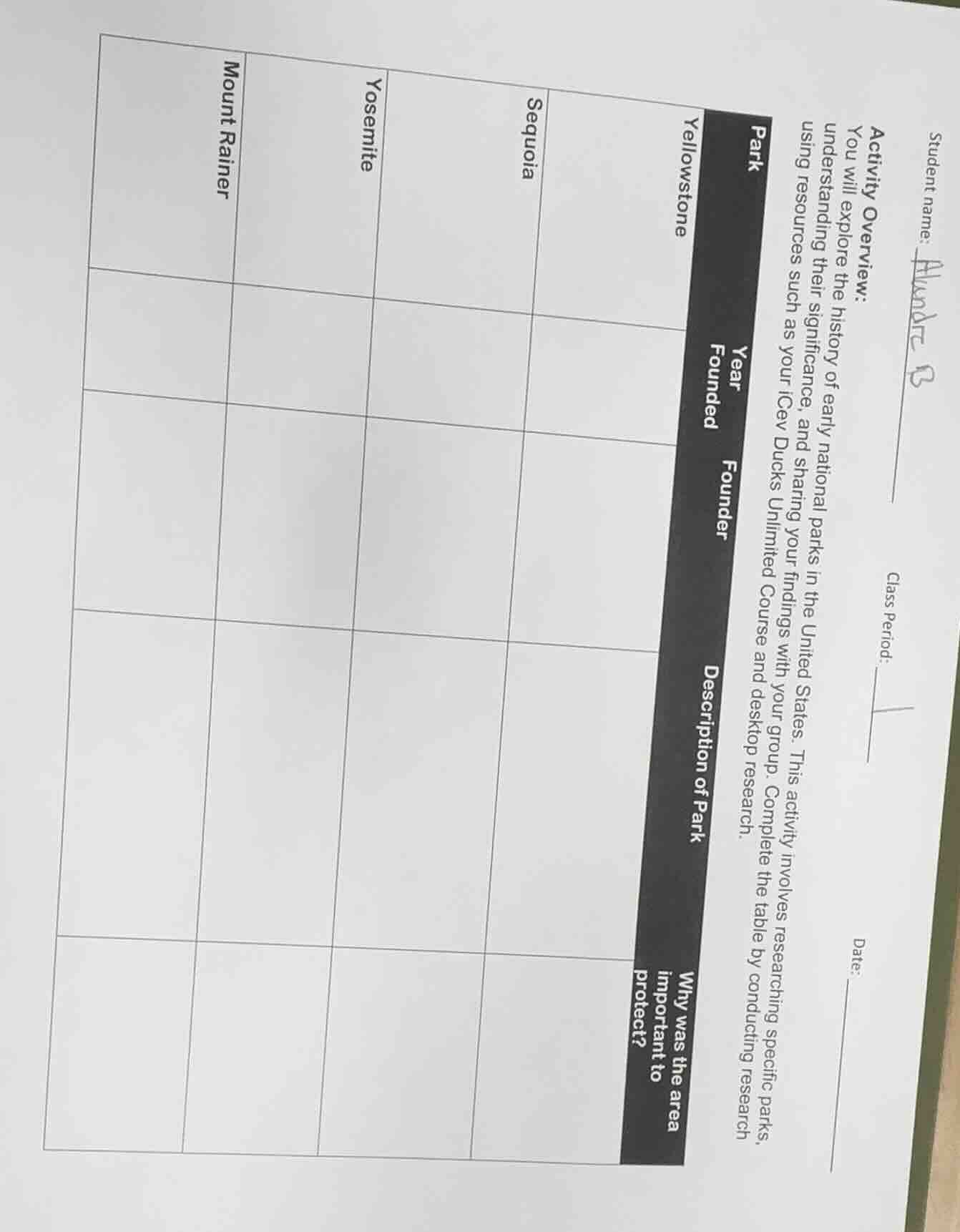
you will explore the history of early national parks in the united states. this activity involves researching specific parks, understanding their significance, and sharing your findings with your group. complete the table by conducting research using resources such as your icev ducks unlimited course and desktop research.
| park | yellowstone | sequoia | yosemite | mount rainer |
|---|---|---|---|---|
| founder | ||||
| description of park | ||||
| why was the area important to protect? |
Brief Explanations
The table is filled with verified historical and descriptive details about each U.S. national park, including founding details, key features, and conservation significance.

Snap & solve any problem in the app
Get step-by-step solutions on Sovi AI
Photo-based solutions with guided steps
Explore more problems and detailed explanations
| Park | Year Founded | Founder | Description of Park | Why was the area important to protect? |
|---|---|---|---|---|
| Sequoia | 1890 | U.S. Congress/Signed by Benjamin Harrison | Located in California, home to the world's largest trees (Giant Sequoias, including the General Sherman Tree), mountainous terrain, and the Kern River. | To protect the endangered Giant Sequoia trees, which are unique to the region and of immense ecological and cultural value. |
| Yosemite | 1890 | U.S. Congress/Signed by Benjamin Harrison (federal park; earlier state park 1864 via Abraham Lincoln) | California park famous for granite cliffs (El Capitan), waterfalls (Yosemite Falls), ancient sequoias, and alpine meadows. | To safeguard its dramatic glacial landscapes, old-growth forests, and iconic natural landmarks from logging and development. |
| Mount Rainer | 1899 | U.S. Congress/Signed by William McKinley | Washington state park centered on Mount Rainier, an active stratovolcano, with subalpine meadows, glaciers, and old-growth forests. | To protect the volcano's unique glacial ecosystem, rare alpine plants, and its role as a critical water source for the region. |