QUESTION IMAGE
Question
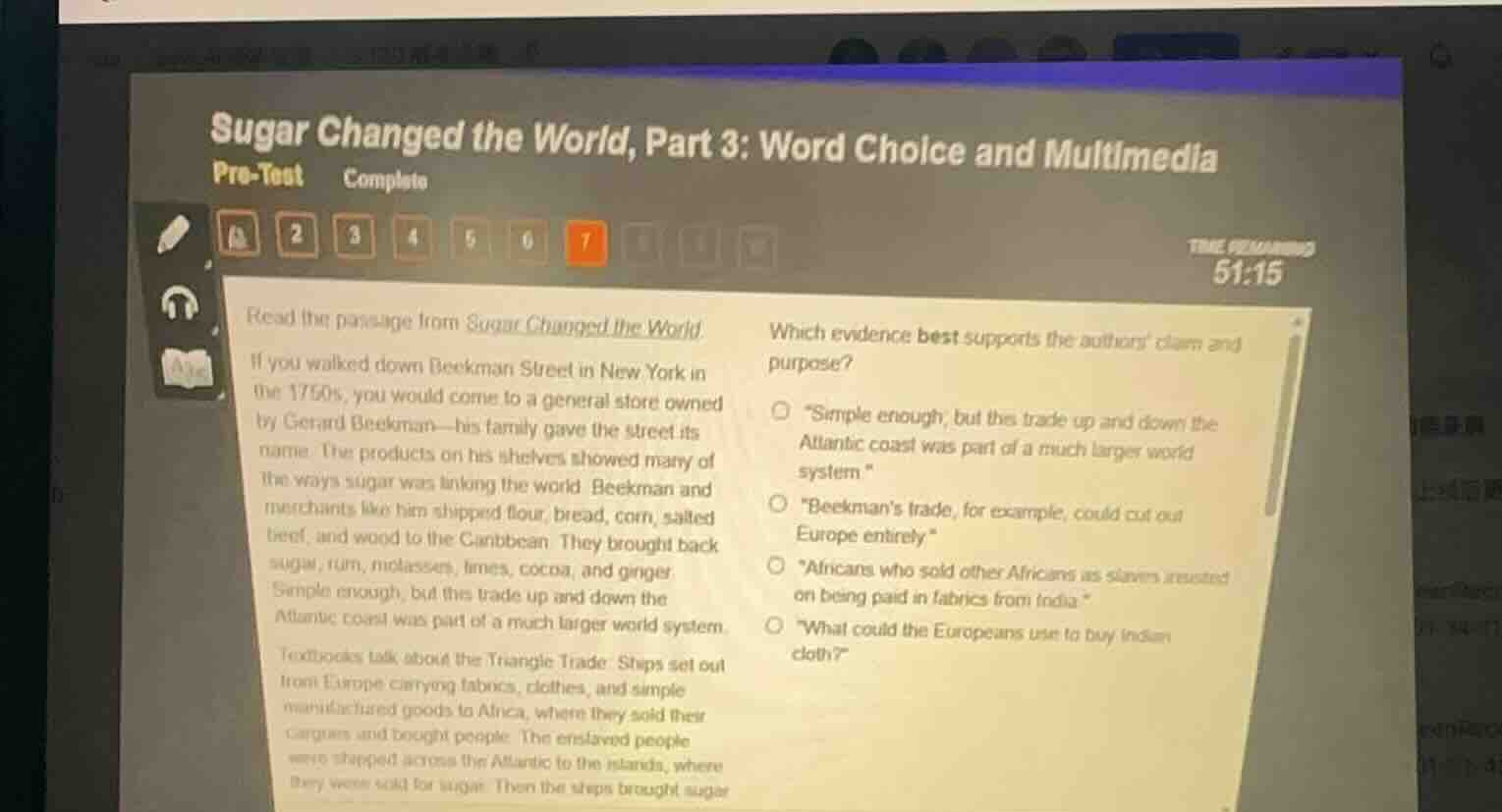
sugar changed the world, part 3: word choice and multimediapre-test completeread the passage from sugar changed the world.if you walked down beekman street in new york in the 1750s, you would come to a general store owned by gerard beekman—his family gave the street its name. the products on his shelves showed many of the ways sugar was linking the world. beekman and merchants like him shipped flour, bread, corn, salted beef, and wood to the caribbean. they brought back sugar, rum, molasses, limes, cocoa, and ginger. simple enough, but this trade up and down the atlantic coast was part of a much larger world system.textbooks talk about the triangle trade. ships set out from europe carrying fabrics, clothes, and simple manufactured goods to africa, where they sold their cargoes and bought people. the enslaved people were shipped across the atlantic to the islands, where they were sold for sugar. then the ships brought sugarwhich evidence best supports the authors claim and purpose?○ “simple enough, but this trade up and down the atlantic coast was part of a much larger world system.”○ “beekmans trade, for example, could cut out europe entirely.”○ “africans who sold other africans as slaves insisted on being paid in fabrics from india.”○ “what could the europeans use to buy indian cloth?”
The authors' claim and purpose here is to show how sugar trade connected the world into a large, interlinked system. The evidence needs to directly illustrate this global, cross-regional connection. The option about Africans being paid with Indian fabrics shows a direct link between Africa, India, and the broader sugar/slave trade system, which demonstrates the far-reaching, interconnected nature of the world system tied to sugar. Other options either only reference a regional Atlantic trade, a narrow example of cutting out Europe, or a rhetorical question without concrete evidence of global linkage.

Snap & solve any problem in the app
Get step-by-step solutions on Sovi AI
Photo-based solutions with guided steps
Explore more problems and detailed explanations
○ "Africans who sold other Africans as slaves insisted on being paid in fabrics from India."