QUESTION IMAGE
Question
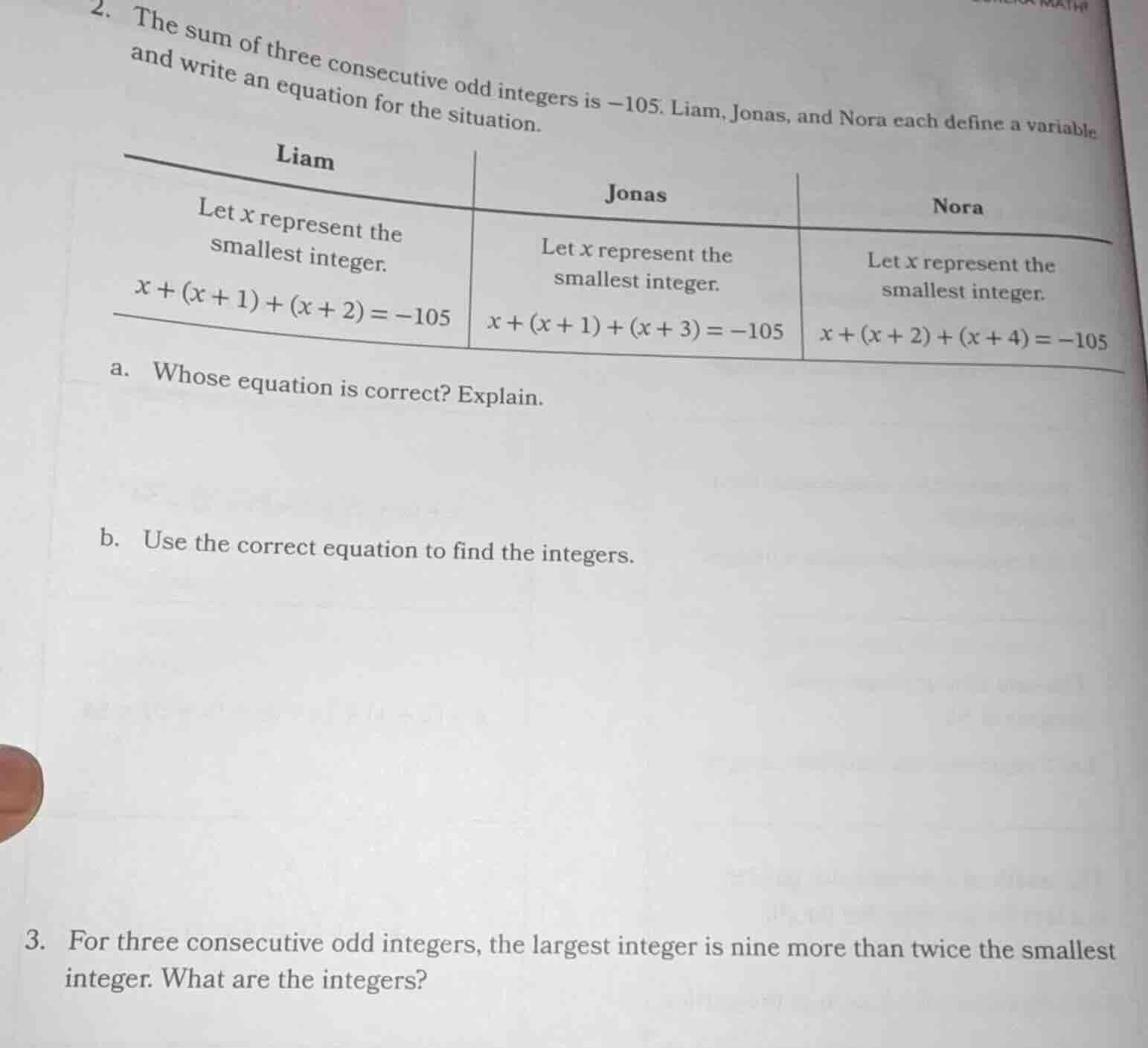
- the sum of three consecutive odd integers is $-105$. liam, jonas, and nora each define a variable and write an equation for the situation.
liam
let $x$ represent the smallest integer.
$x+(x+1)+(x+2)=-105$
jonas
let $x$ represent the smallest integer.
$x+(x+1)+(x+3)=-105$
nora
let $x$ represent the smallest integer.
$x+(x+2)+(x+4)=-105$
a. whose equation is correct? explain.
b. use the correct equation to find the integers.
- for three consecutive odd integers, the largest integer is nine more than twice the smallest integer. what are the integers?
For Problem 2a:
Consecutive odd integers differ by 2. If \(x\) is the smallest odd integer, the next is \(x+2\), and the largest is \(x+4\). Liam's equation uses consecutive integers (difference 1), Jonas uses inconsistent differences, so Nora's equation correctly models consecutive odd integers.
Step1: Simplify the correct equation
Combine like terms in \(x+(x+2)+(x+4)=-105\):
\(3x + 6 = -105\)
Step2: Isolate the variable term
Subtract 6 from both sides:
\(3x = -105 - 6\)
\(3x = -111\)
Step3: Solve for \(x\)
Divide both sides by 3:
\(x = \frac{-111}{3} = -37\)
Step4: Find the other integers
Calculate the second integer: \(x+2 = -37 + 2 = -35\)
Calculate the third integer: \(x+4 = -37 + 4 = -33\)
Step1: Define variables
Let \(x\) = smallest odd integer, \(x+4\) = largest odd integer.
Step2: Set up the equation
Translate the problem to math:
\(x+4 = 2x + 9\)
Step3: Solve for \(x\)
Subtract \(x\) from both sides:
\(4 = x + 9\)
Subtract 9 from both sides:
\(x = 4 - 9 = -5\)
Step4: Find the other integers
Second integer: \(x+2 = -5 + 2 = -3\)
Largest integer: \(x+4 = -5 + 4 = -1\)

Snap & solve any problem in the app
Get step-by-step solutions on Sovi AI
Photo-based solutions with guided steps
Explore more problems and detailed explanations
Nora's equation is correct. Consecutive odd integers have a difference of 2, so the three integers are \(x\), \(x+2\), and \(x+4\), which matches her equation.
---