QUESTION IMAGE
Question
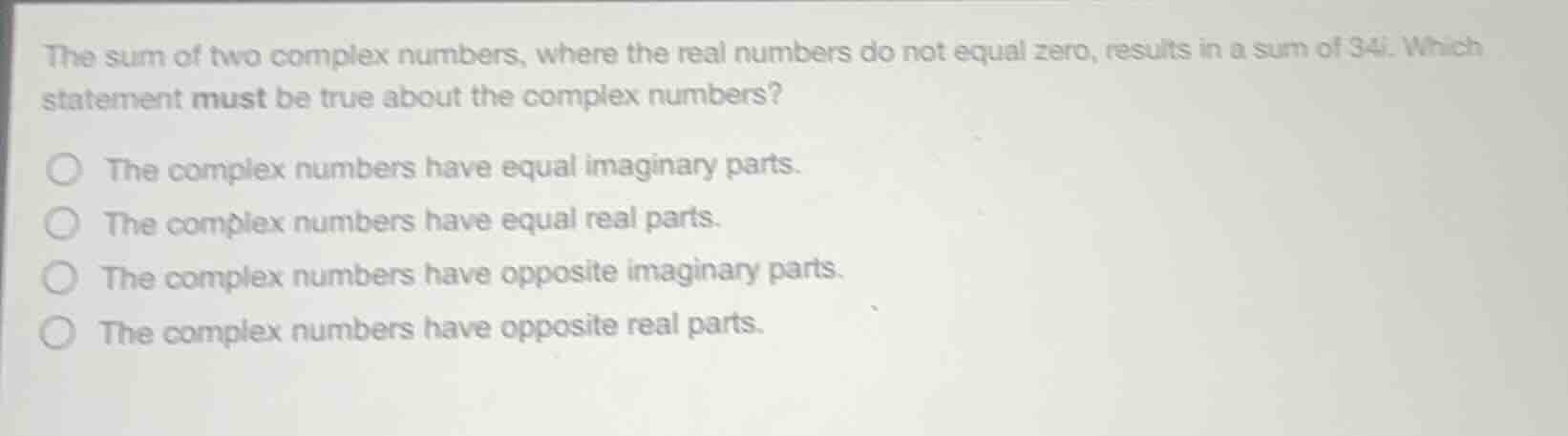
the sum of two complex numbers, where the real numbers do not equal zero, results in a sum of 34i. which statement must be true about the complex numbers?
the complex numbers have equal imaginary parts.
the complex numbers have equal real parts.
the complex numbers have opposite imaginary parts.
the complex numbers have opposite real parts.
Step1: Define complex numbers
Let the two complex numbers be $z_1 = a + bi$ and $z_2 = c + di$, where $a
eq 0$, $c
eq 0$, and $a,b,c,d$ are real numbers.
Step2: Compute their sum
The sum is $z_1 + z_2 = (a + c) + (b + d)i$.
Step3: Match to given sum
We know the sum is $34i = 0 + 34i$. Equate real and imaginary parts:
Real part: $a + c = 0$
Imaginary part: $b + d = 34$
Step4: Analyze the results
From $a + c = 0$, we get $c = -a$, meaning the real parts are opposites. The imaginary parts sum to 34, so they are not equal or opposites.

Snap & solve any problem in the app
Get step-by-step solutions on Sovi AI
Photo-based solutions with guided steps
Explore more problems and detailed explanations
The complex numbers have opposite real parts.