QUESTION IMAGE
Question
summarizing: informational text — quiz — level h
observed that older bilingual adults at a memory clinic
lagged several years behind monolingual people in
showing signs of alzheimers disease. these researchers
hypothesized that speaking more than one language
exercises the brain, which keeps it strong and flexible.
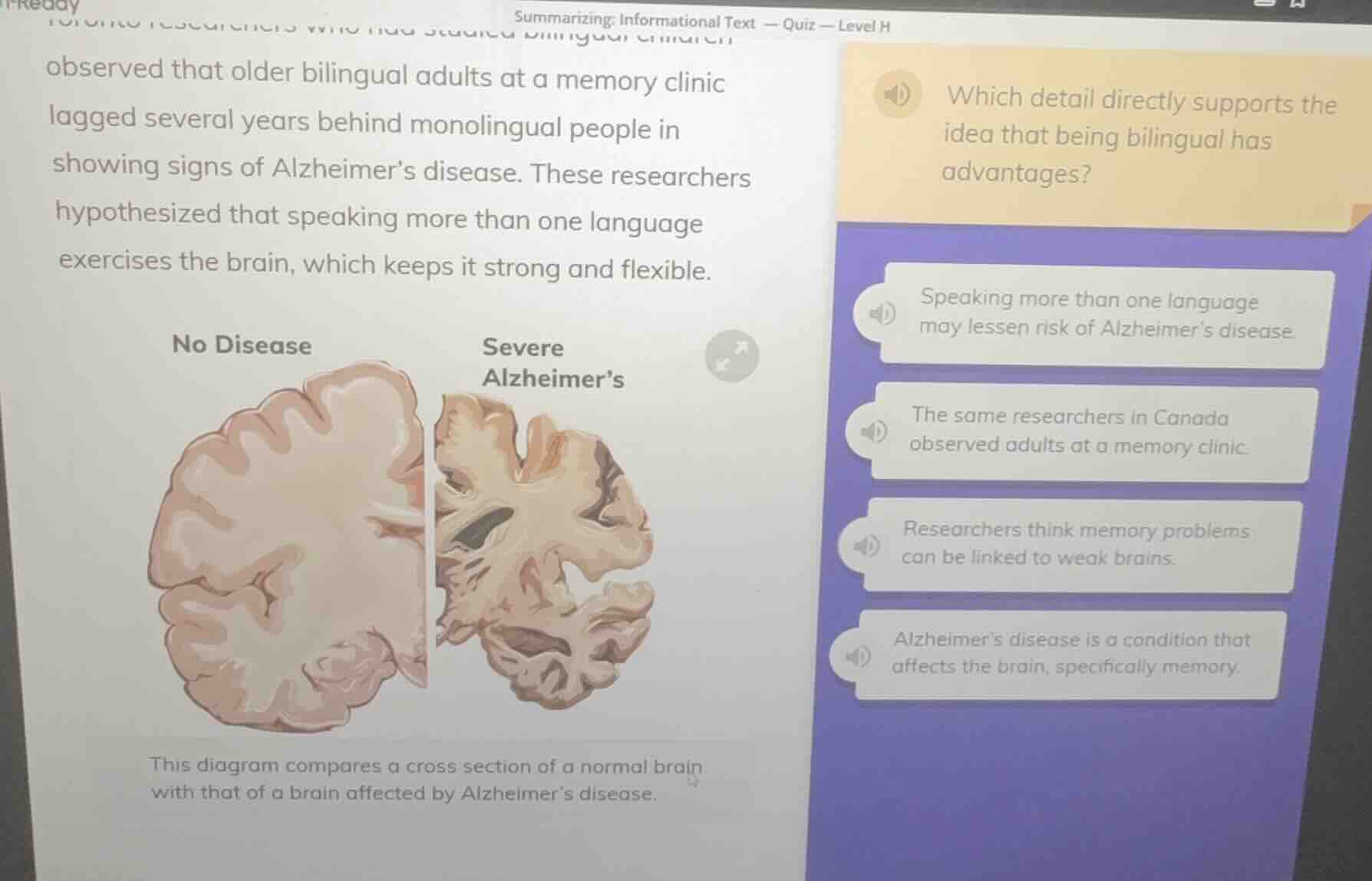
no disease
severe
alzheimers
this diagram compares a cross section of a normal brain
with that of a brain affected by alzheimers disease.
which detail directly supports the
idea that being bilingual has
advantages?
speaking more than one language
may lessen risk of alzheimers disease.
the same researchers in canada
observed adults at a memory clinic.
researchers think memory problems
can be linked to weak brains.
alzheimers disease is a condition that
affects the brain, specifically memory.
The question asks for a detail that directly supports bilingualism having advantages. The first option states bilingualism may lower Alzheimer's risk, which aligns with the text's finding that bilingual adults showed Alzheimer's signs later, a clear advantage. The other options either state research context, a general link, or define the disease, not a direct advantage of bilingualism.

Snap & solve any problem in the app
Get step-by-step solutions on Sovi AI
Photo-based solutions with guided steps
Explore more problems and detailed explanations
Speaking more than one language may lessen risk of Alzheimer's disease.