QUESTION IMAGE
Question
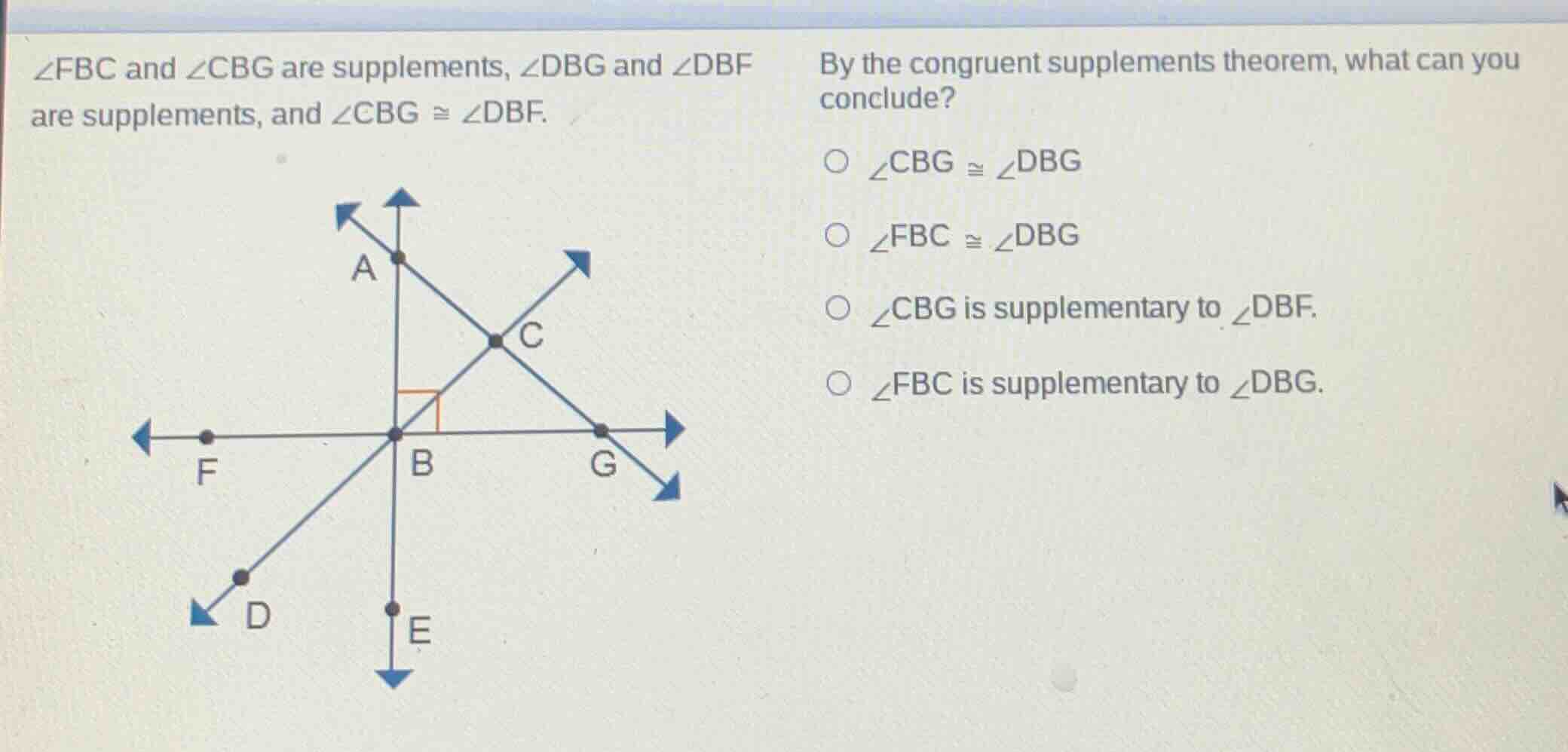
$\angle fbc$ and $\angle cbg$ are supplements, $\angle dbg$ and $\angle dbf$ are supplements, and $\angle cbg \cong \angle dbf$. by the congruent supplements theorem, what can you conclude?\
\\(\bigcirc\\) $\angle cbg \cong \angle dbg$\
\\(\bigcirc\\) $\angle fbc \cong \angle dbg$\
\\(\bigcirc\\) $\angle cbg$ is supplementary to $\angle dbf$.\
\\(\bigcirc\\) $\angle fbc$ is supplementary to $\angle dbg$.
The congruent supplements theorem states that if two angles are supplements of the same angle (or congruent angles), then the two angles are congruent. Here, $\angle FBC$ and $\angle CBG$ are supplements, $\angle DBG$ and $\angle DBF$ are supplements, and $\angle CBG \cong \angle DBF$. So $\angle FBC$ and $\angle DBG$ are supplements of congruent angles ($\angle CBG$ and $\angle DBF$), hence by the congruent supplements theorem, $\angle FBC \cong \angle DBG$. Let's analyze the other options:
- Option 1: There's no info to conclude $\angle CBG \cong \angle DBG$.
- Option 3: We know $\angle CBG \cong \angle DBF$, not supplementary (they are congruent, and if they were supplementary, their sum would be $180^\circ$, but we don't know that).
- Option 4: $\angle FBC$ and $\angle DBG$ are congruent, not necessarily supplementary (unless they are right angles, but we don't have that info).

Snap & solve any problem in the app
Get step-by-step solutions on Sovi AI
Photo-based solutions with guided steps
Explore more problems and detailed explanations
B. $\angle FBC \cong \angle DBG$