QUESTION IMAGE
Question
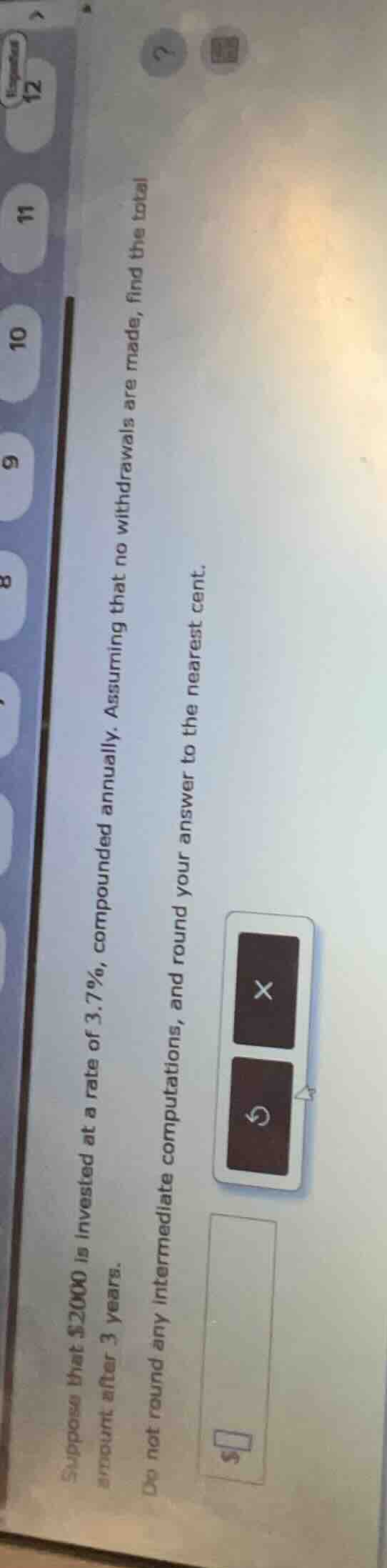
suppose that $2000 is invested at a rate of 3.7%, compounded annually. assuming that no withdrawals are made, find the total amount after 3 years. do not round any intermediate computations, and round your answer to the nearest cent.
Step1: Recall compound interest formula
The compound interest formula is $A = P(1 + \frac{r}{n})^{nt}$, where:
- $P$ is the principal amount ($\$2000$),
- $r$ is the annual interest rate (3.7% or 0.037),
- $n$ is the number of times interest is compounded per year (1, since it's compounded annually),
- $t$ is the number of years (3).
Step2: Substitute values into the formula
Substitute $P = 2000$, $r = 0.037$, $n = 1$, and $t = 3$ into the formula:
$$A = 2000(1 + \frac{0.037}{1})^{1 \times 3}$$
Step3: Simplify the expression
First, calculate the value inside the parentheses: $1 + 0.037 = 1.037$.
Then, calculate the exponent: $1 \times 3 = 3$.
So the formula becomes $A = 2000(1.037)^3$.
Step4: Calculate $(1.037)^3$
Calculate $1.037 \times 1.037 = 1.075369$, then multiply by $1.037$: $1.075369 \times 1.037 \approx 1.115157653$.
Step5: Multiply by the principal
Multiply $2000$ by $1.115157653$: $2000 \times 1.115157653 = 2230.315306$.
Step6: Round to the nearest cent
Rounding $2230.315306$ to the nearest cent gives $\$2230.32$.

Snap & solve any problem in the app
Get step-by-step solutions on Sovi AI
Photo-based solutions with guided steps
Explore more problems and detailed explanations
$\$2230.32$