QUESTION IMAGE
Question
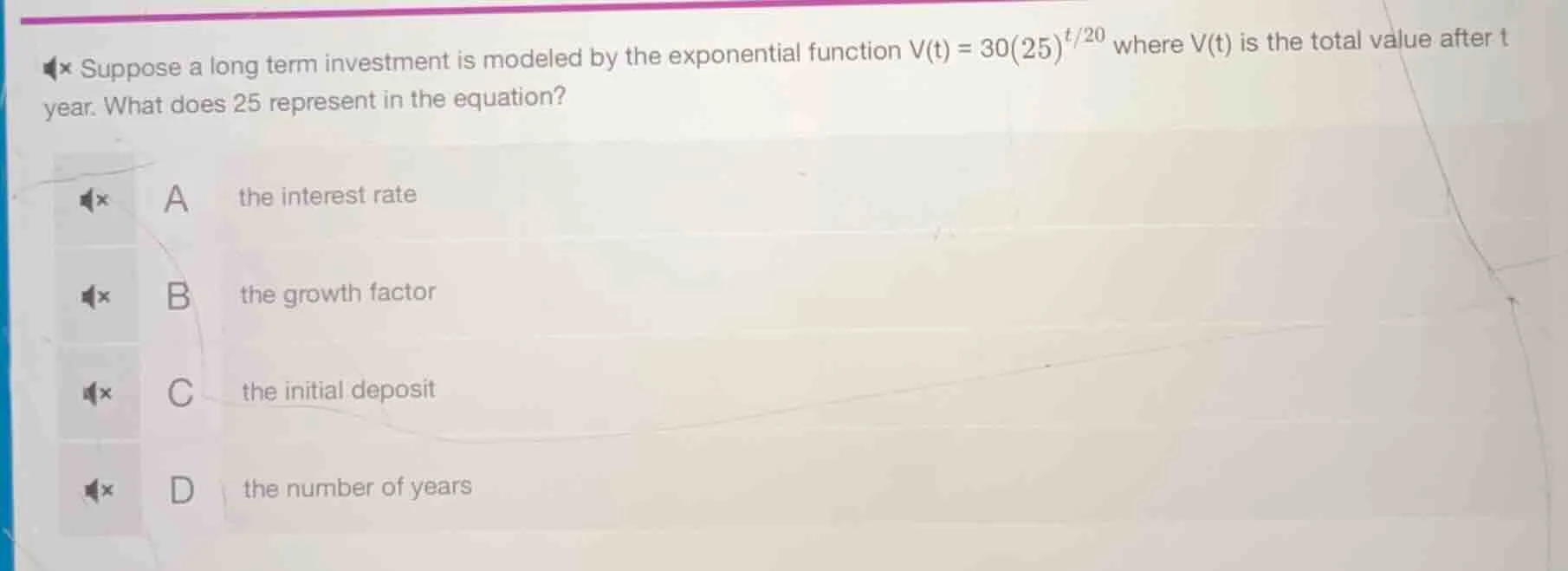
suppose a long term investment is modeled by the exponential function $v(t) = 30(25)^{\frac{t}{20}}$ where $v(t)$ is the total value after $t$ year. what does 25 represent in the equation? a the interest rate b the growth factor c the initial deposit d the number of years
The general form of an exponential growth function is \( V(t)=a(b)^{t/k} \), where \( a \) is the initial value, \( b \) is the growth factor, \( t \) is time, and \( k \) is a constant related to the time period. In the given function \( V(t) = 30(25)^{t/20} \), comparing with the general form: \( a = 30 \) (initial deposit), \( b = 25 \) (growth factor), \( t \) is the number of years, and the interest rate is related to \( b \) (e.g., if \( b=1 + r \), \( r \) is the rate). Option A is incorrect as the interest rate is derived from \( b \), not \( b \) itself. Option C is incorrect because the initial deposit is \( 30 \). Option D is incorrect as \( t \) represents the number of years. So \( 25 \) is the growth factor.

Snap & solve any problem in the app
Get step-by-step solutions on Sovi AI
Photo-based solutions with guided steps
Explore more problems and detailed explanations
B. the growth factor