QUESTION IMAGE
Question
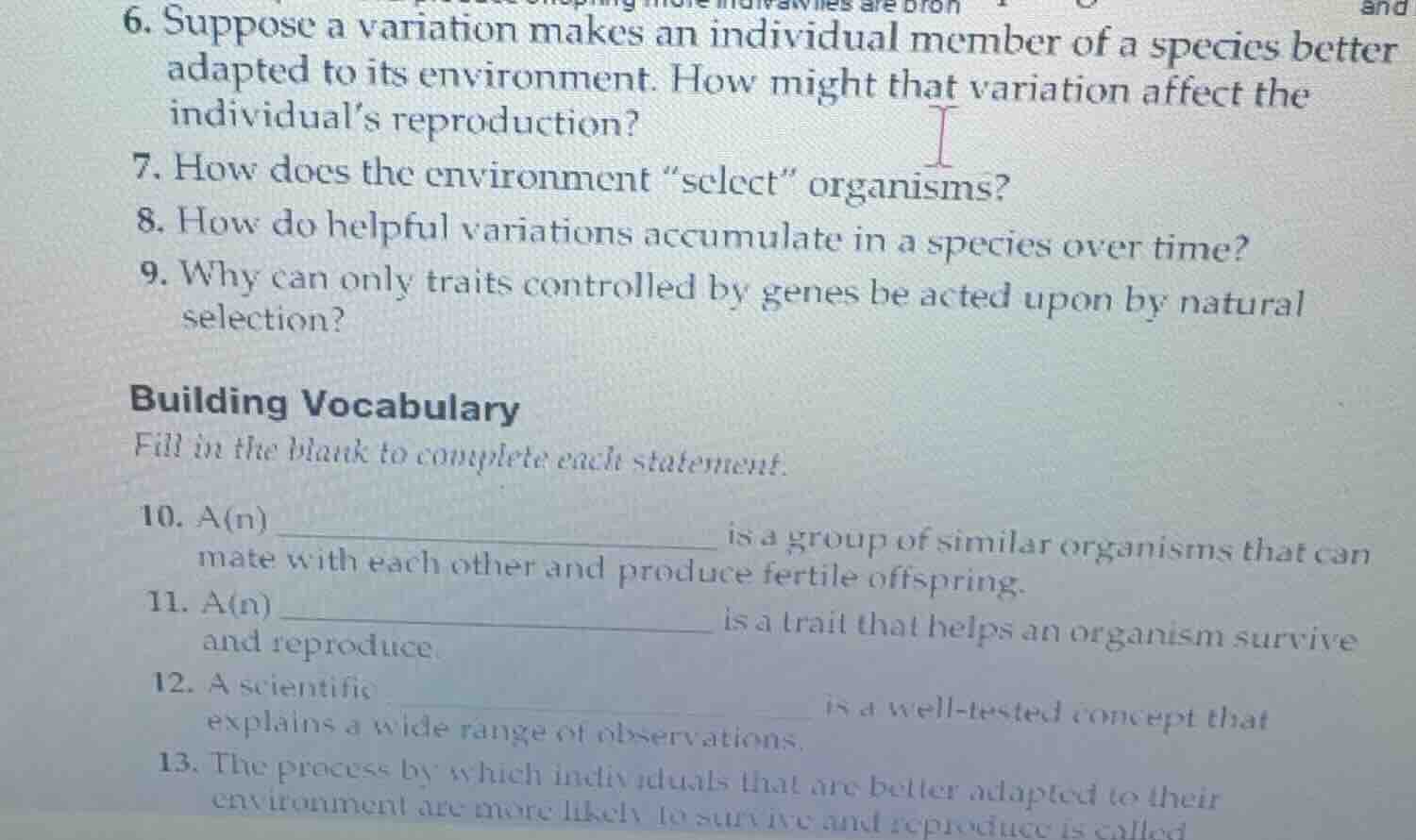
- suppose a variation makes an individual member of a species better adapted to its environment. how might that variation affect the individual’s reproduction?
- how does the environment “select” organisms?
- how do helpful variations accumulate in a species over time?
- why can only traits controlled by genes be acted upon by natural selection?
building vocabulary
fill in the blank to complete each statement.
- a(n) ______________ is a group of similar organisms that can mate with each other and produce fertile offspring.
- a(n) ______________ is a trait that helps an organism survive and reproduce.
- a scientific ______________ is a well - tested concept that explains a wide range of observations.
- the process by which individuals that are better adapted to their environment are more likely to survive and reproduce is called
Brief Explanations
- Better-adapted individuals are more likely to survive long enough to reproduce, and may attract more mates or have higher offspring survival rates, increasing their reproductive output.
- The environment creates conditions where organisms with traits suited to those conditions survive and reproduce more successfully, while those without such traits die or reproduce less.
- Helpful variations make individuals more likely to survive and reproduce, passing those variations to their offspring; over generations, these traits become more common in the population.
- Only genetic traits can be passed from parents to offspring. Non-genetic traits (acquired during an organism's life) cannot be inherited, so natural selection cannot act on them.
- The term describes a group of interbreeding organisms that produce fertile offspring.
- The term refers to a trait that boosts an organism's survival and reproduction.
- This is a well-supported, tested concept that explains multiple observations.
- This is the core process of natural selection, focused on differential survival and reproduction.

Snap & solve any problem in the app
Get step-by-step solutions on Sovi AI
Photo-based solutions with guided steps
Explore more problems and detailed explanations
- The better-adapted individual will likely survive longer, have higher chances of finding mates, and produce more viable offspring, increasing its overall reproductive success.
- The environment "selects" organisms by favoring individuals with traits that improve survival and reproduction in that specific environment; these individuals pass their traits to offspring, making the traits more common over time.
- Helpful variations are passed from surviving, reproducing individuals to their offspring. Over many generations, more individuals in the species inherit these beneficial traits, causing them to accumulate in the population.
- Only genes are passed from parents to offspring. Traits not controlled by genes are acquired during an organism's life and cannot be inherited, so natural selection cannot act on them to change the species over time.
- species
- adaptation
- theory
- natural selection