QUESTION IMAGE
Question
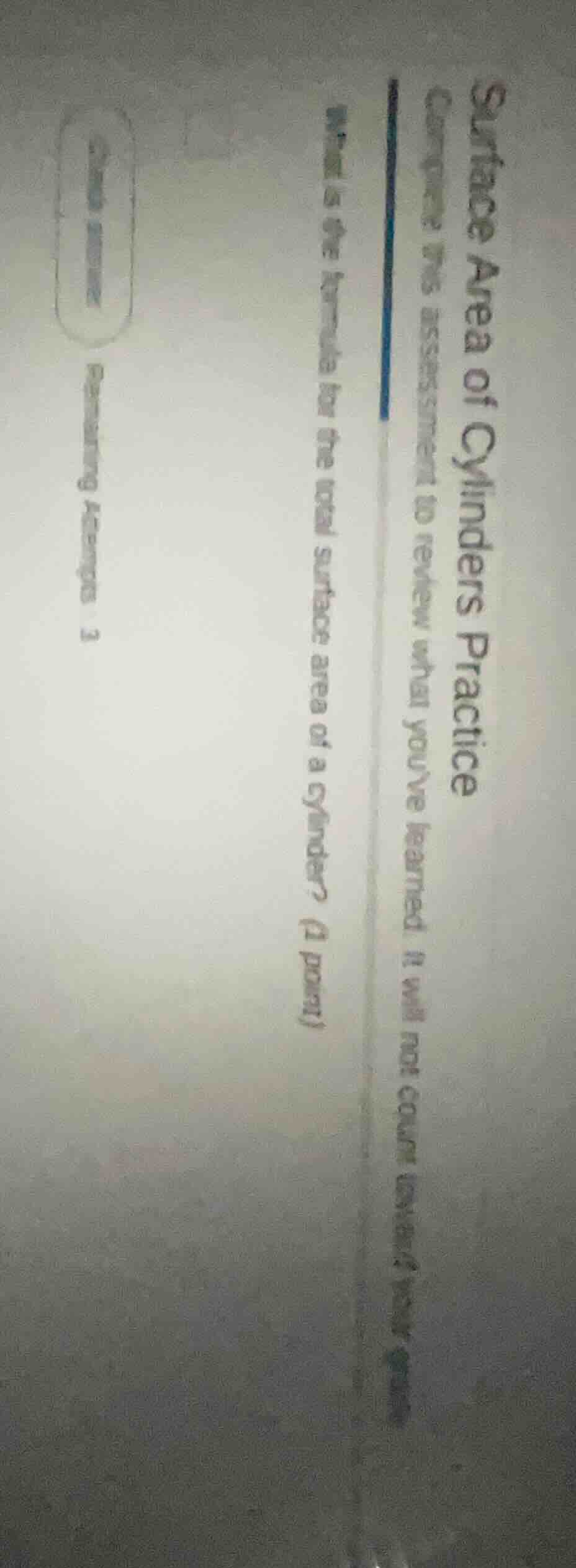
surface area of cylinders practice complete the assessment to review what youve learned. it will not count toward your what is the formula for the total surface area of a cylinder? (1 point)
Step1: Recall the components of a cylinder
A cylinder has two circular bases (top and bottom) and a lateral (curved) surface. The total surface area (TSA) is the sum of the areas of the two bases and the lateral surface area.
Step2: Area of one circular base
The area of a circle is given by \( A_{base}=\pi r^{2} \), where \( r \) is the radius of the base. Since there are two bases, the total area of the two bases is \( 2\pi r^{2} \).
Step3: Lateral surface area of the cylinder
The lateral surface area (LSA) of a cylinder is the area of the curved surface. If we "unroll" the curved surface, it forms a rectangle. The height of this rectangle is the height \( h \) of the cylinder, and the length of the rectangle is the circumference of the circular base, which is \( 2\pi r \). So, the lateral surface area is \( LSA = 2\pi r\times h=2\pi rh \).
Step4: Total surface area formula
To find the total surface area, we add the area of the two bases and the lateral surface area. So, the formula for the total surface area (TSA) of a cylinder is \( TSA = 2\pi r^{2}+2\pi rh \), which can also be factored as \( TSA = 2\pi r(r + h) \).

Snap & solve any problem in the app
Get step-by-step solutions on Sovi AI
Photo-based solutions with guided steps
Explore more problems and detailed explanations
The formula for the total surface area of a cylinder is \( \boldsymbol{2\pi r^{2}+2\pi rh} \) (or \( \boldsymbol{2\pi r(r + h)} \)) where \( r \) is the radius of the base and \( h \) is the height of the cylinder.