QUESTION IMAGE
Question
svlc algebra 1a - standard (15260)
introduction to linear functions
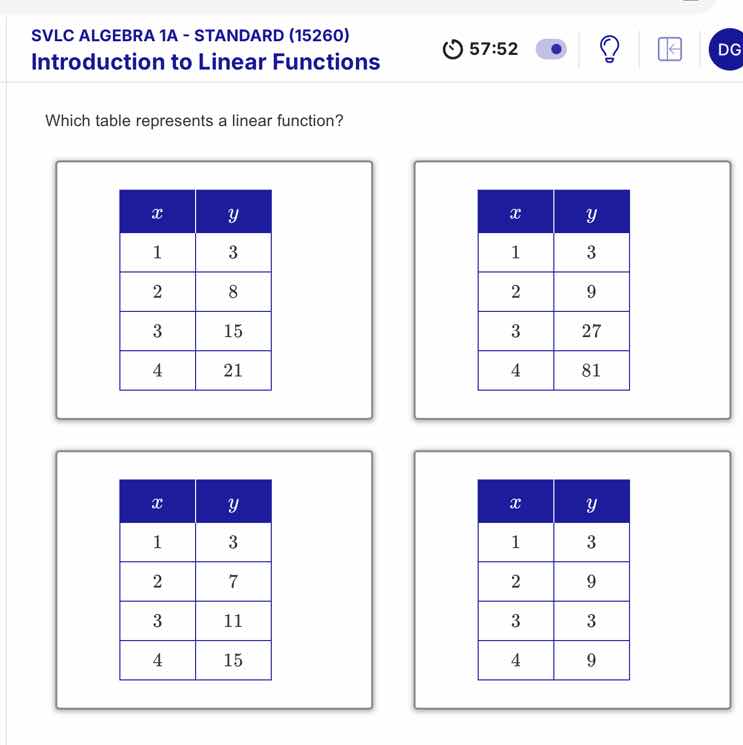
which table represents a linear function?
first table (top left):
x | y
1 | 3
2 | 8
3 | 15
4 | 21
second table (top right):
x | y
1 | 3
2 | 9
3 | 27
4 | 81
third table (bottom left):
x | y
1 | 3
2 | 7
3 | 11
4 | 15
fourth table (bottom right):
x | y
1 | 3
2 | 9
3 | 3
4 | 9
To determine which table represents a linear function, we check the rate of change (slope) between consecutive points. For a linear function, the slope should be constant. The slope \( m \) between two points \((x_1, y_1)\) and \((x_2, y_2)\) is calculated as \( m=\frac{y_2 - y_1}{x_2 - x_1} \). Since the \( x \)-values increase by 1 (from 1 to 2, 2 to 3, etc.), we can simply check the difference in \( y \)-values (\( \Delta y \)) for each consecutive \( x \).
Step 1: Analyze the first table
- From \( x = 1 \) to \( x = 2 \): \( \Delta y=8 - 3 = 5 \)
- From \( x = 2 \) to \( x = 3 \): \( \Delta y=15 - 8 = 7 \)
- The differences are not constant (5 vs. 7), so this is not linear.
Step 2: Analyze the second table
- From \( x = 1 \) to \( x = 2 \): \( \Delta y=9 - 3 = 6 \)
- From \( x = 2 \) to \( x = 3 \): \( \Delta y=27 - 9 = 18 \)
- The differences are not constant (6 vs. 18), so this is not linear (this looks like an exponential function, \( y = 3^x \)).
Step 3: Analyze the third table
- From \( x = 1 \) to \( x = 2 \): \( \Delta y=7 - 3 = 4 \)
- From \( x = 2 \) to \( x = 3 \): \( \Delta y=11 - 7 = 4 \)
- From \( x = 3 \) to \( x = 4 \): \( \Delta y=15 - 11 = 4 \)
- The difference in \( y \)-values is constant (4) for each increase in \( x \) by 1. So the slope is constant (\( m = 4 \)), indicating a linear function.
Step 4: Analyze the fourth table (for completeness)
- From \( x = 1 \) to \( x = 2 \): \( \Delta y=9 - 3 = 6 \)
- From \( x = 2 \) to \( x = 3 \): \( \Delta y=3 - 9 = - 6 \)
- From \( x = 3 \) to \( x = 4 \): \( \Delta y=9 - 3 = 6 \)
- The differences are not constant (6 vs. - 6 vs. 6), so this is not linear.

Snap & solve any problem in the app
Get step-by-step solutions on Sovi AI
Photo-based solutions with guided steps
Explore more problems and detailed explanations
The table with \( x \) values 1, 2, 3, 4 and \( y \) values 3, 7, 11, 15 (the third table) represents a linear function.