QUESTION IMAGE
Question
svlc algebra 1a - standard (15260)
solving systems of linear inequalities
two-variable inequalities
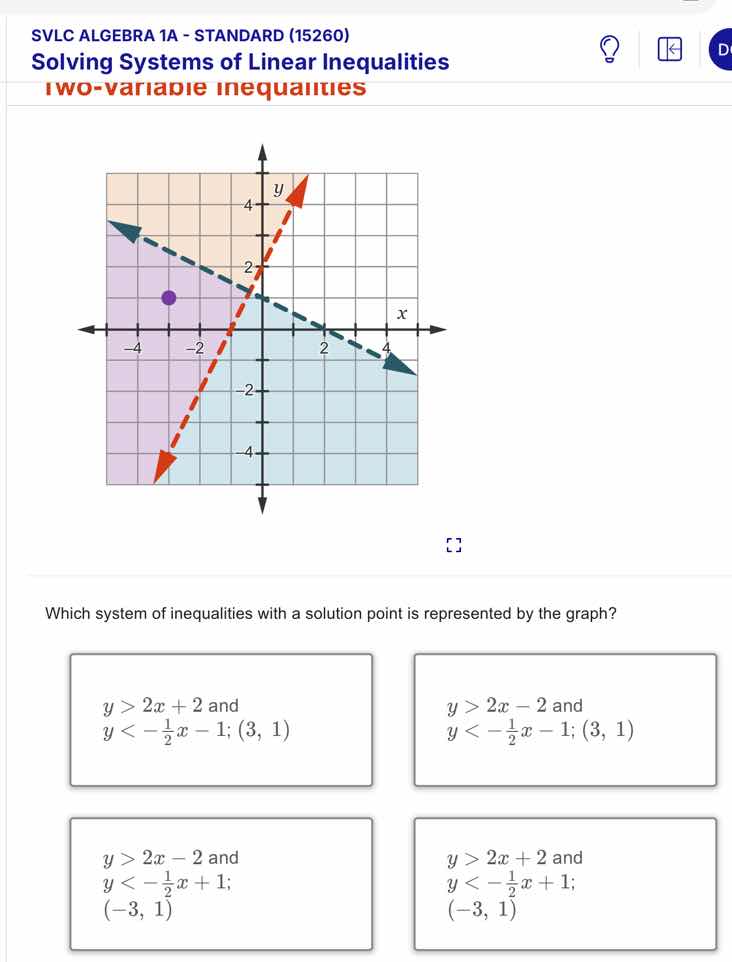
which system of inequalities with a solution point is represented by the graph?
$y > 2x + 2$ and
$y < -\frac{1}{2}x - 1$; $(3, 1)$
$y > 2x - 2$ and
$y < -\frac{1}{2}x - 1$; $(3, 1)$
$y > 2x - 2$ and
$y < -\frac{1}{2}x + 1$;
$(-3, 1)$
$y > 2x + 2$ and
$y < -\frac{1}{2}x + 1$;
$(-3, 1)$
Step1: Analyze the red dashed line
The red dashed line has a slope of 2 and a y - intercept of 2? Wait, no, let's check the equation. The red dashed line: when x = 0, y = 2? Wait, no, looking at the options, let's check the slope - intercept form \(y=mx + b\). The red line: let's see the two - point form. The red dashed line passes through (0, 2)? No, wait, the third and fourth options have the solution point (- 3,1). Let's check the solution point (- 3,1) in the inequalities.
First, for the red line (the line with slope 2):
Let's take the equation of the red dashed line. Let's use the point - slope form. If the solution point is (- 3,1), let's check the inequality \(y>2x + c\) or \(y>2x - c\).
For the blue dashed line (slope \(-\frac{1}{2}\)):
Let's check the y - intercept. The blue dashed line: when x = 0, y = 1? Wait, the inequality for the blue line: let's check the solution point (- 3,1).
Step2: Check the solution point (- 3,1) in the inequalities
Let's check the fourth option: \(y>2x + 2\) and \(y<-\frac{1}{2}x + 1\); (- 3,1)
First, check \(y>2x + 2\) with x=-3, y = 1:
Left - hand side (LHS)=1, Right - hand side (RHS)=2*(-3)+2=-6 + 2=-4. Since \(1>-4\), \(y>2x + 2\) is satisfied.
Now check \(y<-\frac{1}{2}x + 1\) with x = - 3, y = 1:
RHS=\(-\frac{1}{2}*(-3)+1=\frac{3}{2}+1=\frac{5}{2}=2.5\). Since \(1 < 2.5\), \(y<-\frac{1}{2}x + 1\) is satisfied.
Now check the third option: \(y>2x - 2\) and \(y<-\frac{1}{2}x + 1\); (- 3,1)
Check \(y>2x - 2\) with x=-3, y = 1:
RHS=2(-3)-2=-6 - 2=-8. \(1>-8\) is true, but let's check the red line equation. The red dashed line: if the equation is \(y = 2x+2\) (from the fourth option), when x=-3, y=2(-3)+2=-4, and the point (-3,1) is above the red line (since 1 > - 4), so \(y>2x + 2\) is correct.
Now check the blue line: the blue line has a slope of \(-\frac{1}{2}\) and y - intercept 1 (since when x = 0, y = 1). The inequality for the blue line: the shaded region is below the blue line, so \(y<-\frac{1}{2}x + 1\).
Now check the solution point (-3,1):
For \(y>2x + 2\): \(1>2*(-3)+2= - 6 + 2=-4\), true.
For \(y<-\frac{1}{2}x + 1\): \(1<-\frac{1}{2}*(-3)+1=\frac{3}{2}+1=\frac{5}{2}\), true.
Now check the other options:
First option: solution point (3,1). Check \(y>2x + 2\) with x = 3, y = 1: \(1>2*3+2=8\)? No, 1 is not greater than 8. So first option is out.
Second option: solution point (3,1). Check \(y>2x - 2\): \(1>2*3 - 2=4\)? No, 1 is not greater than 4. So second option is out.
Third option: \(y>2x - 2\) with x=-3, y = 1: \(1>2*(-3)-2=-8\), true. But the red line equation: if it's \(y = 2x - 2\), when x = 0, y=-2, but the graph's red line seems to have a y - intercept of 2 (from the graph). Wait, the red dashed line in the graph: when x = 0, y = 2? Let's check the equation of the red line. The slope of the red line is 2. So \(y = 2x + 2\) (since when x = 0, y = 2). So the inequality for the red line (dashed, so > or < without equal) is \(y>2x + 2\) (since the shaded region is above the red line).
Fourth option: \(y>2x + 2\) and \(y<-\frac{1}{2}x + 1\); (- 3,1). Let's confirm the blue line: the blue line has a slope of \(-\frac{1}{2}\) and y - intercept 1 (since when x = 0, y = 1), and the shaded region is below the blue line, so \(y<-\frac{1}{2}x + 1\). And the solution point (-3,1) is in the intersection of the two shaded regions.

Snap & solve any problem in the app
Get step-by-step solutions on Sovi AI
Photo-based solutions with guided steps
Explore more problems and detailed explanations
\(y > 2x + 2\) and \(y<-\frac{1}{2}x + 1\); \((-3,1)\) (the fourth option)