QUESTION IMAGE
Question
synthetic division
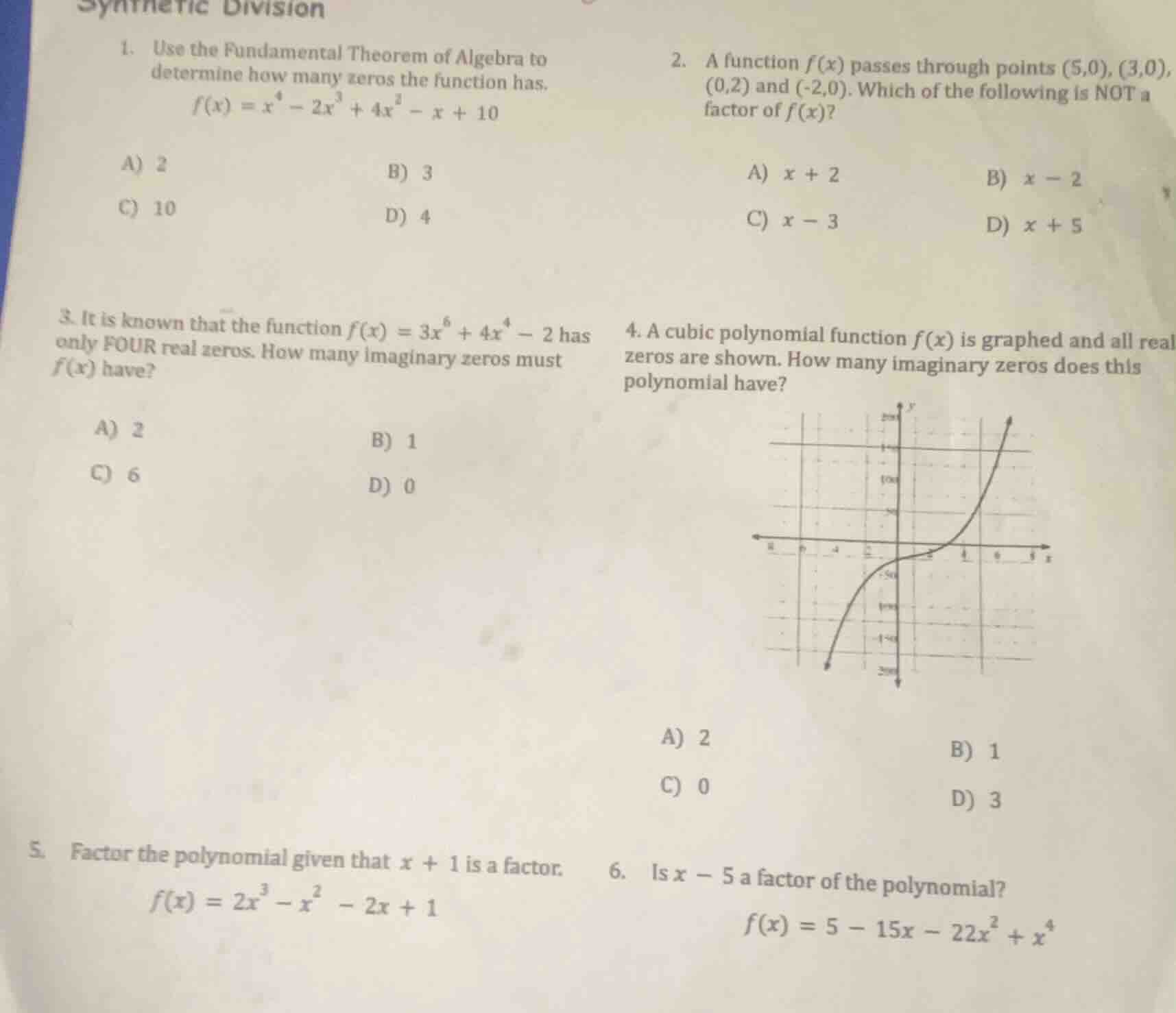
- use the fundamental theorem of algebra to determine how many zeros the function has.
$f(x) = x^4 - 2x^3 + 4x^2 - x + 10$
a) 2
b) 3
c) 10
d) 4
- a function $f(x)$ passes through points (5,0), (3,0), (0,2) and (-2,0). which of the following is not a factor of $f(x)$?
a) $x + 2$
b) $x - 2$
c) $x - 3$
d) $x + 5$
- it is known that the function $f(x) = 3x^6 + 4x^4 - 2$ has only four real zeros. how many imaginary zeros must $f(x)$ have?
a) 2
b) 1
c) 6
d) 0
- a cubic polynomial function $f(x)$ is graphed and all real zeros are shown. how many imaginary zeros does this polynomial have?
a) 2
b) 1
c) 0
d) 3
- factor the polynomial given that $x + 1$ is a factor.
$f(x) = 2x^3 - x^2 - 2x + 1$
- is $x - 5$ a factor of the polynomial?
$f(x) = 5 - 15x - 22x^2 + x^4$
Step1: Apply Fundamental Theorem of Algebra
A degree-$n$ polynomial has $n$ zeros (counting multiplicities). For $f(x)=x^4 - 2x^3 + 4x^2 - x + 10$, degree $n=4$.
Step2: Match to option
The number of zeros equals the degree.
Step1: Relate roots to factors
If $x=a$ is a root, $(x-a)$ is a factor. Given roots $x=5,3,-2$, factors are $(x-5),(x-3),(x+2)$.
Step2: Identify non-factor
Check options: $(x-2)$ does not correspond to any given root.
Step1: Find total zeros (degree 6)
Total zeros = degree = 6.
Step2: Subtract real zeros
Imaginary zeros = Total zeros - Real zeros = $6 - 4 = 2$.
Step1: Degree of cubic polynomial
Cubic polynomial has degree 3, so total zeros = 3.
Step2: Count real zeros from graph
The graph crosses the x-axis 3 times, so 3 real zeros.
Step3: Calculate imaginary zeros
Imaginary zeros = $3 - 3 = 0$.

Snap & solve any problem in the app
Get step-by-step solutions on Sovi AI
Photo-based solutions with guided steps
Explore more problems and detailed explanations
D) 4
---