QUESTION IMAGE
Question
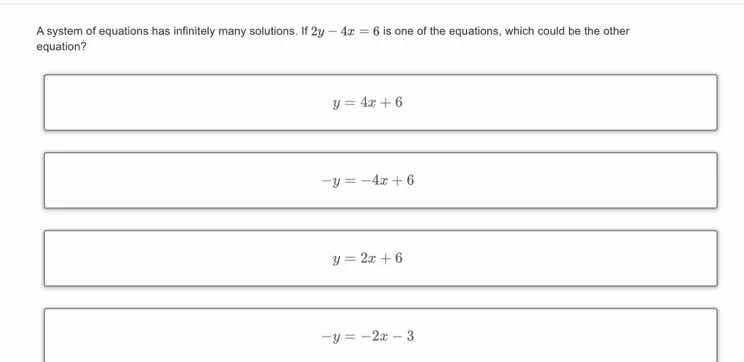
a system of equations has infinitely many solutions. if $2y - 4x = 6$ is one of the equations, which could be the other equation?
$y = 4x + 6$
$-y = -4x + 6$
$y = 2x + 6$
$-y = -2x - 3$
Step1: Recall the condition for infinitely many solutions
A system of linear equations \(a_1x + b_1y = c_1\) and \(a_2x + b_2y = c_2\) has infinitely many solutions if \(\frac{a_1}{a_2}=\frac{b_1}{b_2}=\frac{c_1}{c_2}\) (i.e., the two equations are scalar multiples of each other). First, rewrite the given equation \(2y - 4x = 6\) in the standard form \(ax+by = c\). Rearranging, we get \(- 4x+2y = 6\), or dividing both sides by 2, \( - 2x + y=3\), or \(y = 2x + 3\). We can also work with the original equation and check each option by rewriting them in the same form as the given equation and checking if they are scalar multiples.
Step2: Analyze Option 1: \(y = 4x+6\)
Rewrite the given equation \(2y-4x = 6\) as \(y = 2x + 3\) (divide both sides by 2: \(y - 2x=3\) or \(y=2x + 3\)). The equation \(y = 4x + 6\) has a slope of 4, while the given equation (when solved for \(y\)) has a slope of 2. Since the slopes are different, the lines are not the same, so no infinite solutions.
Step3: Analyze Option 2: \(-y=-4x + 6\)
Rewrite as \(y = 4x - 6\). The slope here is 4, while the given equation (when solved for \(y\)) has a slope of 2. Different slopes, so no infinite solutions.
Step4: Analyze Option 3: \(y = 2x + 6\)
The slope is 2 (same as the given equation when solved for \(y\): \(y = 2x + 3\)), but the y-intercept is 6 vs. 3. So the lines are parallel but not coincident (since y-intercepts differ), so no infinite solutions.
Step5: Analyze Option 4: \(-y=-2x - 3\)
Multiply both sides by - 1: \(y = 2x + 3\). Now, let's check with the original equation \(2y-4x = 6\). Substitute \(y = 2x + 3\) into \(2y-4x\): \(2(2x + 3)-4x=4x + 6 - 4x = 6\), which matches the right-hand side. Alternatively, rewrite the original equation \(2y-4x = 6\) by dividing both sides by - 2: \(-y + 2x=-3\), which is equivalent to \(-y=-2x - 3\) (rearranging: \(-y=-2x - 3\) is the same as \(2x - y=-3\), and the original equation divided by - 2 is \(\frac{2y}{-2}-\frac{4x}{-2}=\frac{6}{-2}\) \(\Rightarrow -y + 2x=-3\), which is the same as \(-y=-2x - 3\)). So the two equations are scalar multiples (the second equation is the first equation multiplied by \(-\frac{1}{2}\)), so they represent the same line, hence infinitely many solutions.

Snap & solve any problem in the app
Get step-by-step solutions on Sovi AI
Photo-based solutions with guided steps
Explore more problems and detailed explanations
\(-y = -2x - 3\)