QUESTION IMAGE
Question
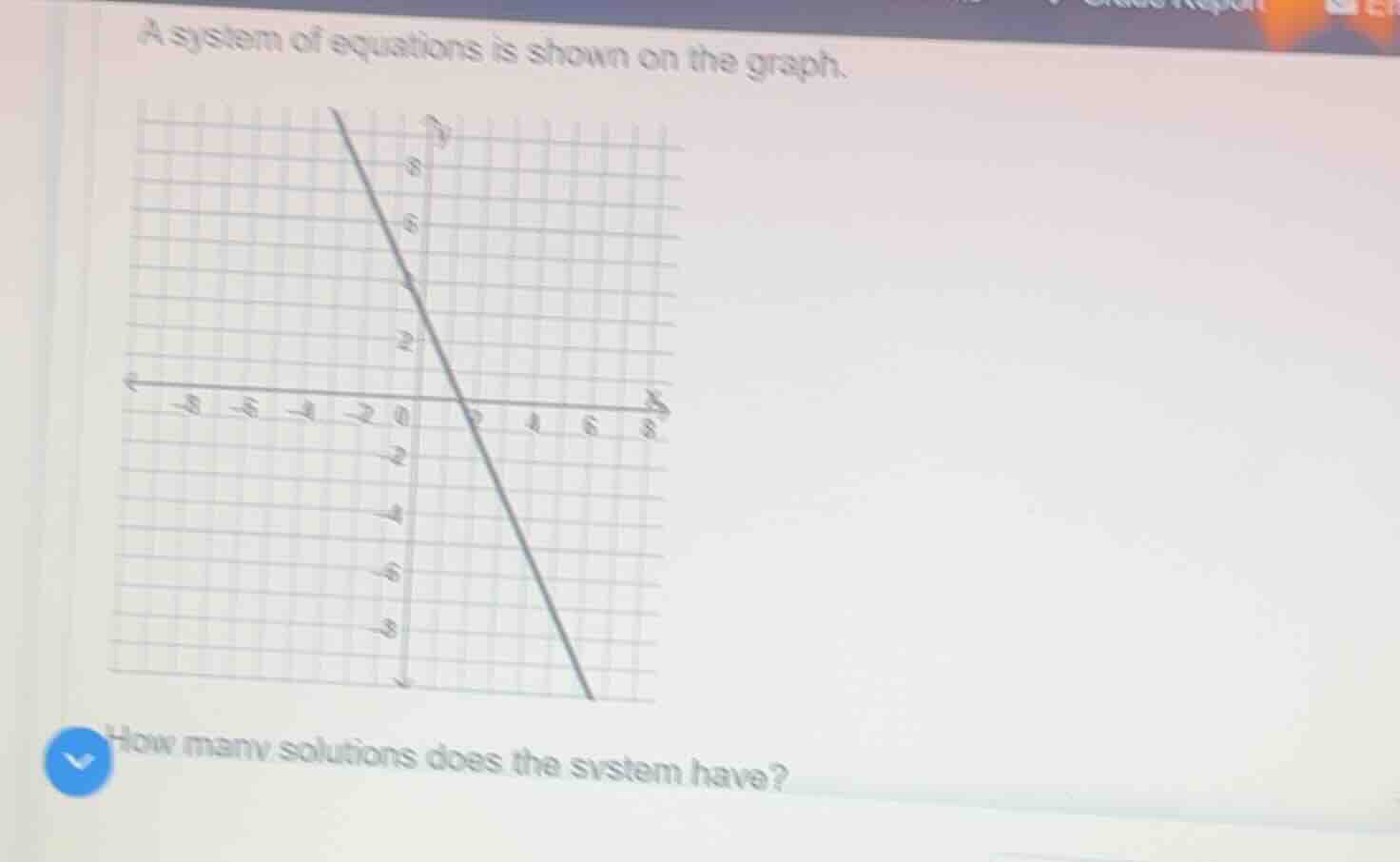
a system of equations is shown on the graph.
how many solutions does the system have?
Step1: Analyze the graph
The graph shows a single line (since it appears to be one line, maybe a system with two identical lines or a single line representing a system? Wait, actually, if it's a system of equations, and the graph is a single line, that means the two equations are dependent (same line), so they have infinitely many solutions? Wait, no, wait the graph here—wait, maybe I misread. Wait, the problem says "a system of equations is shown on the graph". Wait, maybe the graph is two lines that are coinciding (same line), so the system has infinitely many solutions? Wait, no, wait the graph in the image—wait, maybe it's a single line, so the system is of two equations that are the same line. So the solution is the number of points where they intersect. If two lines are the same (coinciding), they intersect at every point on the line, so infinitely many solutions. Wait, but maybe the graph is a single line, so the system has infinitely many solutions? Wait, no, maybe I made a mistake. Wait, let's think again. A system of linear equations: if the lines are parallel, no solution; if intersecting at one point, one solution; if coinciding (same line), infinitely many solutions. So if the graph shows one line, that means the two equations are the same line, so infinitely many solutions? Wait, but maybe the graph is two lines that are overlapping. Wait, the user's graph—from the image, it's a single line. So the system has infinitely many solutions? Wait, no, maybe the problem is that the graph is a single line, so the system is of two equations that are dependent, so infinitely many solutions. Wait, but maybe I misinterpret. Wait, the question is "How many solutions does the system have?" So if the two lines are the same (coinciding), then there are infinitely many solutions. But wait, maybe the graph is a single line, so the system has infinitely many solutions. Wait, but maybe the graph is two lines that are overlapping, so the solution is infinitely many. Alternatively, maybe the graph is a single line, so the system has infinitely many solutions. Wait, but let's check again. Wait, the graph in the image: it's a straight line, so if the system is two equations representing this line, then they are the same line, so infinitely many solutions. But maybe the problem is that the graph is a single line, so the system has infinitely many solutions. Wait, but maybe I made a mistake. Wait, no—if two lines are coinciding (same line), then every point on the line is a solution, so infinitely many solutions. So the answer should be infinitely many? Wait, but maybe the graph is a single line, so the system has infinitely many solutions.
Wait, maybe the original problem's graph is two lines that are overlapping, so the system has infinitely many solutions. So the step is: identify the type of lines (coinciding, parallel, intersecting). If coinciding, infinitely many solutions.
Step2: Determine the solution count
Since the graph shows a single line (coinciding lines for the system), the system has infinitely many solutions.

Snap & solve any problem in the app
Get step-by-step solutions on Sovi AI
Photo-based solutions with guided steps
Explore more problems and detailed explanations
Infinitely many (or "infinite" or "an infinite number of")