QUESTION IMAGE
Question
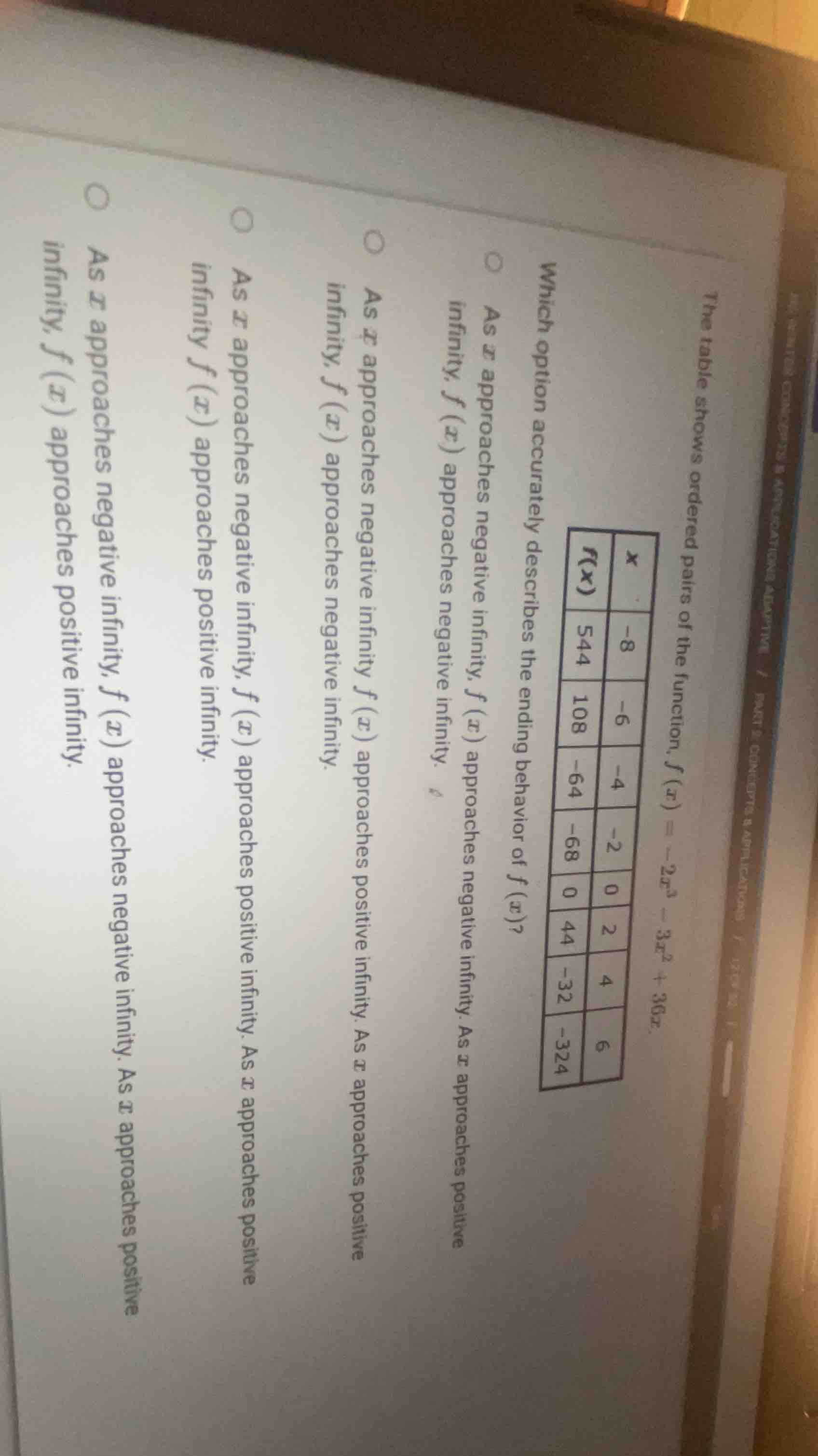
the table shows ordered pairs of the function, $f(x) = -2x^3 - 3x^2 + 36x$.
| x | f(x) |
|---|---|
| -6 | 108 |
| -4 | -64 |
| -2 | -68 |
| 0 | 0 |
| 2 | 44 |
| 4 | -32 |
| 6 | -324 |
which option accurately describes the ending behavior of $f(x)$?
- as $x$ approaches negative infinity, $f(x)$ approaches negative infinity. as $x$ approaches positive infinity, $f(x)$ approaches negative infinity.
- as $x$ approaches negative infinity, $f(x)$ approaches positive infinity. as $x$ approaches positive infinity, $f(x)$ approaches negative infinity.
- as $x$ approaches negative infinity, $f(x)$ approaches positive infinity. as $x$ approaches positive infinity, $f(x)$ approaches positive infinity.
- as $x$ approaches negative infinity, $f(x)$ approaches negative infinity. as $x$ approaches positive infinity, $f(x)$ approaches positive infinity.
Step1: Identify leading term
The function is $f(x) = -2x^3 - 3x^2 + 36x$. The leading term is $-2x^3$, which determines end behavior.
Step2: Analyze degree and leading coefficient
The degree (3) is odd, and the leading coefficient (-2) is negative.
Step3: Evaluate as $x\to-\infty$
For odd degree, negative leading coefficient: as $x\to-\infty$, $x^3\to-\infty$, so $-2x^3\to -2(-\infty) = +\infty$. Thus $f(x)\to+\infty$.
Step4: Evaluate as $x\to+\infty$
As $x\to+\infty$, $x^3\to+\infty$, so $-2x^3\to -2(+\infty) = -\infty$. Thus $f(x)\to-\infty$.
Step5: Match to options
This matches the behavior: As $x$ approaches negative infinity, $f(x)$ approaches positive infinity. As $x$ approaches positive infinity, $f(x)$ approaches negative infinity.

Snap & solve any problem in the app
Get step-by-step solutions on Sovi AI
Photo-based solutions with guided steps
Explore more problems and detailed explanations
As $x$ approaches negative infinity, $f(x)$ approaches positive infinity. As $x$ approaches positive infinity, $f(x)$ approaches negative infinity.